Austin staff propose updating financial policies to focus on credit preservation and more flexible bond timing
April 15, 2026 | Austin, Travis County, Texas
This article was created by AI summarizing key points discussed. AI makes mistakes, so for full details and context, please refer to the video of the full meeting. Please report any errors so we can fix them. Report an error »
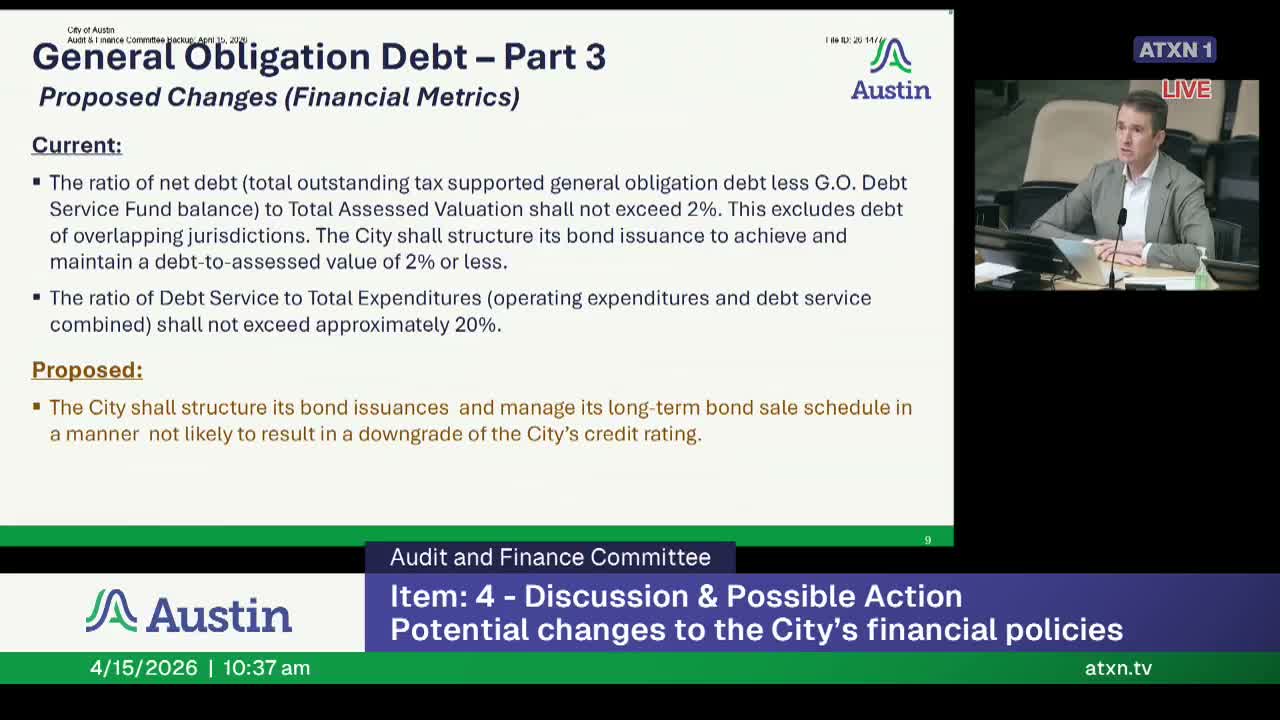
Ed Vannino, the city's chief financial officer, briefed the Audit and Finance Committee on proposed changes to the city's financial policies on April 15, recommending language that ties bond issuance practice to maintaining the city's credit rating rather than fixed numeric debt metrics.
Vannino said staff considered replacing older formulaic metrics (debt to assessed value and debt service as a percent of expenditures) because rating‑agency criteria have shifted to focus more on pension liabilities, total liabilities to income ratios and debt per capita. "The idea is that the city shall structure its bond issuances and manage its long‑term debt schedule in a manner that's not likely to result in a downgrade to the city's credit," Vannino said, indicating the proposed language mirrors the council's previously adopted decision framework.
On bond election timing, staff proposed simplifying the current rule by treating a program as substantially complete when about 90% of anticipated spending is done; new elections would generally wait until the prior program is substantially complete, with exceptions for emergencies or strategic opportunities. Vannino also outlined a proposal to allow proposition‑specific off‑cycle elections under defined circumstances and reiterated policy limits around TIFs (including a 20% affordable housing floor where housing is included) and debt reserve targets.
Council members asked detailed questions about whether the new language should be more aspirational (e.g., retain AAA targets), how state legislative changes to certificate of obligation authority might affect policy, and whether routine maintenance projects should be funded with certificates of obligation or put before voters. Several members favored a "part 4 alternate" approach that would allow proposition‑level elections; staff said they would return with revised language at the May meeting.
Vannino said staff considered replacing older formulaic metrics (debt to assessed value and debt service as a percent of expenditures) because rating‑agency criteria have shifted to focus more on pension liabilities, total liabilities to income ratios and debt per capita. "The idea is that the city shall structure its bond issuances and manage its long‑term debt schedule in a manner that's not likely to result in a downgrade to the city's credit," Vannino said, indicating the proposed language mirrors the council's previously adopted decision framework.
On bond election timing, staff proposed simplifying the current rule by treating a program as substantially complete when about 90% of anticipated spending is done; new elections would generally wait until the prior program is substantially complete, with exceptions for emergencies or strategic opportunities. Vannino also outlined a proposal to allow proposition‑specific off‑cycle elections under defined circumstances and reiterated policy limits around TIFs (including a 20% affordable housing floor where housing is included) and debt reserve targets.
Council members asked detailed questions about whether the new language should be more aspirational (e.g., retain AAA targets), how state legislative changes to certificate of obligation authority might affect policy, and whether routine maintenance projects should be funded with certificates of obligation or put before voters. Several members favored a "part 4 alternate" approach that would allow proposition‑level elections; staff said they would return with revised language at the May meeting.
View the Full Meeting & All Its Details
This article offers just a summary. Unlock complete video, transcripts, and insights as a Founder Member.
✓
Watch full, unedited meeting videos
✓
Search every word spoken in unlimited transcripts
✓
AI summaries & real-time alerts (all government levels)
✓
Permanent access to expanding government content
30-day money-back guarantee
