ACUS judicial review committee narrows title language, debates major-questions guidance
April 17, 2026 | Administrative Conference of the United States (ACUS), Independent Establishments and Government Corporations, Executive, Federal
This article was created by AI summarizing key points discussed. AI makes mistakes, so for full details and context, please refer to the video of the full meeting. Please report any errors so we can fix them. Report an error »
The Administrative Conference of the United States (ACUS) Judicial Review Committee met to continue drafting recommendations on regulatory preambles and made three near-term decisions: the committee will use “in light of” in the recommendation title, it removed the word “current” from the title, and it asked staff to redraft several technical provisions for the next meeting.
The meeting opened with roll call and procedural reminders about speaking privileges and the use of the Zoom hand‑raise and chat functions. Committee members spent the first substantive portion of the hour discussing proposed title changes submitted after the prior meeting. Kristen Hickman opposed a narrower title, saying the draft “is not just talking about the concise statement of basis and purpose as described in 5 53 c,” and arguing the recommendation’s scope reaches beyond the single statutory phrase. Several other members pushed for a title that signals the committee’s focus on judicial‑review concerns; after debate the committee voted 5–4 to keep wording framed “in light of” judicial review rather than phrasing that might read as aimed solely “for” judicial review.
On whether to keep the word “current” in the title, the chair called for a quick hand vote; with only two members indicating they wished to keep the word, the chair interpreted the result as deleting it.
Much of the remainder of the meeting was a line-by-line review of the draft preamble and the recommendations that follow it. Multiple members urged staff to make statutory text — specifically the language of 5 U.S.C. 553(c) and related APA provisions — more prominent in the preamble and in the recommendations’ opening sentences. As one attendee noted, agencies and reviewing courts increasingly focus on statutory text and on whether an agency’s interpretation represents the best reading of the statute.
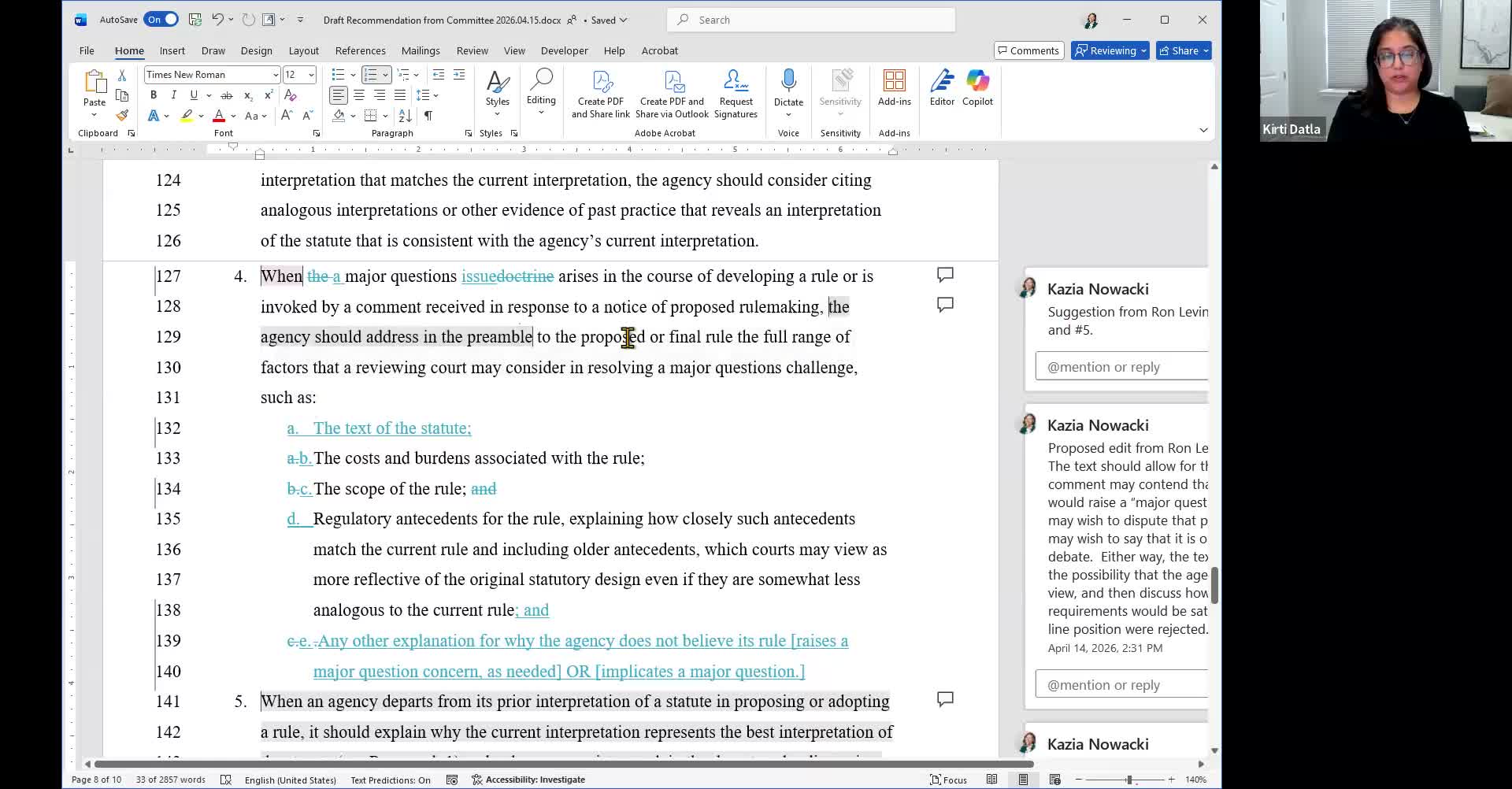
A sustained and technical debate centered on Recommendation 4, which addresses the major questions doctrine. Committee members proposed several alternative formulations for how an agency should treat a commenter’s invocation of the doctrine. Options included a requirement that the agency explain “why the agency believes its rule does not raise a major‑questions concern” when a major‑questions issue arises or is invoked by comment, and a narrower bracketed alternative — that an agency should explain why a rule “implicates a major question.” Members differed on whether to require agencies to respond in every case, whether to use qualifiers such as “genuine” to limit the duty to respond to material invocations, and whether to fold the explanatory language into the main body of Recommendation 4. The committee tentatively adopted a compromise approach asking agencies to explain the point when a major‑questions issue arises or is invoked and the agency believes it should address it; staff were asked to clean up the sentence structure and circulate a redraft.
Other recommendations prompted shorter, targeted debates. Members proposed moving statutory‑text guidance higher in Recommendation 1 and reordering subsections so agencies are first asked to show how the rule comports with statutory text. Recommendation 5’s language about explaining changes in interpretation drew questions about whether and how to require agencies to address reliance interests; members decided to leave that question to staff with additional drafting. Recommendation 9, a technical provision tied to State Farm and Regents precedent on multi‑component rescissions, drew suggestions to redraft or possibly delete it; staff and the consultant were asked to prepare a clearer revision before the next meeting.
The committee ended by setting a follow‑up meeting for Wednesday, April 22, 1–4 p.m. Eastern, and asking staff to circulate the committee’s proposed redlines ahead of that session.
Quotes used in this article come directly from committee members’ remarks during the meeting. All attributions use names or functional labels that appear in the transcript.
The meeting opened with roll call and procedural reminders about speaking privileges and the use of the Zoom hand‑raise and chat functions. Committee members spent the first substantive portion of the hour discussing proposed title changes submitted after the prior meeting. Kristen Hickman opposed a narrower title, saying the draft “is not just talking about the concise statement of basis and purpose as described in 5 53 c,” and arguing the recommendation’s scope reaches beyond the single statutory phrase. Several other members pushed for a title that signals the committee’s focus on judicial‑review concerns; after debate the committee voted 5–4 to keep wording framed “in light of” judicial review rather than phrasing that might read as aimed solely “for” judicial review.
On whether to keep the word “current” in the title, the chair called for a quick hand vote; with only two members indicating they wished to keep the word, the chair interpreted the result as deleting it.
Much of the remainder of the meeting was a line-by-line review of the draft preamble and the recommendations that follow it. Multiple members urged staff to make statutory text — specifically the language of 5 U.S.C. 553(c) and related APA provisions — more prominent in the preamble and in the recommendations’ opening sentences. As one attendee noted, agencies and reviewing courts increasingly focus on statutory text and on whether an agency’s interpretation represents the best reading of the statute.
A sustained and technical debate centered on Recommendation 4, which addresses the major questions doctrine. Committee members proposed several alternative formulations for how an agency should treat a commenter’s invocation of the doctrine. Options included a requirement that the agency explain “why the agency believes its rule does not raise a major‑questions concern” when a major‑questions issue arises or is invoked by comment, and a narrower bracketed alternative — that an agency should explain why a rule “implicates a major question.” Members differed on whether to require agencies to respond in every case, whether to use qualifiers such as “genuine” to limit the duty to respond to material invocations, and whether to fold the explanatory language into the main body of Recommendation 4. The committee tentatively adopted a compromise approach asking agencies to explain the point when a major‑questions issue arises or is invoked and the agency believes it should address it; staff were asked to clean up the sentence structure and circulate a redraft.
Other recommendations prompted shorter, targeted debates. Members proposed moving statutory‑text guidance higher in Recommendation 1 and reordering subsections so agencies are first asked to show how the rule comports with statutory text. Recommendation 5’s language about explaining changes in interpretation drew questions about whether and how to require agencies to address reliance interests; members decided to leave that question to staff with additional drafting. Recommendation 9, a technical provision tied to State Farm and Regents precedent on multi‑component rescissions, drew suggestions to redraft or possibly delete it; staff and the consultant were asked to prepare a clearer revision before the next meeting.
The committee ended by setting a follow‑up meeting for Wednesday, April 22, 1–4 p.m. Eastern, and asking staff to circulate the committee’s proposed redlines ahead of that session.
Quotes used in this article come directly from committee members’ remarks during the meeting. All attributions use names or functional labels that appear in the transcript.
View the Full Meeting & All Its Details
This article offers just a summary. Unlock complete video, transcripts, and insights as a Founder Member.
✓
Watch full, unedited meeting videos
✓
Search every word spoken in unlimited transcripts
✓
AI summaries & real-time alerts (all government levels)
✓
Permanent access to expanding government content
30-day money-back guarantee
