UHERO modelers tell Hawaii committee LNG plan is unlikely to beat renewables-plus-storage
April 17, 2026 | House Committee on Education, House of Representatives, Legislative , Hawaii
This article was created by AI summarizing key points discussed. AI makes mistakes, so for full details and context, please refer to the video of the full meeting. Please report any errors so we can fix them. Report an error »
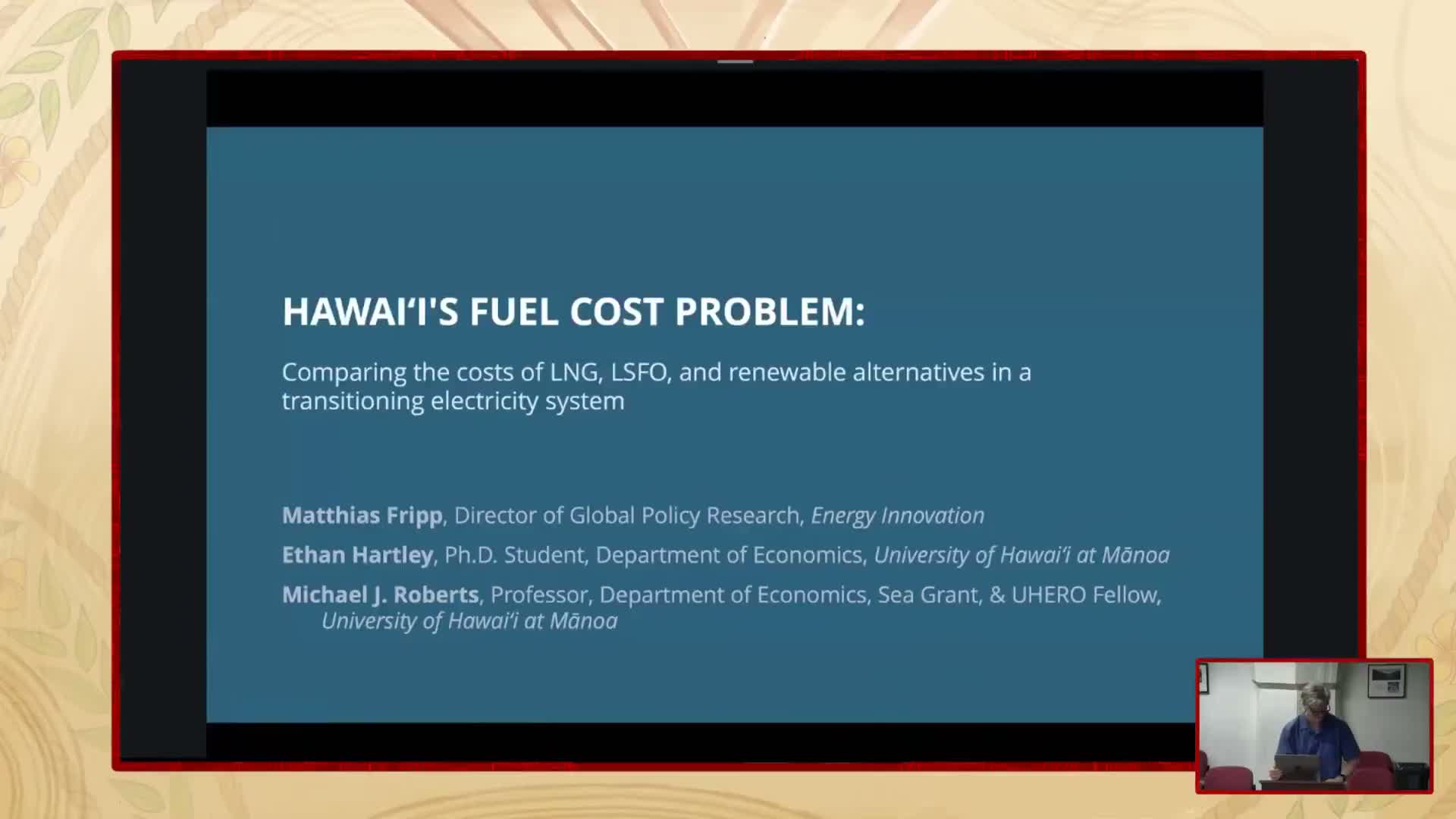
University of Hawaii researchers Michael Roberts and Matthias Fripp presented a scenario-based capacity-planning analysis using the Switch model and told the Committee on Energy and Environmental Protection that most plausible futures favor solar plus batteries over large LNG imports.
Roberts framed the analysis by noting recent fuel-price volatility and changes in low-sulfur fuel oil contracts that affect Hawaiian Electric Company (HECO) cost inputs. He said long-term LNG supply contracts carry distinct risks for a small buyer, including take-or-pay commitments, potential contract renegotiation and high cost-overrun risk for liquefaction and shipping infrastructure.
Fripp explained the model inputs and a 3×3 scenario matrix: low/medium/high solar cost crossed with low/medium/high fuel-price forecasts. The model optimizes investment and hourly operations subject to technical constraints and a renewable portfolio standard. Across most cases, Fripp reported, a plan that forces a large LNG buildout and associated infrastructure would cost more in net present value than a least-cost plan emphasizing solar and batteries. In the team’s reference case, Fripp said, adopting the proposed 500 MW LNG build and infrastructure produced about $100 million in additional present-value costs compared with the least-cost alternative; the LNG option could also displace roughly 20 percentage points of renewables that otherwise would be built.
Fripp summarized risks that are underappreciated in public discussions: LNG contracts are typically structured to protect sellers; export capacity constraints can limit supply-response; and historical projects often experience 40–70% cost overruns. He also stressed land-use inputs and noted that their land inventory (excluding military land) showed more available onshore solar than HECO’s earlier conservative screening — and that rooftop and canopy PV could substitute if utility-scale land proves constrained.
Roberts and Fripp emphasized transparency: Fripp said the project’s code and inputs will be published in a GitHub repository so other analysts can replicate the scenarios and run additional sensitivity cases. The presenters recommended the committee request follow-up runs exploring stricter land constraints, alternative contract terms and additional robustness checks before any procurement of LNG or long-term commitments.
"These long-term LNG contracts are designed to protect the seller, not the buyer," Fripp said, warning of take-or-pay exposure and limited ability to expand liquefaction capacity quickly. The researchers suggested the committee prioritize procurement and interconnection reforms that can accelerate low-cost solar and storage deployment as a lower-risk alternative to LNG-based supply.
Roberts framed the analysis by noting recent fuel-price volatility and changes in low-sulfur fuel oil contracts that affect Hawaiian Electric Company (HECO) cost inputs. He said long-term LNG supply contracts carry distinct risks for a small buyer, including take-or-pay commitments, potential contract renegotiation and high cost-overrun risk for liquefaction and shipping infrastructure.
Fripp explained the model inputs and a 3×3 scenario matrix: low/medium/high solar cost crossed with low/medium/high fuel-price forecasts. The model optimizes investment and hourly operations subject to technical constraints and a renewable portfolio standard. Across most cases, Fripp reported, a plan that forces a large LNG buildout and associated infrastructure would cost more in net present value than a least-cost plan emphasizing solar and batteries. In the team’s reference case, Fripp said, adopting the proposed 500 MW LNG build and infrastructure produced about $100 million in additional present-value costs compared with the least-cost alternative; the LNG option could also displace roughly 20 percentage points of renewables that otherwise would be built.
Fripp summarized risks that are underappreciated in public discussions: LNG contracts are typically structured to protect sellers; export capacity constraints can limit supply-response; and historical projects often experience 40–70% cost overruns. He also stressed land-use inputs and noted that their land inventory (excluding military land) showed more available onshore solar than HECO’s earlier conservative screening — and that rooftop and canopy PV could substitute if utility-scale land proves constrained.
Roberts and Fripp emphasized transparency: Fripp said the project’s code and inputs will be published in a GitHub repository so other analysts can replicate the scenarios and run additional sensitivity cases. The presenters recommended the committee request follow-up runs exploring stricter land constraints, alternative contract terms and additional robustness checks before any procurement of LNG or long-term commitments.
"These long-term LNG contracts are designed to protect the seller, not the buyer," Fripp said, warning of take-or-pay exposure and limited ability to expand liquefaction capacity quickly. The researchers suggested the committee prioritize procurement and interconnection reforms that can accelerate low-cost solar and storage deployment as a lower-risk alternative to LNG-based supply.
View the Full Meeting & All Its Details
This article offers just a summary. Unlock complete video, transcripts, and insights as a Founder Member.
✓
Watch full, unedited meeting videos
✓
Search every word spoken in unlimited transcripts
✓
AI summaries & real-time alerts (all government levels)
✓
Permanent access to expanding government content
30-day money-back guarantee
