Board of Adjustments approves 50-foot flagpole for Hampstead Place Apartments to restore highway visibility
April 16, 2026 | Pender County, North Carolina
This article was created by AI summarizing key points discussed. AI makes mistakes, so for full details and context, please refer to the video of the full meeting. Please report any errors so we can fix them. Report an error »
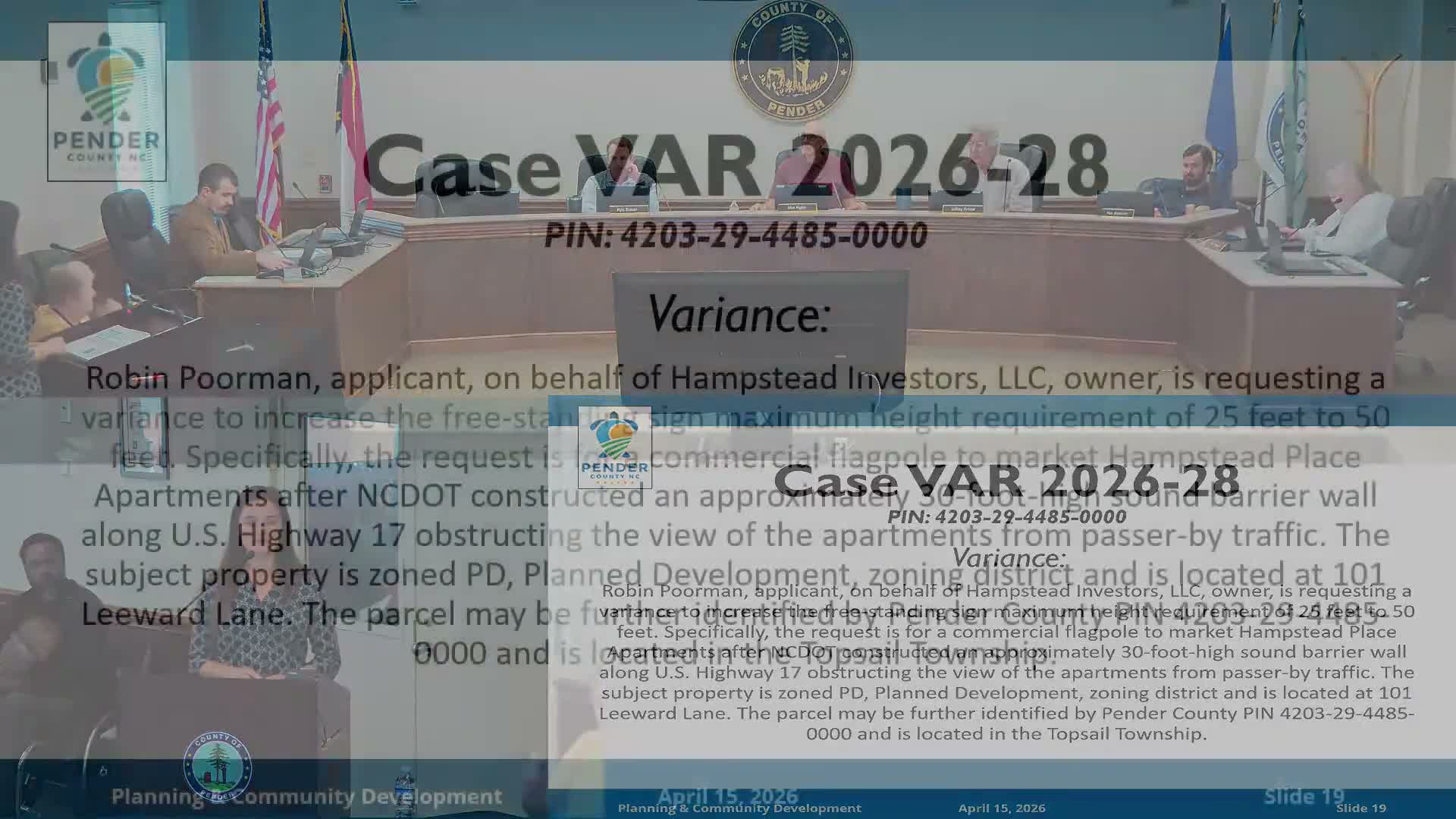
The Pender County Board of Adjustments on April 15 approved a variance to allow a 50-foot commercial flagpole at Hampstead Place Apartments to restore visibility lost when NCDOT built an approximately 30-foot sound wall along U.S. Highway 17.
Madeline Spencer, presenting the case for staff at the board meeting, said the applicant seeks relief from the Pender County Unified Development Ordinance (UDO) provision limiting freestanding sign height to 25 feet (UDO §9.7.0.1[b]). Spencer said the property at 101 Leeward Lane in Topsail Township had been screened from highway traffic after the NCDOT sound wall was installed as part of the Hampstead Bypass project and that the requested 50-foot pole would extend over the wall but remain inside the applicant’s property lines.
Robin Poorman, regional manager for Hampstead Place Apartments, told the board occupancy had “dropped significantly” after the sound wall went up and said the complex had not engaged NCDOT about an encroachment agreement. Poorman confirmed the proposed design includes separate poles for U.S. and North Carolina flags and a dedicated commercial flagpole carrying a 6-by-10-foot (60-square-foot) banner.
Board members questioned whether the flagpole should be treated as signage or be exempt as governmental insignia, whether DOT had been consulted, and whether a smaller height would meet the minimum‑variance standard. Spencer and the applicant said government flags (U.S., state) are exempt, but a commercial banner is regulated as a freestanding sign; the applicant had provided a site plan showing the pole set back 10 feet from the property line and the sound wall.
Committee member S5 moved to grant the variance and amended the motion to require the pole be set back at least 10 feet from the property line or from the NCDOT right of way, whichever is more restrictive. The motion was seconded and approved by voice vote.
The board’s action cites the hardship created by the NCDOT sound wall and applies the standard UDO variance findings (UDO variance section discussed at hearing). The board did not require a formal visibility study before approval but discussed the option of staff and applicant working to establish a minimum necessary height if further evidence was provided.
The applicant’s variance (case 2026‑28) was approved with the stated setback condition. Staff and the applicant will coordinate any required permits and building inspections in advance of installation.
Madeline Spencer, presenting the case for staff at the board meeting, said the applicant seeks relief from the Pender County Unified Development Ordinance (UDO) provision limiting freestanding sign height to 25 feet (UDO §9.7.0.1[b]). Spencer said the property at 101 Leeward Lane in Topsail Township had been screened from highway traffic after the NCDOT sound wall was installed as part of the Hampstead Bypass project and that the requested 50-foot pole would extend over the wall but remain inside the applicant’s property lines.
Robin Poorman, regional manager for Hampstead Place Apartments, told the board occupancy had “dropped significantly” after the sound wall went up and said the complex had not engaged NCDOT about an encroachment agreement. Poorman confirmed the proposed design includes separate poles for U.S. and North Carolina flags and a dedicated commercial flagpole carrying a 6-by-10-foot (60-square-foot) banner.
Board members questioned whether the flagpole should be treated as signage or be exempt as governmental insignia, whether DOT had been consulted, and whether a smaller height would meet the minimum‑variance standard. Spencer and the applicant said government flags (U.S., state) are exempt, but a commercial banner is regulated as a freestanding sign; the applicant had provided a site plan showing the pole set back 10 feet from the property line and the sound wall.
Committee member S5 moved to grant the variance and amended the motion to require the pole be set back at least 10 feet from the property line or from the NCDOT right of way, whichever is more restrictive. The motion was seconded and approved by voice vote.
The board’s action cites the hardship created by the NCDOT sound wall and applies the standard UDO variance findings (UDO variance section discussed at hearing). The board did not require a formal visibility study before approval but discussed the option of staff and applicant working to establish a minimum necessary height if further evidence was provided.
The applicant’s variance (case 2026‑28) was approved with the stated setback condition. Staff and the applicant will coordinate any required permits and building inspections in advance of installation.
Don't Miss a Word: See the Full Meeting!
Go beyond summaries. Unlock every video, transcript, and key insight with a Founder Membership.
✓
Get instant access to full meeting videos
✓
Search and clip any phrase from complete transcripts
✓
Receive AI-powered summaries & custom alerts
✓
Enjoy lifetime, unrestricted access to government data
30-day money-back guarantee
