Committee debates broad digital‑product "right to repair" bill, members raise safety and scope concerns
April 16, 2026 | 2026 Legislature Alaska, Alaska
This article was created by AI summarizing key points discussed. AI makes mistakes, so for full details and context, please refer to the video of the full meeting. Please report any errors so we can fix them. Report an error »
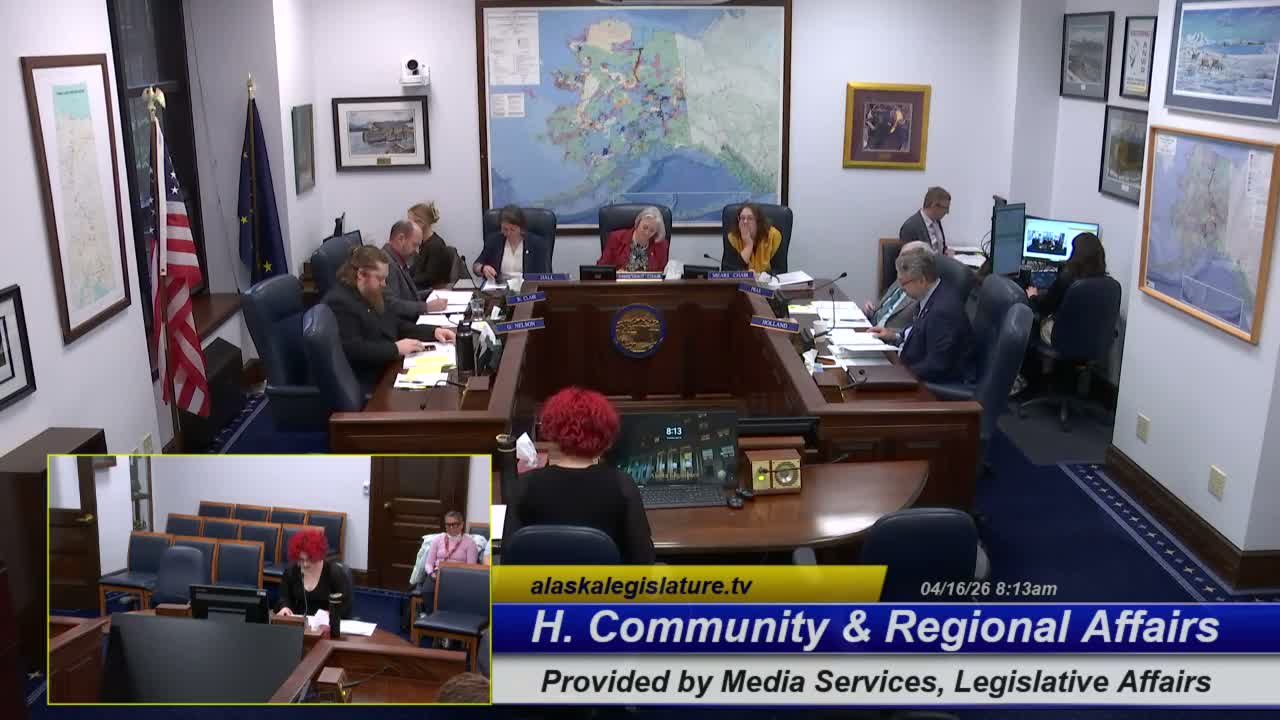
At its April 16 meeting the House Community and Regional Affairs Committee took testimony and extensive questions on HB 162, a broad digital‑product repair bill described by staff as a committee substitute (work draft 34‑LS0809).
Emma Solchinski, legislative intern to a House member and staff presenter, summarized the draft: the bill would require digital product manufacturers to provide consumers and independent repair providers the same parts, tools and documentation that they provide to authorized repair providers, permit reasonable charges for parts and exempt categories such as motor vehicles, medical devices, life‑safety systems and certain security and access control equipment. "These provisions require digital product manufacturers to provide to consumers and independent repair providers same parts, tools, and documentation that they provide to authorized repair providers," Solchinski told the committee.
Committee members pressed staff on enforcement and scope. Solchinski said enforcement authority would rest with the Attorney General and that the bill creates a private right of action allowing owners to sue manufacturers in addition to AG enforcement. Representative G. Nelson repeatedly warned the bill’s breadth could sweep in heavy equipment, aircraft and other regulated systems and raised life‑safety and certification concerns, citing a widely reported example in which a manufacturer altered telematics in a state after a repair‑law change. "With this broad of a sweeping application as this one would have, we might potentially face the same thing," Nelson said.
Staff also explained "parts pairing" with an iPhone example: genuine replacement screens can be disabled by a device's pairing system and display non‑dismissible warnings or disable features like Face ID; HB 162 aims to prevent that outcome for consumers and independent repairers.
Members acknowledged the policy goals but flagged implementation and legal challenges, the need to refine definitions (for example, of "misleading alerts" and parts pairing), and carve‑outs for dealership distribution models and highly regulated equipment. The committee set an amendment deadline for HB 162 at noon Friday, April 17, and did not vote on the measure at the hearing.
Next steps: members may submit amendments by the April 17 noon deadline; staff said they are open to revisions to clarify definitions and scope.
Emma Solchinski, legislative intern to a House member and staff presenter, summarized the draft: the bill would require digital product manufacturers to provide consumers and independent repair providers the same parts, tools and documentation that they provide to authorized repair providers, permit reasonable charges for parts and exempt categories such as motor vehicles, medical devices, life‑safety systems and certain security and access control equipment. "These provisions require digital product manufacturers to provide to consumers and independent repair providers same parts, tools, and documentation that they provide to authorized repair providers," Solchinski told the committee.
Committee members pressed staff on enforcement and scope. Solchinski said enforcement authority would rest with the Attorney General and that the bill creates a private right of action allowing owners to sue manufacturers in addition to AG enforcement. Representative G. Nelson repeatedly warned the bill’s breadth could sweep in heavy equipment, aircraft and other regulated systems and raised life‑safety and certification concerns, citing a widely reported example in which a manufacturer altered telematics in a state after a repair‑law change. "With this broad of a sweeping application as this one would have, we might potentially face the same thing," Nelson said.
Staff also explained "parts pairing" with an iPhone example: genuine replacement screens can be disabled by a device's pairing system and display non‑dismissible warnings or disable features like Face ID; HB 162 aims to prevent that outcome for consumers and independent repairers.
Members acknowledged the policy goals but flagged implementation and legal challenges, the need to refine definitions (for example, of "misleading alerts" and parts pairing), and carve‑outs for dealership distribution models and highly regulated equipment. The committee set an amendment deadline for HB 162 at noon Friday, April 17, and did not vote on the measure at the hearing.
Next steps: members may submit amendments by the April 17 noon deadline; staff said they are open to revisions to clarify definitions and scope.
View the Full Meeting & All Its Details
This article offers just a summary. Unlock complete video, transcripts, and insights as a Founder Member.
✓
Watch full, unedited meeting videos
✓
Search every word spoken in unlimited transcripts
✓
AI summaries & real-time alerts (all government levels)
✓
Permanent access to expanding government content
30-day money-back guarantee
