Proponents say ranked‑choice voting wastes ballots; opponents say repeal would weaken disclosure and let parties close primaries
April 16, 2026 | 2026 Legislature Alaska, Alaska
This article was created by AI summarizing key points discussed. AI makes mistakes, so for full details and context, please refer to the video of the full meeting. Please report any errors so we can fix them. Report an error »
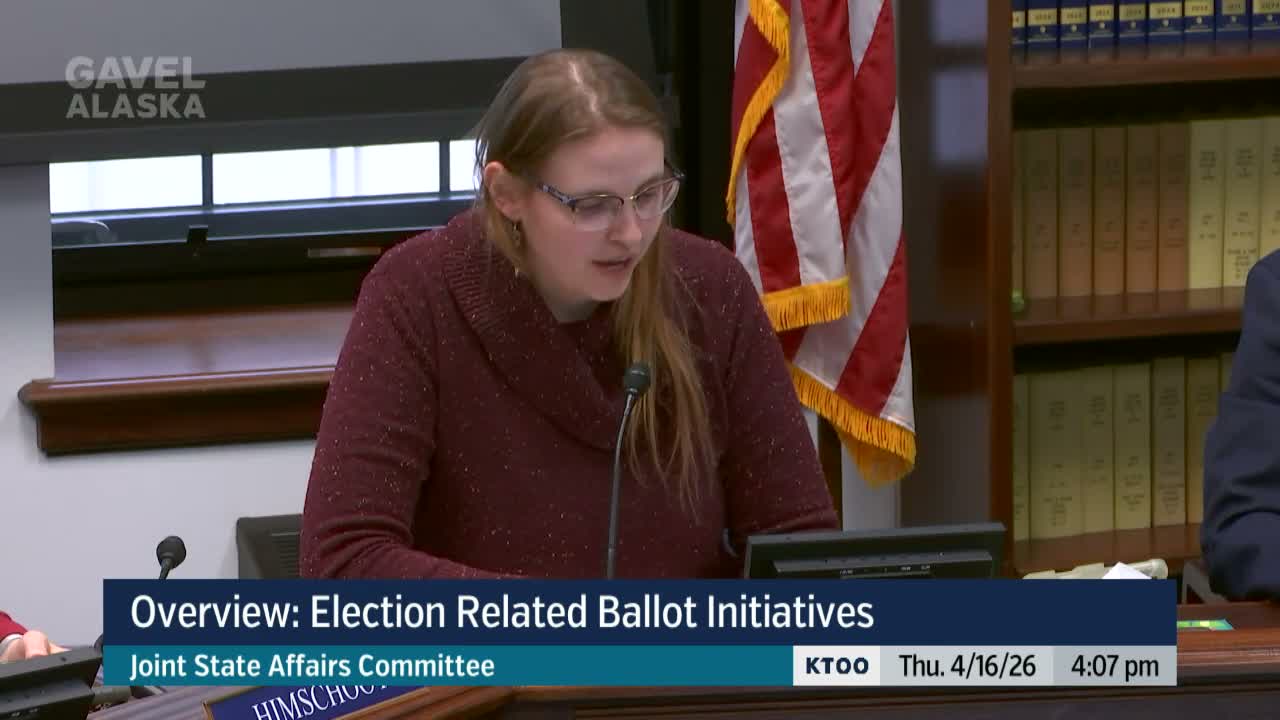
Supporters and opponents of ballot measure 24 ESEG squared off at an informational joint hearing of the Alaska House and Senate State Affairs committees on April 16.
Bethany Markham, treasurer for Repeal Now, said the initiative would repeal the 2020 reforms that introduced ranked‑choice voting (RCV), a top‑four primary and new disclosure rules. Markham told the committees that nearly 15,000 ballots were "exhausted" in the 2022 special congressional election and argued those ballots were effectively "trashed" because they no longer counted in later rounds. "If your vote doesn't count in another round, then what's the difference?" Greg Powers, the campaign consultant who joined the presentation, said during questions that that is the point the sponsors were making.
Committee members pressed for evidence that ballots were physically discarded; Markham said "exhausted" is the technical term used by election officials and that the campaign is compiling a local record of irregularities. Senators and representatives asked whether hand counts are feasible under RCV; Markham and Powers said recounts and manual processes exist, while opponents pointed to errors elsewhere as reasons to repeal.
Scott Kendall, representing Protect Alaska's Elections (the registered APOC opposition), told the committees the 2020 reforms ensured majority winners and curbed the spoiler effect. Kendall said courts have upheld that RCV satisfies "one person, one vote," disputed claims of systemic irregularities in Alaska elections so far, and described how the 2020 disclosure requirements increase transparency and ban so‑called dark money by requiring donors and timely reporting for large out‑of‑state contributions.
Kendall also warned that 24 ESEG would repeal disclosure penalties and allow parties, by bylaw change, to close primaries to unaffiliated voters. He urged the committee to consider that the measure is an "all‑or‑nothing" package that would simultaneously eliminate disclosures, reinstate closed‑primary power for parties, and return to plurality outcomes in some races.
The hearing was informational; committee members asked follow‑up questions but took no votes.
Bethany Markham, treasurer for Repeal Now, said the initiative would repeal the 2020 reforms that introduced ranked‑choice voting (RCV), a top‑four primary and new disclosure rules. Markham told the committees that nearly 15,000 ballots were "exhausted" in the 2022 special congressional election and argued those ballots were effectively "trashed" because they no longer counted in later rounds. "If your vote doesn't count in another round, then what's the difference?" Greg Powers, the campaign consultant who joined the presentation, said during questions that that is the point the sponsors were making.
Committee members pressed for evidence that ballots were physically discarded; Markham said "exhausted" is the technical term used by election officials and that the campaign is compiling a local record of irregularities. Senators and representatives asked whether hand counts are feasible under RCV; Markham and Powers said recounts and manual processes exist, while opponents pointed to errors elsewhere as reasons to repeal.
Scott Kendall, representing Protect Alaska's Elections (the registered APOC opposition), told the committees the 2020 reforms ensured majority winners and curbed the spoiler effect. Kendall said courts have upheld that RCV satisfies "one person, one vote," disputed claims of systemic irregularities in Alaska elections so far, and described how the 2020 disclosure requirements increase transparency and ban so‑called dark money by requiring donors and timely reporting for large out‑of‑state contributions.
Kendall also warned that 24 ESEG would repeal disclosure penalties and allow parties, by bylaw change, to close primaries to unaffiliated voters. He urged the committee to consider that the measure is an "all‑or‑nothing" package that would simultaneously eliminate disclosures, reinstate closed‑primary power for parties, and return to plurality outcomes in some races.
The hearing was informational; committee members asked follow‑up questions but took no votes.
View the Full Meeting & All Its Details
This article offers just a summary. Unlock complete video, transcripts, and insights as a Founder Member.
✓
Watch full, unedited meeting videos
✓
Search every word spoken in unlimited transcripts
✓
AI summaries & real-time alerts (all government levels)
✓
Permanent access to expanding government content
30-day money-back guarantee
