Committee advances bill extending limited liability protections to trained armed security officers
April 13, 2026 | 2026 Legislature LA, Louisiana
This article was created by AI summarizing key points discussed. AI makes mistakes, so for full details and context, please refer to the video of the full meeting. Please report any errors so we can fix them. Report an error »
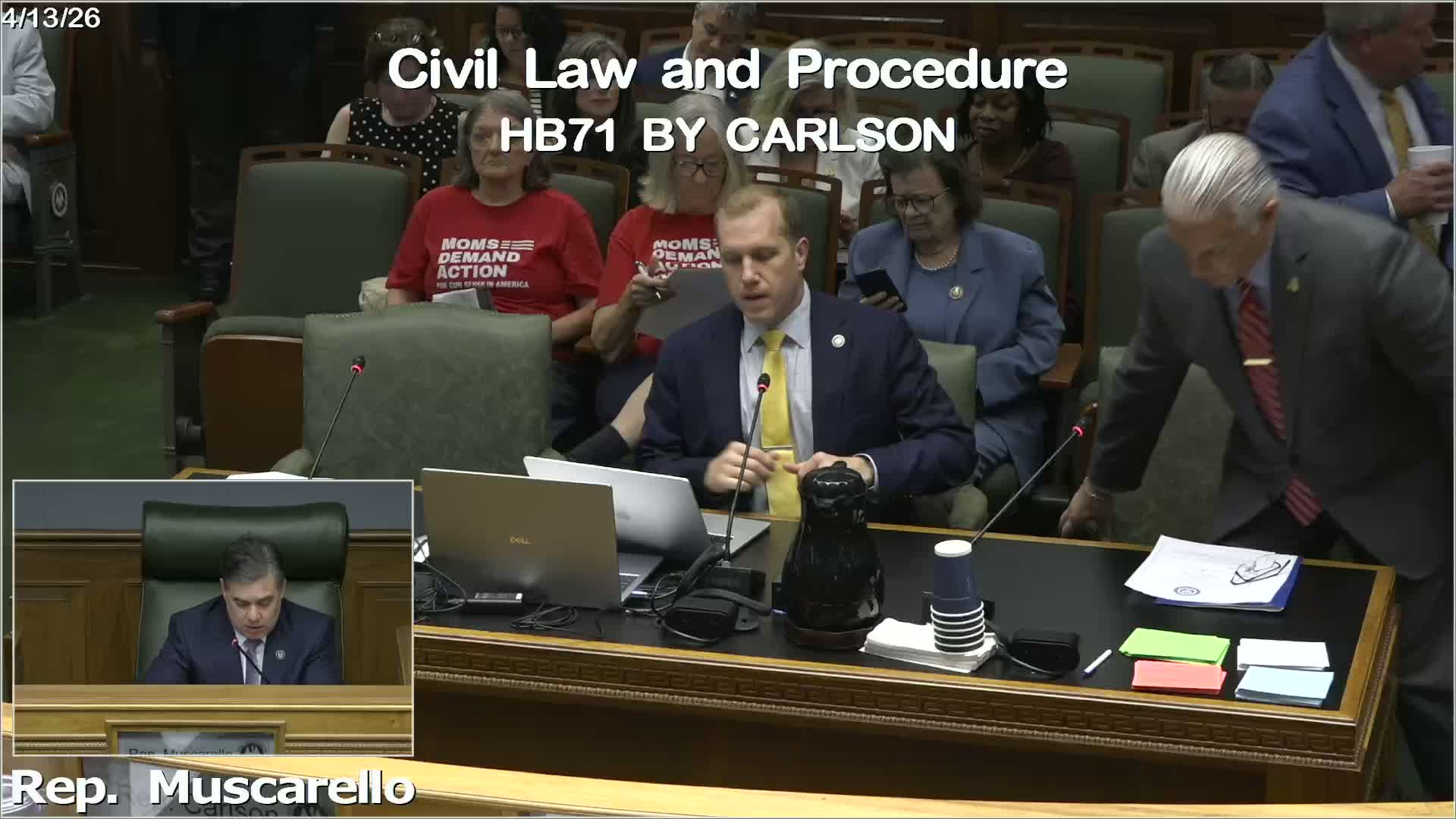
Representative Danny Carlson brought HB71 before the committee, saying the bill ‘‘makes a common-sense update’’ to extend existing limited-liability protections to properly trained and registered armed private security officers. He said these individuals ‘‘are entrusted with serious responsibility’’ and when they act lawfully the statute should protect them.
Carl Cazan, executive director of the Louisiana State Board of Private Security Examiners, told the panel the industry is professionalizing and faces rising insurance costs. He said the board is standardizing training and ‘‘strengthening our training requirements’’ and noted that in New Orleans ‘‘in 36 months … they had 13 lethal force encounters involving private security personnel.’’ He said carriers are pulling back and that the change would help preserve qualified providers.
Opponents questioned whether current training is sufficient. Becky Andrews, a resident of Baton Rouge who testified in opposition, said the change would extend immunity ‘‘currently only given to law enforcement…to liability in cases involving the use of self defense’’ and warned it could make ‘‘it nearly impossible for people who are hurt or killed to obtain monetary damages.’’ Trinity Patterson said she was ‘‘not sure that the amount of hours of training is sufficient enough to give them so much leeway’’ given the difference between security training and police academy training.
Representative Carlson closed by stressing the bill does not grant blanket immunity: the protection applies only where responding law enforcement and the district attorney find the use of force justifiable. After debate the committee moved HB71 and conducted a roll-call vote; the clerk recorded the committee result as favorable (the roll-call summary announced in committee: "7 yeas, 1 nay").
Next steps: HB71 was reported out of committee and will be scheduled for consideration by the full House.
Carl Cazan, executive director of the Louisiana State Board of Private Security Examiners, told the panel the industry is professionalizing and faces rising insurance costs. He said the board is standardizing training and ‘‘strengthening our training requirements’’ and noted that in New Orleans ‘‘in 36 months … they had 13 lethal force encounters involving private security personnel.’’ He said carriers are pulling back and that the change would help preserve qualified providers.
Opponents questioned whether current training is sufficient. Becky Andrews, a resident of Baton Rouge who testified in opposition, said the change would extend immunity ‘‘currently only given to law enforcement…to liability in cases involving the use of self defense’’ and warned it could make ‘‘it nearly impossible for people who are hurt or killed to obtain monetary damages.’’ Trinity Patterson said she was ‘‘not sure that the amount of hours of training is sufficient enough to give them so much leeway’’ given the difference between security training and police academy training.
Representative Carlson closed by stressing the bill does not grant blanket immunity: the protection applies only where responding law enforcement and the district attorney find the use of force justifiable. After debate the committee moved HB71 and conducted a roll-call vote; the clerk recorded the committee result as favorable (the roll-call summary announced in committee: "7 yeas, 1 nay").
Next steps: HB71 was reported out of committee and will be scheduled for consideration by the full House.
Don't Miss a Word: See the Full Meeting!
Go beyond summaries. Unlock every video, transcript, and key insight with a Founder Membership.
✓
Get instant access to full meeting videos
✓
Search and clip any phrase from complete transcripts
✓
Receive AI-powered summaries & custom alerts
✓
Enjoy lifetime, unrestricted access to government data
30-day money-back guarantee
