Senate committee weighs municipal power to cap annual assessment increases (3–10%) and 10-year true-up
April 15, 2026 | 2026 Legislature Alaska, Alaska
This article was created by AI summarizing key points discussed. AI makes mistakes, so for full details and context, please refer to the video of the full meeting. Please report any errors so we can fix them. Report an error »
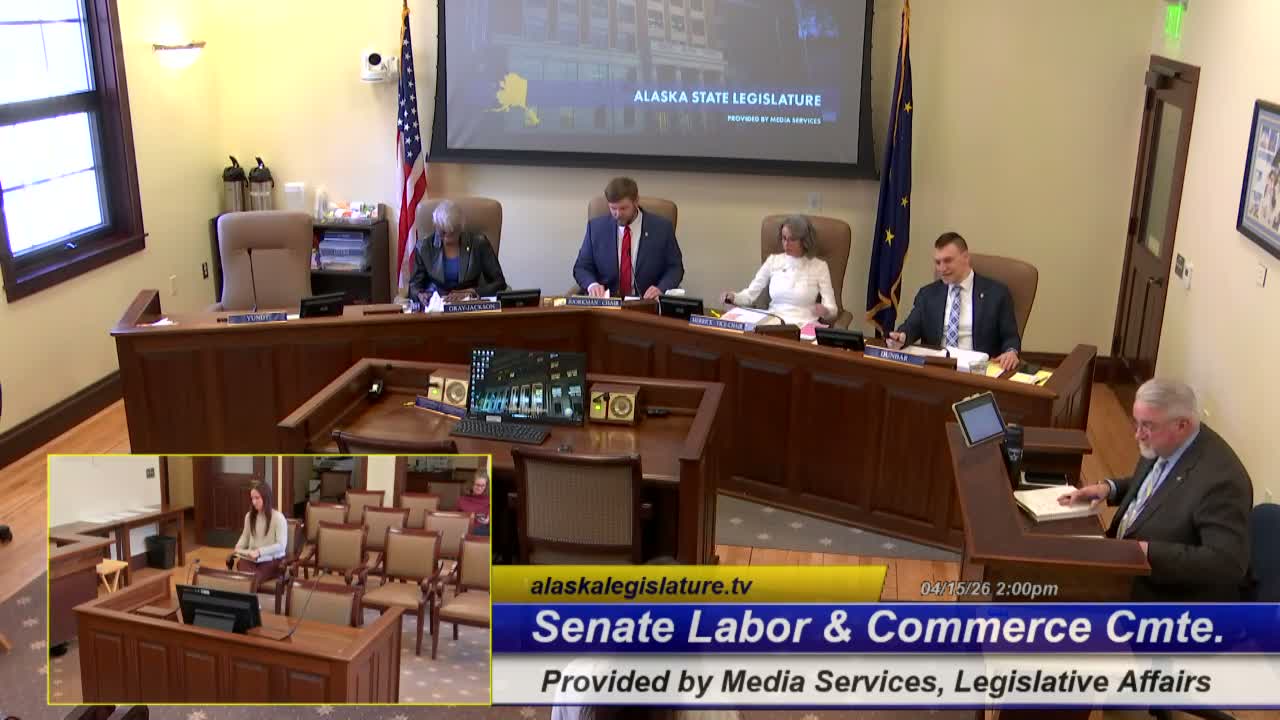
Senate Bill 259 was presented to the Senate Labor and Commerce Committee on April 15 by Sevea Bieber, staff to Senator Bjorkman. Bieber said SB 259 would authorize municipalities to cap annual assessment increases in an ordinance at any rate between 3% and 10%, allow assessors to "true up" assessed value when a property is improved or ownership transfers, and require a full true-value adjustment every 10 years. In its current form, the bill would apply where the property is occupied as housing.
Bieber told the committee the policy is designed to protect property owners from sudden unaffordable property tax increases, allow easier household budgeting and planning, and reduce the risk of displacement among long-term residents. She said the cap would reflect "full and true value" and be enacted by municipal ordinance, with the assessor permitted to adjust values for improvements or transfers.
Senator Dunbar asked whether municipalities must apply the ordinance to all property or could target residential versus commercial property. Committee discussion noted a draft committee substitute (CS) in members’ packets that would insert a target date for municipalities to reach full and true value and avoid creating separate, split assessment roles that could complicate the state assessor’s responsibilities. Dunbar raised hypothetical distortions in places such as Valdez or Kenai if industrial or large commercial facilities caused residential comparables to shift and asked how smoothing would affect mill rates.
Committee members emphasized that assessed values should rely on comparable properties of similar use and that smoothing should not replace the comparables system. The chair said the committee intends to invite the state assessor to the next meeting for technical questions. Sandra Moller, director at the Division of Community and Regional Affairs, told the committee the state currently lacks a state assessor (vacant for personal reasons) and cautioned that the bill could have unintended consequences for full-value determinations that feed school reimbursement and local match calculations. She offered to receive written questions and provide answers when DCRA can respond.
No formal action or votes were taken; the committee scheduled further consideration of SB 259 at a subsequent meeting when the state assessor can appear.
Bieber told the committee the policy is designed to protect property owners from sudden unaffordable property tax increases, allow easier household budgeting and planning, and reduce the risk of displacement among long-term residents. She said the cap would reflect "full and true value" and be enacted by municipal ordinance, with the assessor permitted to adjust values for improvements or transfers.
Senator Dunbar asked whether municipalities must apply the ordinance to all property or could target residential versus commercial property. Committee discussion noted a draft committee substitute (CS) in members’ packets that would insert a target date for municipalities to reach full and true value and avoid creating separate, split assessment roles that could complicate the state assessor’s responsibilities. Dunbar raised hypothetical distortions in places such as Valdez or Kenai if industrial or large commercial facilities caused residential comparables to shift and asked how smoothing would affect mill rates.
Committee members emphasized that assessed values should rely on comparable properties of similar use and that smoothing should not replace the comparables system. The chair said the committee intends to invite the state assessor to the next meeting for technical questions. Sandra Moller, director at the Division of Community and Regional Affairs, told the committee the state currently lacks a state assessor (vacant for personal reasons) and cautioned that the bill could have unintended consequences for full-value determinations that feed school reimbursement and local match calculations. She offered to receive written questions and provide answers when DCRA can respond.
No formal action or votes were taken; the committee scheduled further consideration of SB 259 at a subsequent meeting when the state assessor can appear.
Don't Miss a Word: See the Full Meeting!
Go beyond summaries. Unlock every video, transcript, and key insight with a Founder Membership.
✓
Get instant access to full meeting videos
✓
Search and clip any phrase from complete transcripts
✓
Receive AI-powered summaries & custom alerts
✓
Enjoy lifetime, unrestricted access to government data
30-day money-back guarantee
