Panel hears bill to join Occupational Therapy Licensure Compact; supporters say it could cut licensing time from weeks to minutes
April 13, 2026 | 2026 Legislature Alaska, Alaska
This article was created by AI summarizing key points discussed. AI makes mistakes, so for full details and context, please refer to the video of the full meeting. Please report any errors so we can fix them. Report an error »
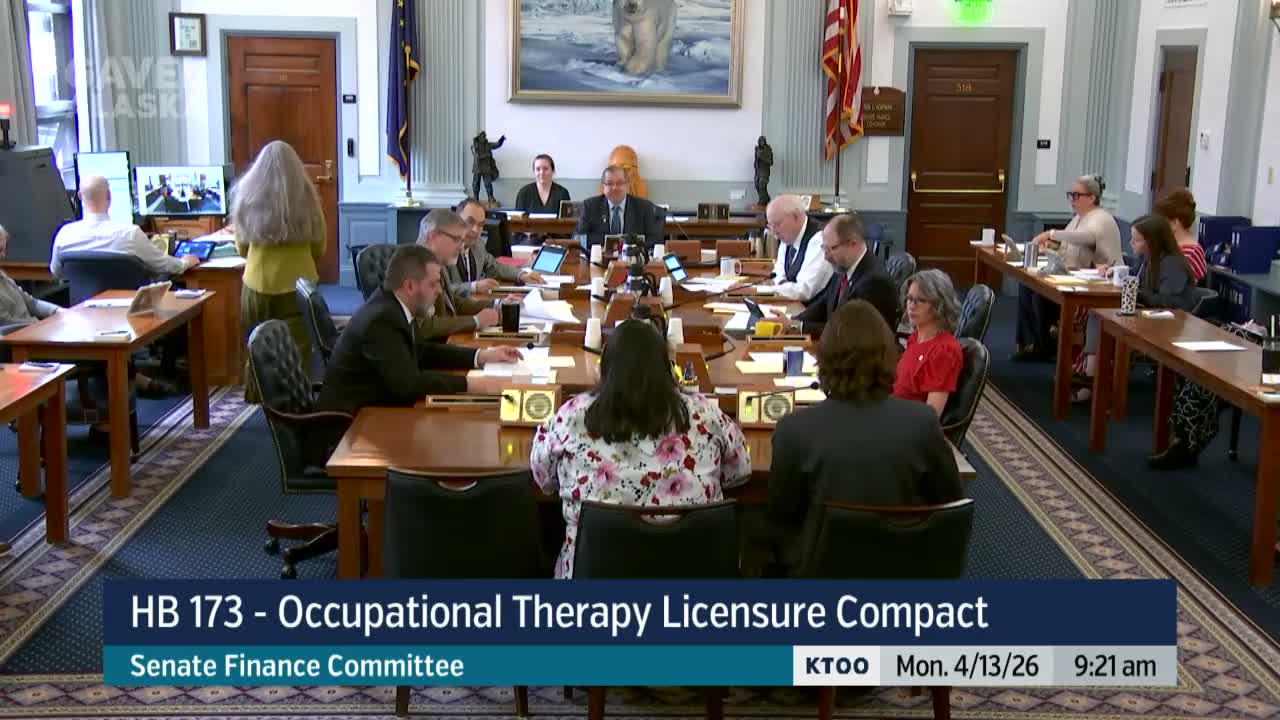
Juneau — The Alaska Senate Finance Committee on April 13, 2026 held a first hearing on House Bill 173 to join the Occupational Therapy Licensure Compact, a multistate agreement that creates a shared data system and a process for granting practice privileges to therapists licensed in other member states.
Representative Jimmy, sponsor of HB 173, said rural Alaskans often miss or wait months for therapy appointments because of weather and travel delays and that the compact could improve timely access to care.
Brianne Oswald, an occupational therapist and outgoing president of the Alaska Occupational Therapy Association, said Alaska has only one in‑state OT education program producing roughly a dozen graduates a year and that the state relies on out‑of‑state therapists. "It took almost three months for me to get a license to practice in the state," Oswald said, and she urged the committee to adopt the compact to reduce licensing delays.
Carl Sims of the Council of State Governments’ National Center for Interstate Compacts described the compact’s mechanics: it establishes uniform eligibility criteria for practitioners to obtain practice privileges in member states, preserves each state’s scope‑of‑practice rules and allows states to discipline practitioners under their own laws. "Our compact currently has 33 member states and is operational," Sims said.
Tori Daughtry, member and secretary of the State Physical Therapy and Occupational Therapy Board, told the committee the board’s average turnaround for out‑of‑state occupational‑therapy licenses is about four weeks and that compact authorization could be much faster. "We're jumping from four weeks to three minutes if we were to enact the OT compact," Daughtry said, describing how the compact’s data system shortens onboarding for already‑vetted practitioners.
Committee members asked how complaint investigations and disciplinary costs would be handled. Sullivan Raab, director of the Division of Corporations, Business and Professional Licensing, said investigations for incidents that occur in Alaska would be handled by the division and that costs are borne through license and compact privilege fees. Raab and other witnesses said compact participants typically pay fees comparable to direct licensure, and that compact data systems allow member states to see adverse actions taken elsewhere.
Other testifiers from rural Alaska and employers urged adoption to reduce long wait lists and improve access while preserving the Alaska licensing board’s authority to protect the public. Senator Kiel reported a zero fiscal note for the bill, noting regulation changes would be required. The committee set HB 173 aside for further consideration.
Representative Jimmy, sponsor of HB 173, said rural Alaskans often miss or wait months for therapy appointments because of weather and travel delays and that the compact could improve timely access to care.
Brianne Oswald, an occupational therapist and outgoing president of the Alaska Occupational Therapy Association, said Alaska has only one in‑state OT education program producing roughly a dozen graduates a year and that the state relies on out‑of‑state therapists. "It took almost three months for me to get a license to practice in the state," Oswald said, and she urged the committee to adopt the compact to reduce licensing delays.
Carl Sims of the Council of State Governments’ National Center for Interstate Compacts described the compact’s mechanics: it establishes uniform eligibility criteria for practitioners to obtain practice privileges in member states, preserves each state’s scope‑of‑practice rules and allows states to discipline practitioners under their own laws. "Our compact currently has 33 member states and is operational," Sims said.
Tori Daughtry, member and secretary of the State Physical Therapy and Occupational Therapy Board, told the committee the board’s average turnaround for out‑of‑state occupational‑therapy licenses is about four weeks and that compact authorization could be much faster. "We're jumping from four weeks to three minutes if we were to enact the OT compact," Daughtry said, describing how the compact’s data system shortens onboarding for already‑vetted practitioners.
Committee members asked how complaint investigations and disciplinary costs would be handled. Sullivan Raab, director of the Division of Corporations, Business and Professional Licensing, said investigations for incidents that occur in Alaska would be handled by the division and that costs are borne through license and compact privilege fees. Raab and other witnesses said compact participants typically pay fees comparable to direct licensure, and that compact data systems allow member states to see adverse actions taken elsewhere.
Other testifiers from rural Alaska and employers urged adoption to reduce long wait lists and improve access while preserving the Alaska licensing board’s authority to protect the public. Senator Kiel reported a zero fiscal note for the bill, noting regulation changes would be required. The committee set HB 173 aside for further consideration.
Don't Miss a Word: See the Full Meeting!
Go beyond summaries. Unlock every video, transcript, and key insight with a Founder Membership.
✓
Get instant access to full meeting videos
✓
Search and clip any phrase from complete transcripts
✓
Receive AI-powered summaries & custom alerts
✓
Enjoy lifetime, unrestricted access to government data
30-day money-back guarantee
