Senate Finance screening of Tooksook Bay documentary underscores push for Senate Bill 41 on K–12 mental-health education
April 15, 2026 | 2026 Legislature Alaska, Alaska
This article was created by AI summarizing key points discussed. AI makes mistakes, so for full details and context, please refer to the video of the full meeting. Please report any errors so we can fix them. Report an error »
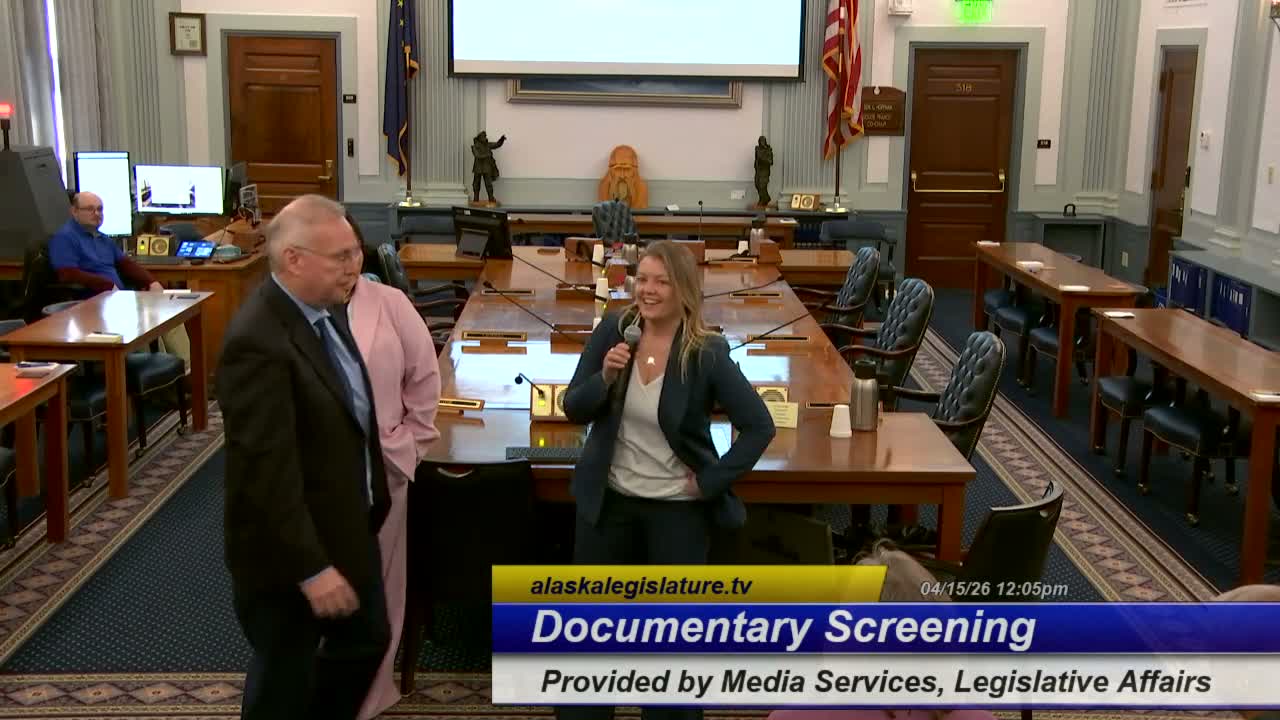
In the Senate Finance Room, members of the Senate Finance Committee and community speakers watched a 19‑minute documentary produced with Alaska Public Media that centered youth voices from a southwestern Alaska village and urged passage of Senate Bill 41 to expand mental‑health education in K–12 schools.
The screening was introduced by a moderator and by community participants from the village identified in the transcript as Nellie’s hometown. Brooke Ivy, who identified herself as a board member of the American Foundation for Suicide Prevention (Alaska chapter), said the film grew out of Hope and Healing Week and was intended to show how local students and elders work together to support grieving families and build protective factors. “The film you’re about to watch … is really focused on bringing the community together — elders, community members, and school students, to focus on healing and processing the grief of loss through more community, cultural meaningful ways,” Ivy said.
Senator Ray Jackson, identified in the transcript as present, said he had recently viewed the film and urged colleagues to advance Senate Bill 41. “It just makes me think and realize … how important Senate Bill 41 is to make it to the finish line,” Jackson said, noting the measure had nearly passed in prior years.
The documentary included several first‑person testimonials from young people and community members. One student speaker described losing multiple friends and relatives to suicide and said, “I almost took my life, but somebody brought me back. I was dead for 5 minutes.” Other speakers described the village’s cultural practices — drumming, candlelight ceremonies, potlucks and a “throw party” celebration — as part of healing traditions and community resilience.
Presenters and interviewees repeatedly emphasized the shortage of continuous, professional mental‑health services in remote villages: limited access to daily therapy and a heavy caseload for school staff who follow students through K–12 but cannot provide ongoing adult services after graduation. An AFSP volunteer described Hope and Healing Week activities — community walks, elder talks and celebration events — as efforts to “start the conversation” and connect young people to supports.
Brooke Ivy also noted that, according to remarks in the event, Alaska had the nation’s highest suicide rate in 2023; that assertion was stated in the presentation and is reported here as made in the transcript and not independently verified by this article.
No formal committee vote or legislative action occurred at the screening. Organizers and speakers asked lawmakers to carry the policy conversation forward and to prioritize accessible, sustained mental‑health supports for rural communities and schools.
The event closed with speakers thanking attendees and urging continued legislative attention to school‑based mental‑health education and community‑led prevention efforts.
The screening was introduced by a moderator and by community participants from the village identified in the transcript as Nellie’s hometown. Brooke Ivy, who identified herself as a board member of the American Foundation for Suicide Prevention (Alaska chapter), said the film grew out of Hope and Healing Week and was intended to show how local students and elders work together to support grieving families and build protective factors. “The film you’re about to watch … is really focused on bringing the community together — elders, community members, and school students, to focus on healing and processing the grief of loss through more community, cultural meaningful ways,” Ivy said.
Senator Ray Jackson, identified in the transcript as present, said he had recently viewed the film and urged colleagues to advance Senate Bill 41. “It just makes me think and realize … how important Senate Bill 41 is to make it to the finish line,” Jackson said, noting the measure had nearly passed in prior years.
The documentary included several first‑person testimonials from young people and community members. One student speaker described losing multiple friends and relatives to suicide and said, “I almost took my life, but somebody brought me back. I was dead for 5 minutes.” Other speakers described the village’s cultural practices — drumming, candlelight ceremonies, potlucks and a “throw party” celebration — as part of healing traditions and community resilience.
Presenters and interviewees repeatedly emphasized the shortage of continuous, professional mental‑health services in remote villages: limited access to daily therapy and a heavy caseload for school staff who follow students through K–12 but cannot provide ongoing adult services after graduation. An AFSP volunteer described Hope and Healing Week activities — community walks, elder talks and celebration events — as efforts to “start the conversation” and connect young people to supports.
Brooke Ivy also noted that, according to remarks in the event, Alaska had the nation’s highest suicide rate in 2023; that assertion was stated in the presentation and is reported here as made in the transcript and not independently verified by this article.
No formal committee vote or legislative action occurred at the screening. Organizers and speakers asked lawmakers to carry the policy conversation forward and to prioritize accessible, sustained mental‑health supports for rural communities and schools.
The event closed with speakers thanking attendees and urging continued legislative attention to school‑based mental‑health education and community‑led prevention efforts.
Don't Miss a Word: See the Full Meeting!
Go beyond summaries. Unlock every video, transcript, and key insight with a Founder Membership.
✓
Get instant access to full meeting videos
✓
Search and clip any phrase from complete transcripts
✓
Receive AI-powered summaries & custom alerts
✓
Enjoy lifetime, unrestricted access to government data
30-day money-back guarantee
