Austin Energy staff propose new value‑of‑solar credits after five‑year rolling average update
April 13, 2026 | Austin, Travis County, Texas
This article was created by AI summarizing key points discussed. AI makes mistakes, so for full details and context, please refer to the video of the full meeting. Please report any errors so we can fix them. Report an error »
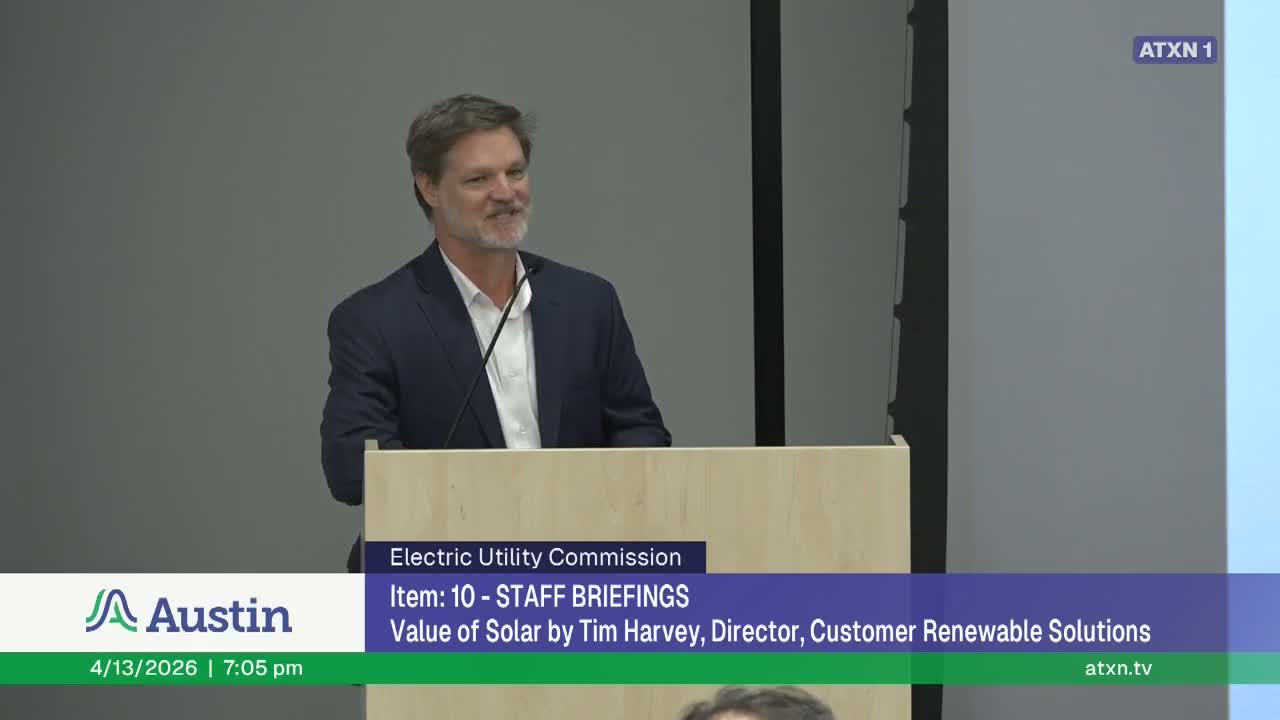
Austin Energy staff told the Electric Utility Commission on April 13 that they will update the utility’s value‑of‑solar credit using a five‑year rolling average and the utility’s avoided‑cost methodology.
Tim Harvey, director of customer renewable solutions, said the value stacks energy, transmission (4CP) savings, ancillary services and a societal benefit component derived from the federal social cost‑of‑carbon calculations and ERCOT market carbon intensity. Based on the five‑year averaging approach presented, Harvey said the proposed credit for systems under one megawatt would be 12.88¢ per kilowatt‑hour and 10.21¢ per kilowatt‑hour for systems above one megawatt. Staff said the update will move through the FY27 budget process and be effective Nov. 1 with other rates.
Harvey explained why the societal benefit line rose in recent years: changes in the White House’s social cost‑of‑carbon technical report and discount‑rate assumptions produced materially different present‑value numbers for the years included in the five‑year average. Commissioners suggested evaluating a six‑year rolling average so extreme weather or single‑event price spikes do not overly swing the credit.
Commissioner questions focused on how transmission savings and ancillary services were computed, the potential volatility of an energy‑market component that can spike in singular events, and requests for more public‑facing explainer material on why Austin uses a separate PV meter and how the value is calculated.
Why it matters: The value‑of‑solar credit is the utility’s mechanism for compensating rooftop and distributed generators and replaces net metering; changes to that credit affect the economics of rooftop solar and storage for customers and the demand for distributed resources.
What’s next: Staff said updated analyses are posted on Austin Energy’s value‑of‑solar web page and will be included in the FY27 rate/budget package; commissioners asked staff to consider alternative averaging approaches and to provide clearer web‑based explainers for customers.
Tim Harvey, director of customer renewable solutions, said the value stacks energy, transmission (4CP) savings, ancillary services and a societal benefit component derived from the federal social cost‑of‑carbon calculations and ERCOT market carbon intensity. Based on the five‑year averaging approach presented, Harvey said the proposed credit for systems under one megawatt would be 12.88¢ per kilowatt‑hour and 10.21¢ per kilowatt‑hour for systems above one megawatt. Staff said the update will move through the FY27 budget process and be effective Nov. 1 with other rates.
Harvey explained why the societal benefit line rose in recent years: changes in the White House’s social cost‑of‑carbon technical report and discount‑rate assumptions produced materially different present‑value numbers for the years included in the five‑year average. Commissioners suggested evaluating a six‑year rolling average so extreme weather or single‑event price spikes do not overly swing the credit.
Commissioner questions focused on how transmission savings and ancillary services were computed, the potential volatility of an energy‑market component that can spike in singular events, and requests for more public‑facing explainer material on why Austin uses a separate PV meter and how the value is calculated.
Why it matters: The value‑of‑solar credit is the utility’s mechanism for compensating rooftop and distributed generators and replaces net metering; changes to that credit affect the economics of rooftop solar and storage for customers and the demand for distributed resources.
What’s next: Staff said updated analyses are posted on Austin Energy’s value‑of‑solar web page and will be included in the FY27 rate/budget package; commissioners asked staff to consider alternative averaging approaches and to provide clearer web‑based explainers for customers.
View the Full Meeting & All Its Details
This article offers just a summary. Unlock complete video, transcripts, and insights as a Founder Member.
✓
Watch full, unedited meeting videos
✓
Search every word spoken in unlimited transcripts
✓
AI summaries & real-time alerts (all government levels)
✓
Permanent access to expanding government content
30-day money-back guarantee
