Senate rejects bill that would lower parent-turnout threshold to trigger charter conversion applications
April 15, 2026 | 2026 Legislature LA, Louisiana
This article was created by AI summarizing key points discussed. AI makes mistakes, so for full details and context, please refer to the video of the full meeting. Please report any errors so we can fix them. Report an error »
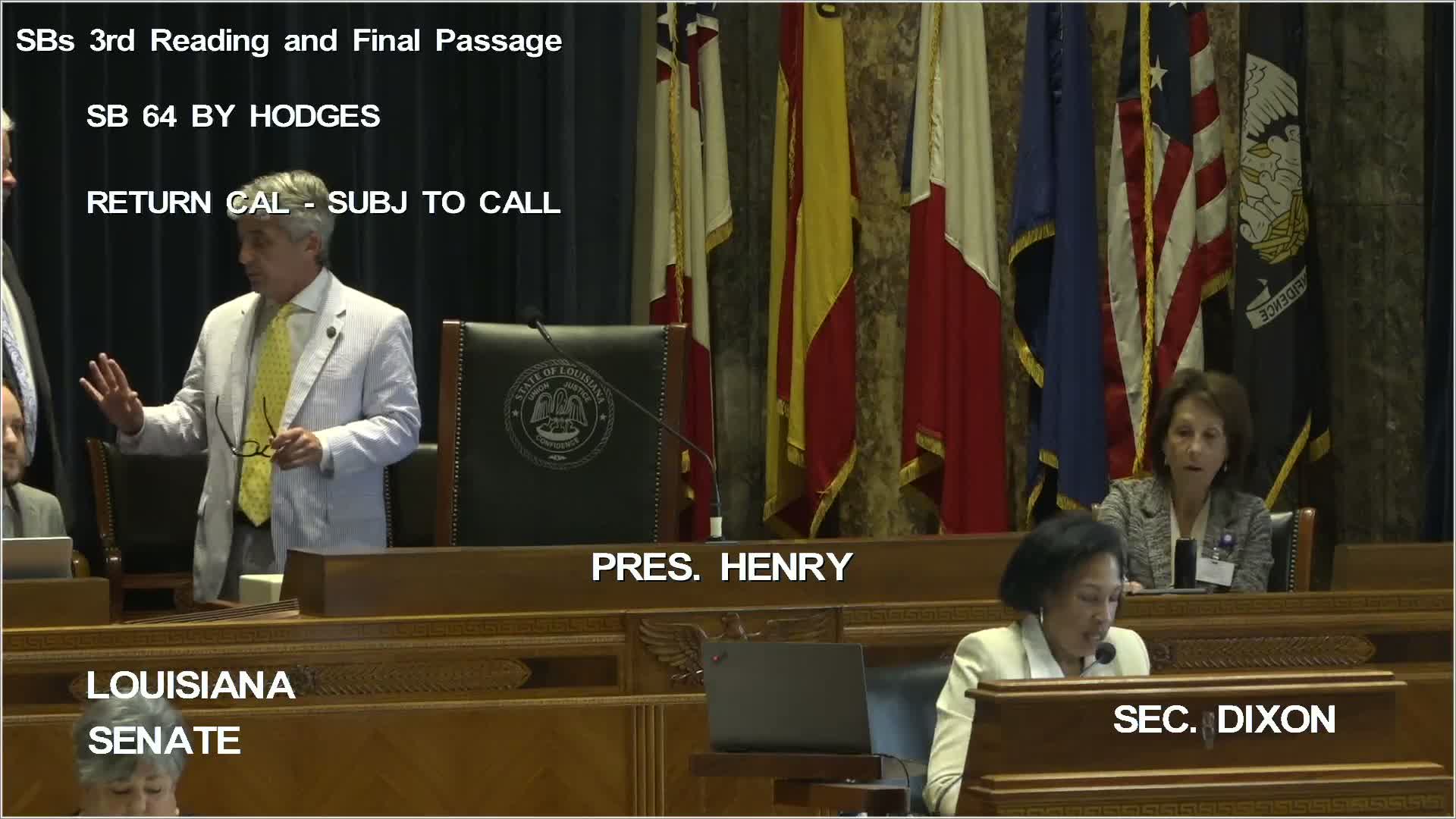
The Louisiana Senate on April 14 voted down Senate Bill 65, a measure that would have relaxed the parent‑vote threshold used to submit applications converting existing public schools into charter schools. Senator Cathy, the bill’s sponsor, framed the measure as restoring the meaningful voice of parents and faculty; opponents warned it could allow a small fraction of parents to move a public school toward a charter without broad community participation.
Supporters said the bill would change the current rule by counting a simple majority of ballots returned rather than treating nonreturned ballots as automatic "no" votes. "Senate Bill 65 fixes that by using a simple majority of those who actually vote," the sponsor said, arguing the current rule effectively silences parents who return ballots. The sponsor also emphasized that the measure only permits an application to be submitted to the Board of Elementary and Secondary Education (BESE) for full review, not an automatic conversion.
Critics repeatedly pressed on practical consequences for taxpayers and local school systems. "This bill lowers the participation of parents in that process," Senator Jackson Andrews said on the floor, urging that property taxpayers and district constituents should have a say when bond indebtedness and school buildings are involved. Questions centered on whether parents could trigger an application in a school with large enrollment if only a small number of ballots were returned and whether bonded indebtedness and facility control could shift to charter operators.
Lawmakers adopted a Morris amendment that added a 25% participation floor — requiring ballots to represent at least 25% of enrolled pupils for a valid election — before later rejecting an Andrews amendment that would have required a districtwide vote of taxpayers in addition to faculty and parents. That Andrews amendment failed on the roll call (15 yeas, 21 nays) after a lengthy exchange over cost and fairness.
Sponsor’s emphasis that the bill merely permits a 600‑page application to be filed with BESE drew repeated floor restatements that BESE retains authority to approve or deny applications and that faculty votes would be protected and made private under the bill. Opponents countered that fiscal and facility consequences (bonds, ongoing maintenance) risk leaving taxpayers with the remaining liabilities if a charter fails.
After prolonged questioning and debate, the secretary closed the voting machines and the clerk announced the result. The tally recorded on the floor showed the bill failed final passage; the clerk corrected and confirmed the final machine tally on the record, and the bill did not advance.
Why it matters: The debate highlighted a statewide policy fault line between expanding parental/faculty control and protecting broader community and taxpayer interests when school property and bond indebtedness are at stake. Proponents said the bill restores democratic weight to those who return ballots; opponents said it lowers participation standards and risks unintended fiscal effects at the local level.
What’s next: With the floor vote failed, SB 65 will not move forward from this session unless refiled or reconsidered by sponsors. Lawmakers did not adopt language permanently transferring bond obligations; sponsors reiterated that BESE retains final approval authority and financial-review steps remain part of the process.
Supporters said the bill would change the current rule by counting a simple majority of ballots returned rather than treating nonreturned ballots as automatic "no" votes. "Senate Bill 65 fixes that by using a simple majority of those who actually vote," the sponsor said, arguing the current rule effectively silences parents who return ballots. The sponsor also emphasized that the measure only permits an application to be submitted to the Board of Elementary and Secondary Education (BESE) for full review, not an automatic conversion.
Critics repeatedly pressed on practical consequences for taxpayers and local school systems. "This bill lowers the participation of parents in that process," Senator Jackson Andrews said on the floor, urging that property taxpayers and district constituents should have a say when bond indebtedness and school buildings are involved. Questions centered on whether parents could trigger an application in a school with large enrollment if only a small number of ballots were returned and whether bonded indebtedness and facility control could shift to charter operators.
Lawmakers adopted a Morris amendment that added a 25% participation floor — requiring ballots to represent at least 25% of enrolled pupils for a valid election — before later rejecting an Andrews amendment that would have required a districtwide vote of taxpayers in addition to faculty and parents. That Andrews amendment failed on the roll call (15 yeas, 21 nays) after a lengthy exchange over cost and fairness.
Sponsor’s emphasis that the bill merely permits a 600‑page application to be filed with BESE drew repeated floor restatements that BESE retains authority to approve or deny applications and that faculty votes would be protected and made private under the bill. Opponents countered that fiscal and facility consequences (bonds, ongoing maintenance) risk leaving taxpayers with the remaining liabilities if a charter fails.
After prolonged questioning and debate, the secretary closed the voting machines and the clerk announced the result. The tally recorded on the floor showed the bill failed final passage; the clerk corrected and confirmed the final machine tally on the record, and the bill did not advance.
Why it matters: The debate highlighted a statewide policy fault line between expanding parental/faculty control and protecting broader community and taxpayer interests when school property and bond indebtedness are at stake. Proponents said the bill restores democratic weight to those who return ballots; opponents said it lowers participation standards and risks unintended fiscal effects at the local level.
What’s next: With the floor vote failed, SB 65 will not move forward from this session unless refiled or reconsidered by sponsors. Lawmakers did not adopt language permanently transferring bond obligations; sponsors reiterated that BESE retains final approval authority and financial-review steps remain part of the process.
View the Full Meeting & All Its Details
This article offers just a summary. Unlock complete video, transcripts, and insights as a Founder Member.
✓
Watch full, unedited meeting videos
✓
Search every word spoken in unlimited transcripts
✓
AI summaries & real-time alerts (all government levels)
✓
Permanent access to expanding government content
30-day money-back guarantee
