Bibb County board reviews rezoning options as enrollment declines
April 17, 2026 | Bibb County, School Districts, Georgia
This article was created by AI summarizing key points discussed. AI makes mistakes, so for full details and context, please refer to the video of the full meeting. Please report any errors so we can fix them. Report an error »
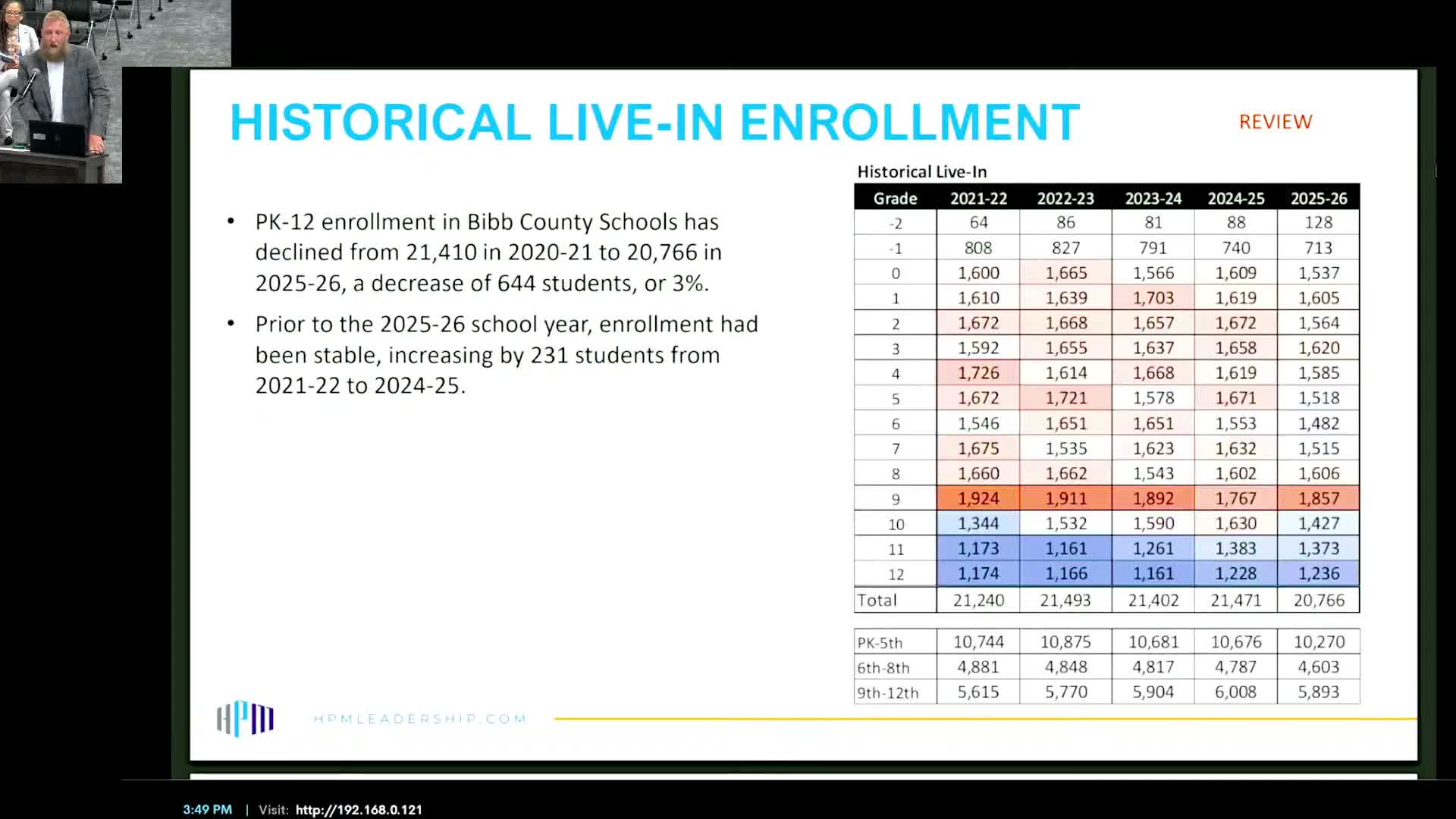
The Bibb County Board of Education heard a detailed presentation Thursday on enrollment trends and preliminary attendance‑zone options that district staff and HBM consultants said are intended to improve facility utilization and feeder patterns.
"We have declined from, you know, a little over 21,000 students in 2020–21 to 20,776 in 2025–26," Scott Leopold of HBM told the board, summarizing the demographic modeling that underpins the review. The consultant said projections show a further decline of roughly 920 students — about 4.4 percent — over the next decade.
Leopold outlined three options for board review. Option 1 is a districtwide rezoning that would change 11 elementary boundaries and five middle‑school boundaries to reduce the number of zoned elementary schools with fewer than 450 K–5 students from nine to seven and to create single feeder paths from middle to high school. Districtwide zoned elementary utilization under that plan would remain approximately 77.6 percent, staff said.
Options 2a and 2b would convert Williams Elementary to an early learning center (pre‑K 3–4) and redistribute Williams students to neighboring schools. Staff said those scenarios would raise zoned elementary utilization to about 80.8 percent and reduce the number of schools under the 450 threshold to six (2a) or seven (2b), but would remove a neighborhood elementary and require capital improvements at the Williams campus.
"These options are not final recommendations but rather starting points," Dr. Levitt told the board, emphasizing that the district will use community feedback to refine any final plan. Staff said an online address‑locator and survey will go live to let families see how each option would affect their assignments, and they scheduled in‑person and virtual town halls on April 20 and April 21.
Board members pressed staff on how the plans would affect transfers, magnet placements and state funding. District staff said transfer and magnet placements were locked in the model, pre‑K enrollment is not included in the state’s K–5 funding threshold, and that the district will return with specific policy citations and cost estimates for staffing and transportation trade‑offs.
Several members voiced concern about the student experience and transportation. "The devil's in the details," Board President Morton said, urging staff to provide clear, school‑level budget impacts before the board commits to a course of action.
What’s next: staff will run supplemental financial and transportation scenarios, provide examples of comparable district models for centralized early learning centers, and collect input at the April town halls before returning to the board with refined recommendations.
"We have declined from, you know, a little over 21,000 students in 2020–21 to 20,776 in 2025–26," Scott Leopold of HBM told the board, summarizing the demographic modeling that underpins the review. The consultant said projections show a further decline of roughly 920 students — about 4.4 percent — over the next decade.
Leopold outlined three options for board review. Option 1 is a districtwide rezoning that would change 11 elementary boundaries and five middle‑school boundaries to reduce the number of zoned elementary schools with fewer than 450 K–5 students from nine to seven and to create single feeder paths from middle to high school. Districtwide zoned elementary utilization under that plan would remain approximately 77.6 percent, staff said.
Options 2a and 2b would convert Williams Elementary to an early learning center (pre‑K 3–4) and redistribute Williams students to neighboring schools. Staff said those scenarios would raise zoned elementary utilization to about 80.8 percent and reduce the number of schools under the 450 threshold to six (2a) or seven (2b), but would remove a neighborhood elementary and require capital improvements at the Williams campus.
"These options are not final recommendations but rather starting points," Dr. Levitt told the board, emphasizing that the district will use community feedback to refine any final plan. Staff said an online address‑locator and survey will go live to let families see how each option would affect their assignments, and they scheduled in‑person and virtual town halls on April 20 and April 21.
Board members pressed staff on how the plans would affect transfers, magnet placements and state funding. District staff said transfer and magnet placements were locked in the model, pre‑K enrollment is not included in the state’s K–5 funding threshold, and that the district will return with specific policy citations and cost estimates for staffing and transportation trade‑offs.
Several members voiced concern about the student experience and transportation. "The devil's in the details," Board President Morton said, urging staff to provide clear, school‑level budget impacts before the board commits to a course of action.
What’s next: staff will run supplemental financial and transportation scenarios, provide examples of comparable district models for centralized early learning centers, and collect input at the April town halls before returning to the board with refined recommendations.
Don't Miss a Word: See the Full Meeting!
Go beyond summaries. Unlock every video, transcript, and key insight with a Founder Membership.
✓
Get instant access to full meeting videos
✓
Search and clip any phrase from complete transcripts
✓
Receive AI-powered summaries & custom alerts
✓
Enjoy lifetime, unrestricted access to government data
30-day money-back guarantee
