Snowmobile association reports mostly safe season, urges higher fines to enforce registration
April 17, 2026 | Transportation, HOUSE OF REPRESENTATIVES, Committees, Legislative , Vermont
This article was created by AI summarizing key points discussed. AI makes mistakes, so for full details and context, please refer to the video of the full meeting. Please report any errors so we can fix them. Report an error »
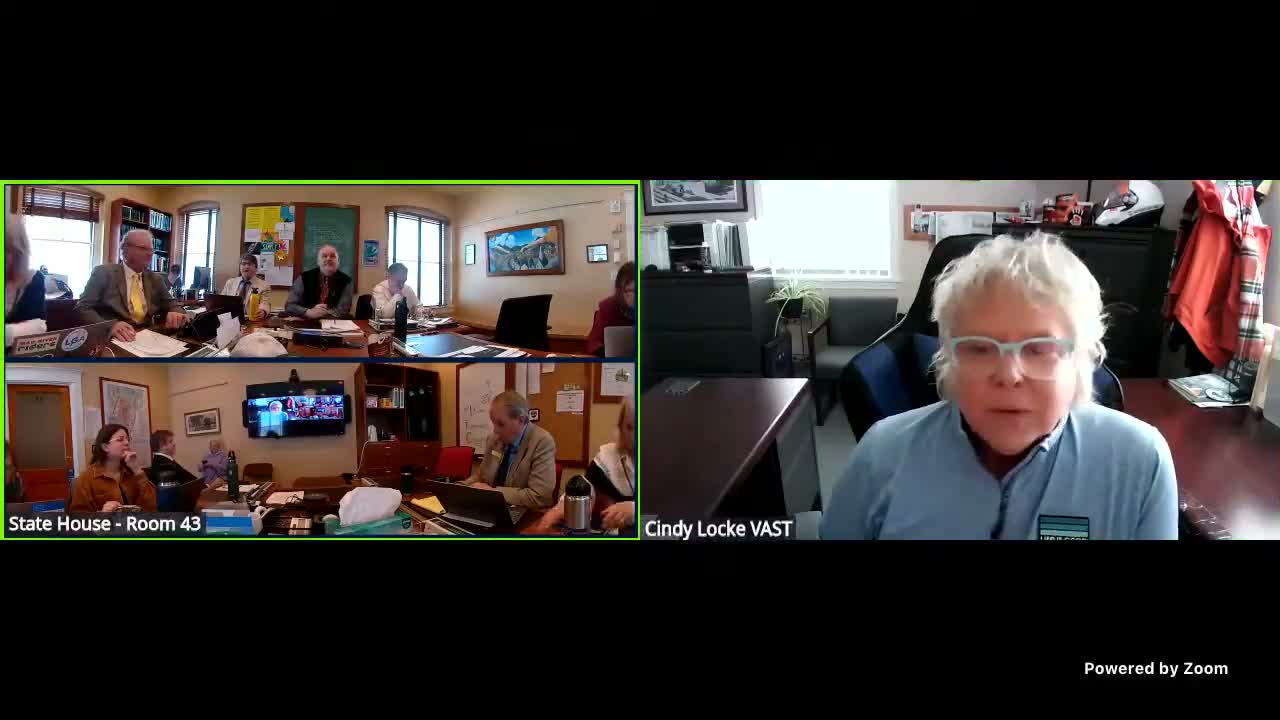
Cindy Locke, executive director of the Vermont Association of Snow Travelers (VAST), told the Vermont House Transportation committee on April 16 that the organization had a strong season overall but saw two serious accidents this winter, including a fatal crash involving a rider with no prior experience or mandatory safety training. Locke said VAST counts about 20,000 members statewide, budgeted roughly $1.2 million for grooming this season and runs a total organization budget of about $4,000,000.
Locke described VAST’s safety infrastructure: about 40 volunteer safety ambassadors who patrol trails in high‑visibility vests, cooperative agreements with state agencies including the Agency of Transportation and Fish and Wildlife, and an in‑house risk retention group that carries $2,000,000 in liability coverage (above a state‑mandated $1,000,000 minimum). "We have very, very high safety standards," Locke said, adding the ambassadors log rides and assist law enforcement when needed.
The association urged the committee to adopt an increase proposed in section 17 of S.326 that would raise penalties for riding without a valid trail pass or registration. Locke said the current on‑the‑spot fine (about $240) is roughly the same as VAST’s most expensive season pass ($235), creating little deterrent for people who "just came up for the day." "We're asking for that increase," she said, arguing a higher fine would push more people to buy passes and ensure riders carry insurance and required safety training.
Representative White and other committee members discussed the scale of the increase; one member referenced a $450 penalty figure while Locke used $400 as an illustrative comparison. Locke emphasized that fines remitted through enforcement are modest — she estimated the organization receives about $8,000 annually in fine revenues — and that most VAST revenue is rebated to local clubs for grooming, fuel and trail maintenance. "Most of that money goes right out the door," Locke said, describing how VAST pays clubs by the mile to groom and supports more than 100 grooming machines statewide.
Locke also recounted two accidents this winter: the Island Pond fatality involving a rider who had never ridden and had not completed the state’s mandatory safety course when required, and a separate Northeast Kingdom incident that Fish and Wildlife believed may have been caused by a medical event and remains under investigation. "We haven't had any fatalities in the last five years until this year," Locke said.
Committee members asked for enforcement and citation trends; Locke offered to provide historic ticketing numbers and said law enforcement partners have urged the penalty increase. The committee did not take a vote on S.326 during the hearing; members said work on the bill would continue and a potential markup depends on floor scheduling.
The committee adjourned until the next scheduled session.
Locke described VAST’s safety infrastructure: about 40 volunteer safety ambassadors who patrol trails in high‑visibility vests, cooperative agreements with state agencies including the Agency of Transportation and Fish and Wildlife, and an in‑house risk retention group that carries $2,000,000 in liability coverage (above a state‑mandated $1,000,000 minimum). "We have very, very high safety standards," Locke said, adding the ambassadors log rides and assist law enforcement when needed.
The association urged the committee to adopt an increase proposed in section 17 of S.326 that would raise penalties for riding without a valid trail pass or registration. Locke said the current on‑the‑spot fine (about $240) is roughly the same as VAST’s most expensive season pass ($235), creating little deterrent for people who "just came up for the day." "We're asking for that increase," she said, arguing a higher fine would push more people to buy passes and ensure riders carry insurance and required safety training.
Representative White and other committee members discussed the scale of the increase; one member referenced a $450 penalty figure while Locke used $400 as an illustrative comparison. Locke emphasized that fines remitted through enforcement are modest — she estimated the organization receives about $8,000 annually in fine revenues — and that most VAST revenue is rebated to local clubs for grooming, fuel and trail maintenance. "Most of that money goes right out the door," Locke said, describing how VAST pays clubs by the mile to groom and supports more than 100 grooming machines statewide.
Locke also recounted two accidents this winter: the Island Pond fatality involving a rider who had never ridden and had not completed the state’s mandatory safety course when required, and a separate Northeast Kingdom incident that Fish and Wildlife believed may have been caused by a medical event and remains under investigation. "We haven't had any fatalities in the last five years until this year," Locke said.
Committee members asked for enforcement and citation trends; Locke offered to provide historic ticketing numbers and said law enforcement partners have urged the penalty increase. The committee did not take a vote on S.326 during the hearing; members said work on the bill would continue and a potential markup depends on floor scheduling.
The committee adjourned until the next scheduled session.
View the Full Meeting & All Its Details
This article offers just a summary. Unlock complete video, transcripts, and insights as a Founder Member.
✓
Watch full, unedited meeting videos
✓
Search every word spoken in unlimited transcripts
✓
AI summaries & real-time alerts (all government levels)
✓
Permanent access to expanding government content
30-day money-back guarantee
