Committee approves bill to require campuses with health centers to provide medication abortion access; sponsors add exemptions and clarifications
April 16, 2026 | 2026 Legislature CO, Colorado
This article was created by AI summarizing key points discussed. AI makes mistakes, so for full details and context, please refer to the video of the full meeting. Please report any errors so we can fix them. Report an error »
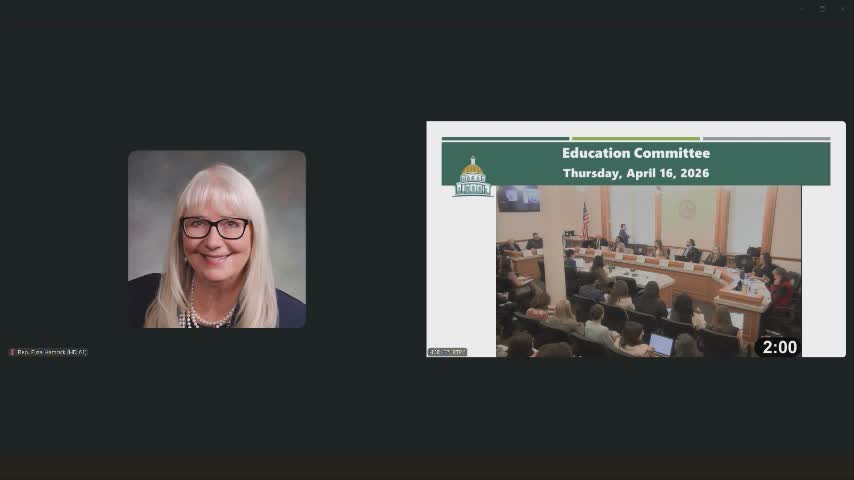
Rep. Winn and Rep. Garcia introduced House Bill 13‑35, which would require institutes of higher education that operate student health centers to ensure medication abortion is accessible to enrolled students either by stocking medication on site, arranging off‑site pharmacy access, or through prescriptions dispensed to students. The sponsors emphasized equity and timeliness: "This bill predominantly just again, I wanna emphasize that it just requires campuses with health centers that provide reproductive health care or primary care to provide medication access," Rep. Winn said.
Supporters—students, campus health providers and reproductive‑rights organizations—argued the measure closes logistical barriers for students who lack transportation, live out‑of‑state, or cannot easily access clinics off campus. "When they need time‑sensitive reproductive health care, transportation cost and confidentiality become major obstacles," said Cathia Garcia of Planned Parenthood of the Rocky Mountains.
Opponents included medical professionals, rural district leaders, and several advocacy organizations who raised multiple implementation concerns: whether campus health centers have ultrasound and imaging capacity to confirm gestational age and exclude ectopic pregnancy, how clinics would manage complications, training and OSHA‑style handling of biohazard events in residential settings, and how costs would be borne. Several speakers referred to recent insurance‑claims analyses and urged clearer medical standards, data collection and conscience protections.
Committee sponsors offered three committee amendments that: (1) protect institutions that would violate federal grant requirements (L1); (2) clarify off‑site prescription and privacy language (L2); and (3) narrow the institutional exemption language to "sincerely held" religious objections as requested (L3). Two committee amendments proposing (a) an on‑campus requirement to stock reversal‑medication and (b) an institutional opt‑out notification were considered; one failed and others were adopted in modified form. Fiscal analysts said the committee fiscal note showed no direct state appropriation because institutions could use institutional revenue or patient billing to cover costs; witnesses cited widely differing implementation cost estimates from other states and institutions and urged continued fiscal study.
After amendments, the committee voted 8–5 to pass HB 13‑35 to the Committee of the Whole with a favorable recommendation. Sponsors said the bill is intended to operationalize the constitutional right adopted by voters while preserving flexibility for health centers and exemptions for institutions with conflicting federal obligations.
Supporters—students, campus health providers and reproductive‑rights organizations—argued the measure closes logistical barriers for students who lack transportation, live out‑of‑state, or cannot easily access clinics off campus. "When they need time‑sensitive reproductive health care, transportation cost and confidentiality become major obstacles," said Cathia Garcia of Planned Parenthood of the Rocky Mountains.
Opponents included medical professionals, rural district leaders, and several advocacy organizations who raised multiple implementation concerns: whether campus health centers have ultrasound and imaging capacity to confirm gestational age and exclude ectopic pregnancy, how clinics would manage complications, training and OSHA‑style handling of biohazard events in residential settings, and how costs would be borne. Several speakers referred to recent insurance‑claims analyses and urged clearer medical standards, data collection and conscience protections.
Committee sponsors offered three committee amendments that: (1) protect institutions that would violate federal grant requirements (L1); (2) clarify off‑site prescription and privacy language (L2); and (3) narrow the institutional exemption language to "sincerely held" religious objections as requested (L3). Two committee amendments proposing (a) an on‑campus requirement to stock reversal‑medication and (b) an institutional opt‑out notification were considered; one failed and others were adopted in modified form. Fiscal analysts said the committee fiscal note showed no direct state appropriation because institutions could use institutional revenue or patient billing to cover costs; witnesses cited widely differing implementation cost estimates from other states and institutions and urged continued fiscal study.
After amendments, the committee voted 8–5 to pass HB 13‑35 to the Committee of the Whole with a favorable recommendation. Sponsors said the bill is intended to operationalize the constitutional right adopted by voters while preserving flexibility for health centers and exemptions for institutions with conflicting federal obligations.
View the Full Meeting & All Its Details
This article offers just a summary. Unlock complete video, transcripts, and insights as a Founder Member.
✓
Watch full, unedited meeting videos
✓
Search every word spoken in unlimited transcripts
✓
AI summaries & real-time alerts (all government levels)
✓
Permanent access to expanding government content
30-day money-back guarantee
