Developer says six Seattle ordinances destroyed value of affordable-housing property; city urges legal limits on takings claims
April 16, 2026 | Other Court, Judicial , Washington
This article was created by AI summarizing key points discussed. AI makes mistakes, so for full details and context, please refer to the video of the full meeting. Please report any errors so we can fix them. Report an error »
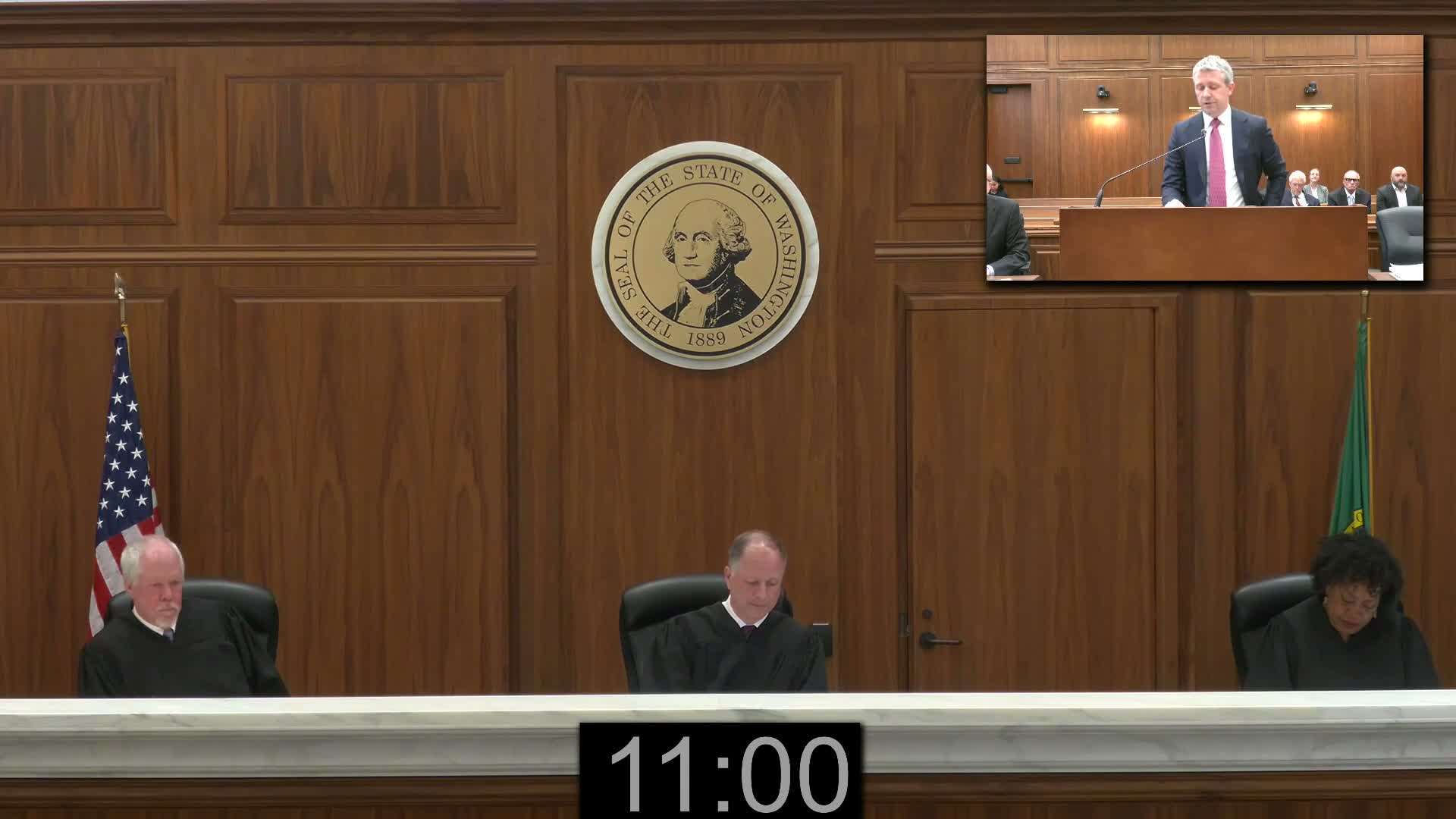
Scott Pritchard, counsel for appellant GRE Downtowner LLC, told the court that six ordinances passed by the City of Seattle “operated together to destroy the value of the Addison,” an affordable‑housing complex in Seattle, and that GRE is in default on its mortgage as of November 2023. Pritchard said vacancy rates rose to nearly 45 percent, rent collections fell from roughly 93 percent to below 45 percent, bad debt jumped from about $40,000 per year to more than $500,000 in 2022, and that the property now “loses over 2,700,000 per year.” He said GRE invested $39,000,000 in the Addison and that, on an income‑approach valuation, the property is functionally valueless.
Pritchard framed the complaint as two complementary claims. First, he said GRE plausibly pleaded a regulatory‑takings claim under Penn Central by alleging facts showing the ordinances cumulatively upended reasonable investment‑backed expectations for a project that had operated sustainably under the LIHTC regime. Second, he said a separate physical‑takings theory is supported by the roommate ordinance and eviction moratoria because, in his view, those measures can effectively authorize third‑party occupancy that eliminates a landlord’s right to exclude. He argued that Maple Bear (a 2023 Washington Supreme Court decision) and other precedent show Penn Central inquiries are fact‑intensive and that dismissal under CR 12(b)(6) improperly resolved disputed factual issues.
The City of Seattle, through counsel Roger Wynne, urged a different approach. Wynne argued the proper limitations period for regulatory‑takings claims should be three years (the limitations period for injury to person or rights of another) rather than a ten‑year adverse‑possession period that applies to direct appropriation claims under Peterson and Highline. He told the court that, under controlling takings law, the Penn Central economic‑impact prong measures what a hypothetical buyer would pay for the property once it is encumbered by the regulation, not the operator’s lost profits, and that many of GRE’s alleged business losses are therefore not the kind of property‑value diminution that Penn Central protects.
Wynne also disputed the physical‑invasion framing of the roommate ordinance, saying the ordinance regulates the landlord‑tenant relationship (tenants may invite people up to occupancy limits while landlords retain screening and exclusion rights subject to narrow exceptions) and that treating such rules as per se invasions would threaten housing and anti‑discrimination laws. He cited Washington decisions he described as endorsing a landlord‑tenant line of cases and urged that the court fill any limitations‑period gap left by the Supreme Court cautiously, pointing to Valley View and Orion as guidance that Peterson is not dispositive for all regulatory‑takings claims.
The court engaged both sides at length on legal standards. One judge questioned whether investors in a highly regulated sector must simply accept regulatory change; another queried whether the sheer number of ordinances could matter if many were adopted in a short span. Pritchard stressed the complaint’s level of pleaded detail and the combination of measures (six ordinances) that he said together produced an exceptional and destructive outcome for the Addison. Wynne pushed back that case law does not support a cumulative‑impact theory that converts broad regulatory regimes into takings claims and emphasized the distinction between business‑level harms and diminution in market value attributable to legal encumbrances.
No ruling is recorded in the transcript. Counsel reserved time for rebuttal and the argument concluded with the court thanking counsel and ending the calendar for the day.
Pritchard framed the complaint as two complementary claims. First, he said GRE plausibly pleaded a regulatory‑takings claim under Penn Central by alleging facts showing the ordinances cumulatively upended reasonable investment‑backed expectations for a project that had operated sustainably under the LIHTC regime. Second, he said a separate physical‑takings theory is supported by the roommate ordinance and eviction moratoria because, in his view, those measures can effectively authorize third‑party occupancy that eliminates a landlord’s right to exclude. He argued that Maple Bear (a 2023 Washington Supreme Court decision) and other precedent show Penn Central inquiries are fact‑intensive and that dismissal under CR 12(b)(6) improperly resolved disputed factual issues.
The City of Seattle, through counsel Roger Wynne, urged a different approach. Wynne argued the proper limitations period for regulatory‑takings claims should be three years (the limitations period for injury to person or rights of another) rather than a ten‑year adverse‑possession period that applies to direct appropriation claims under Peterson and Highline. He told the court that, under controlling takings law, the Penn Central economic‑impact prong measures what a hypothetical buyer would pay for the property once it is encumbered by the regulation, not the operator’s lost profits, and that many of GRE’s alleged business losses are therefore not the kind of property‑value diminution that Penn Central protects.
Wynne also disputed the physical‑invasion framing of the roommate ordinance, saying the ordinance regulates the landlord‑tenant relationship (tenants may invite people up to occupancy limits while landlords retain screening and exclusion rights subject to narrow exceptions) and that treating such rules as per se invasions would threaten housing and anti‑discrimination laws. He cited Washington decisions he described as endorsing a landlord‑tenant line of cases and urged that the court fill any limitations‑period gap left by the Supreme Court cautiously, pointing to Valley View and Orion as guidance that Peterson is not dispositive for all regulatory‑takings claims.
The court engaged both sides at length on legal standards. One judge questioned whether investors in a highly regulated sector must simply accept regulatory change; another queried whether the sheer number of ordinances could matter if many were adopted in a short span. Pritchard stressed the complaint’s level of pleaded detail and the combination of measures (six ordinances) that he said together produced an exceptional and destructive outcome for the Addison. Wynne pushed back that case law does not support a cumulative‑impact theory that converts broad regulatory regimes into takings claims and emphasized the distinction between business‑level harms and diminution in market value attributable to legal encumbrances.
No ruling is recorded in the transcript. Counsel reserved time for rebuttal and the argument concluded with the court thanking counsel and ending the calendar for the day.
View the Full Meeting & All Its Details
This article offers just a summary. Unlock complete video, transcripts, and insights as a Founder Member.
✓
Watch full, unedited meeting videos
✓
Search every word spoken in unlimited transcripts
✓
AI summaries & real-time alerts (all government levels)
✓
Permanent access to expanding government content
30-day money-back guarantee
