Panel hears hours of opposition and support for optional split mill levy; proposal is postponed indefinitely
April 16, 2026 | 2026 Legislature CO, Colorado
This article was created by AI summarizing key points discussed. AI makes mistakes, so for full details and context, please refer to the video of the full meeting. Please report any errors so we can fix them. Report an error »
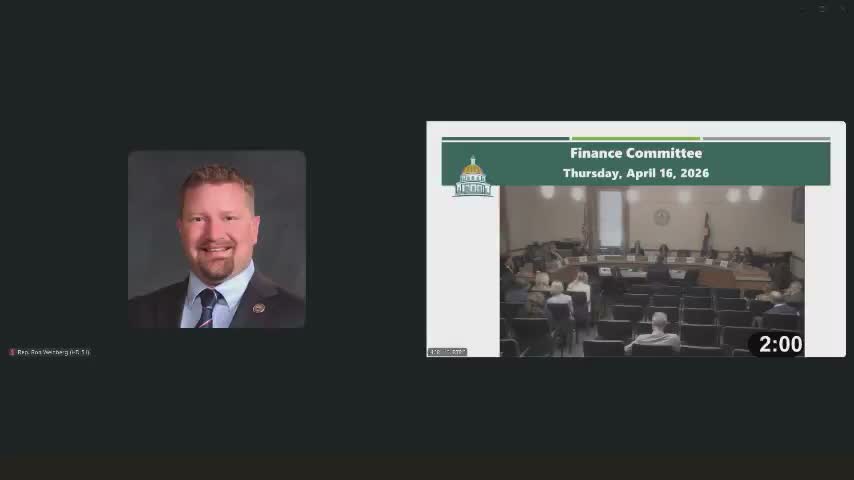
Representatives and a broad cross section of local government officials, business groups, housing advocates and economists spent hours on April 17 debating House Bill 11‑19, a proposal to allow local governments to adopt an optional split mill levy that would tax land at a higher rate and buildings at a lower rate.
Representative Woodrow, the bill sponsor, framed the measure as an opt‑in tool to encourage infill, housing construction and maintenance by reducing the tax penalty for improving property. "This bill gives locals the option to split their property tax mill levy so that the tax rate on buildings...is lower, and the tax rate on land is higher," he told the committee, saying the measure is voluntary and must be revenue neutral.
Assessors and county officials testified in unified opposition, citing complex implementation issues, legal concerns and distributional effects. Brenda Donas, Weld County Assessor, told the committee the change "creates winners and losers" parcel‑by‑parcel, with small single‑story buildings and manufactured homes likely to face higher taxes while larger, multi‑story structures could see decreases. She estimated software and county implementation costs could be substantial and argued the bill would not be cost‑neutral for local governments.
Multiple witnesses warned of impacts to tax increment financing (TIF) and urban renewal projects, saying lowering the levy on improvements would reduce the increment that repays redevelopment bonds. Monica Babbitt, executive director of the Colorado Assessors Association, testified that roughly 300 active TIF projects statewide could be affected and said the methodology for calculating increment revenue is set by the property tax administrator.
Legal and bond‑market concerns were also raised. Tiffany Leachman, a bond counsel, cited constitutional questions tied to Colorado’s uniformity requirement and warned investors and municipal bond underwriters could view split levies as a destabilizing change that would affect bond ratings and market access.
Supporters included housing advocates, economists and researchers who said the option could reduce land speculation and encourage redevelopment. Kevin Matthews of UB Denver said split rates are "not a tax increase. It is a rebalancing and effectively a tax exemption on new construction," and researchers presented assessor‑data models suggesting many lower‑income neighborhoods could see net tax decreases under some implementations.
In response to testimony, the sponsor offered three amendments: a mandatory two‑year lag between a local opt‑in decision and implementation to give counties time to upgrade systems; an explicit exclusion for urban renewal authorities and downtown development authorities (TIF areas); and an expansion of the scope of contracted property tax audits to review how counties assess land values. Committee members adopted each amendment without objection.
After extended questioning and debate, Representative Woodrow moved HB 11‑19 as amended to the committee on appropriations with a favorable recommendation. The motion failed on a recorded committee poll, 3–8. A subsequent motion to postpone the bill indefinitely passed by reverse roll call, and the committee concluded its consideration for the day.
Committee members voiced mixed views in closing. Supporters urged further study and local pilots; opponents cautioned that the state’s complex property tax systems, TIF commitments, potential pass‑through risks to tenants in mobile home parks, and legal questions make the change premature without more guardrails.
Representative Woodrow, the bill sponsor, framed the measure as an opt‑in tool to encourage infill, housing construction and maintenance by reducing the tax penalty for improving property. "This bill gives locals the option to split their property tax mill levy so that the tax rate on buildings...is lower, and the tax rate on land is higher," he told the committee, saying the measure is voluntary and must be revenue neutral.
Assessors and county officials testified in unified opposition, citing complex implementation issues, legal concerns and distributional effects. Brenda Donas, Weld County Assessor, told the committee the change "creates winners and losers" parcel‑by‑parcel, with small single‑story buildings and manufactured homes likely to face higher taxes while larger, multi‑story structures could see decreases. She estimated software and county implementation costs could be substantial and argued the bill would not be cost‑neutral for local governments.
Multiple witnesses warned of impacts to tax increment financing (TIF) and urban renewal projects, saying lowering the levy on improvements would reduce the increment that repays redevelopment bonds. Monica Babbitt, executive director of the Colorado Assessors Association, testified that roughly 300 active TIF projects statewide could be affected and said the methodology for calculating increment revenue is set by the property tax administrator.
Legal and bond‑market concerns were also raised. Tiffany Leachman, a bond counsel, cited constitutional questions tied to Colorado’s uniformity requirement and warned investors and municipal bond underwriters could view split levies as a destabilizing change that would affect bond ratings and market access.
Supporters included housing advocates, economists and researchers who said the option could reduce land speculation and encourage redevelopment. Kevin Matthews of UB Denver said split rates are "not a tax increase. It is a rebalancing and effectively a tax exemption on new construction," and researchers presented assessor‑data models suggesting many lower‑income neighborhoods could see net tax decreases under some implementations.
In response to testimony, the sponsor offered three amendments: a mandatory two‑year lag between a local opt‑in decision and implementation to give counties time to upgrade systems; an explicit exclusion for urban renewal authorities and downtown development authorities (TIF areas); and an expansion of the scope of contracted property tax audits to review how counties assess land values. Committee members adopted each amendment without objection.
After extended questioning and debate, Representative Woodrow moved HB 11‑19 as amended to the committee on appropriations with a favorable recommendation. The motion failed on a recorded committee poll, 3–8. A subsequent motion to postpone the bill indefinitely passed by reverse roll call, and the committee concluded its consideration for the day.
Committee members voiced mixed views in closing. Supporters urged further study and local pilots; opponents cautioned that the state’s complex property tax systems, TIF commitments, potential pass‑through risks to tenants in mobile home parks, and legal questions make the change premature without more guardrails.
Don't Miss a Word: See the Full Meeting!
Go beyond summaries. Unlock every video, transcript, and key insight with a Founder Membership.
✓
Get instant access to full meeting videos
✓
Search and clip any phrase from complete transcripts
✓
Receive AI-powered summaries & custom alerts
✓
Enjoy lifetime, unrestricted access to government data
30-day money-back guarantee
