District outlines special-education staffing gaps and recruitment options
April 13, 2026 | South Portland Public Schools, School Districts, Maine
This article was created by AI summarizing key points discussed. AI makes mistakes, so for full details and context, please refer to the video of the full meeting. Please report any errors so we can fix them. Report an error »
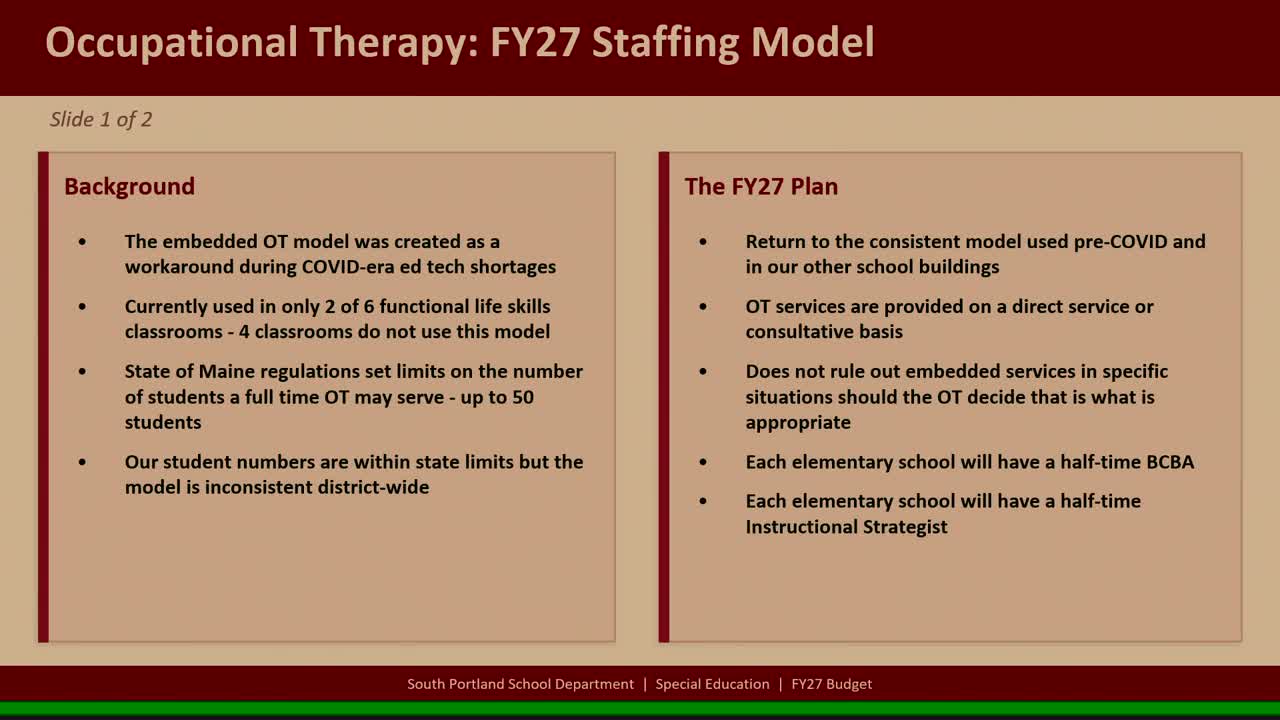
District instructional staff told the board the special-education program is strained by staffing shortages and the board discussed recruitment strategies and trade-offs.
"The change now would leave us with 3.8 OTs in the district," Kat Cox, director of instructional support, said while explaining the embedded occupational-therapy model that the district adopted near the end of the COVID era to increase coverage in life-skills classrooms.
Cox outlined the embedded-OT approach and said some equipment or interventions (slant boards, stools, adaptive devices) are focused supports that vary by classroom. She also said the state guidance frames caseload expectations (an OT could be expected to carry up to 190 students under state guidance), but she cautioned that those numbers are not advocacy targets.
To address EdTech shortages and flexible staffing needs, Cox recommended exploring referral incentive programs, using hiring platforms such as Indeed or ZipRecruiter in a fuller capacity, and evaluating vetted outside agencies for behavior clinicians (BCBAs) while acknowledging supervision and oversight trade-offs for subcontracted staff. Board members asked about exit interviews, data collection on turnover and the cost trade-offs between subcontracting and hiring.
Finance director Abigail Ketchin reiterated budget constraints that frame staffing decisions and offered examples of what modest local tax increases could yield in additional dollars for personnel and programs.
Next steps: district staff will follow up with more detailed numbers on current EdTech counts and return to the board with recruitment cost estimates and possible partnership options.
"The change now would leave us with 3.8 OTs in the district," Kat Cox, director of instructional support, said while explaining the embedded occupational-therapy model that the district adopted near the end of the COVID era to increase coverage in life-skills classrooms.
Cox outlined the embedded-OT approach and said some equipment or interventions (slant boards, stools, adaptive devices) are focused supports that vary by classroom. She also said the state guidance frames caseload expectations (an OT could be expected to carry up to 190 students under state guidance), but she cautioned that those numbers are not advocacy targets.
To address EdTech shortages and flexible staffing needs, Cox recommended exploring referral incentive programs, using hiring platforms such as Indeed or ZipRecruiter in a fuller capacity, and evaluating vetted outside agencies for behavior clinicians (BCBAs) while acknowledging supervision and oversight trade-offs for subcontracted staff. Board members asked about exit interviews, data collection on turnover and the cost trade-offs between subcontracting and hiring.
Finance director Abigail Ketchin reiterated budget constraints that frame staffing decisions and offered examples of what modest local tax increases could yield in additional dollars for personnel and programs.
Next steps: district staff will follow up with more detailed numbers on current EdTech counts and return to the board with recruitment cost estimates and possible partnership options.
View the Full Meeting & All Its Details
This article offers just a summary. Unlock complete video, transcripts, and insights as a Founder Member.
✓
Watch full, unedited meeting videos
✓
Search every word spoken in unlimited transcripts
✓
AI summaries & real-time alerts (all government levels)
✓
Permanent access to expanding government content
30-day money-back guarantee
