House committee weighs letting lenders also administer Vermont commercial PACE program
April 16, 2026 | Commerce & Economic Development, HOUSE OF REPRESENTATIVES, Committees, Legislative , Vermont
This article was created by AI summarizing key points discussed. AI makes mistakes, so for full details and context, please refer to the video of the full meeting. Please report any errors so we can fix them. Report an error »
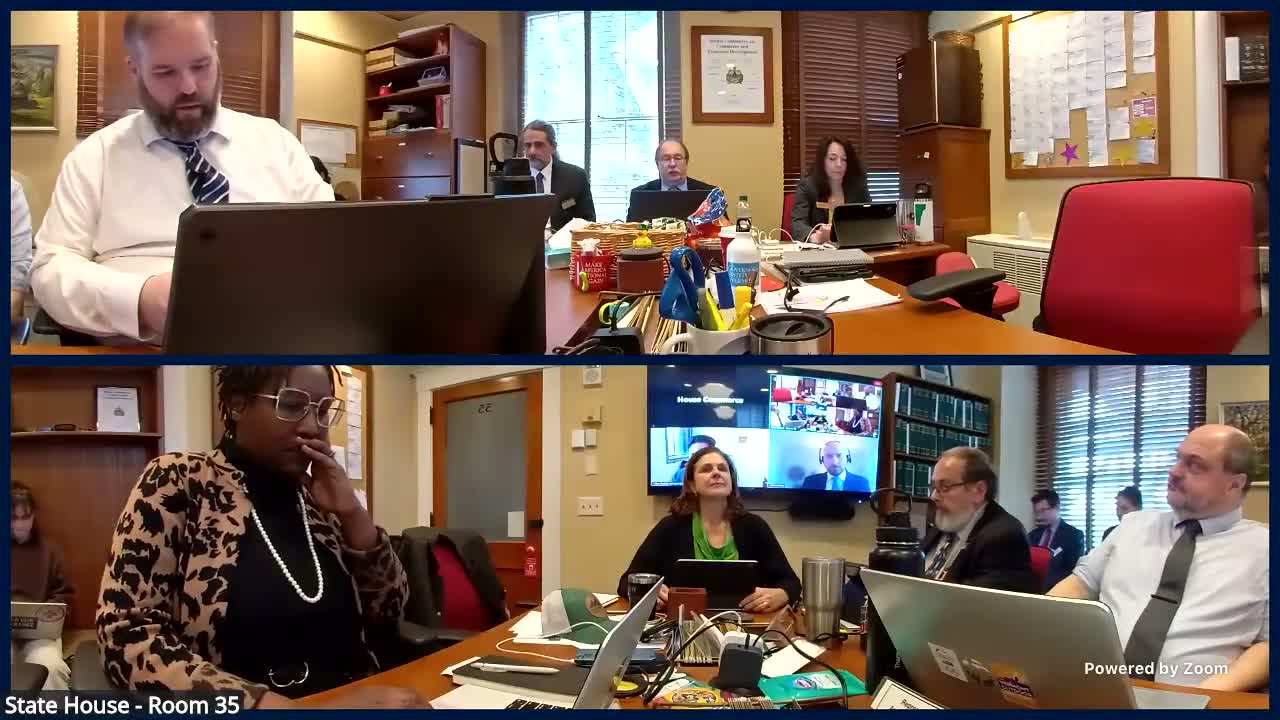
The Vermont House Committee on Commerce & Economic Development continued work on draft S.327 on April 15, focusing on a commercial property-assessed clean energy (CPACE) provision. Joan Goldstein of VIDA testified that VIDA supports the legislation and would like to participate as a lender in the program, while urging several technical changes to the draft.
Goldstein told the committee VIDA "support[s] the bill" and recommended replacing references to "assessed value" with "appraised or stabilized value" to better reflect commercial practice. She also said the bill's most recent draft had spelled out resiliency measures and that she had recommended clarifying when projects must "meet or exceed" code; Goldstein asked whether projects done above code could inadvertently be made ineligible by the current wording.
Sam Buckley, an engineer at VIDA, added that much of the administrative work for CPACE occurs at origination and that a lender could feasibly serve both as lender and administrator. "A lot of the administrative role occurs upfront, in conjunction with origination," Buckley said, arguing this model could reduce barriers for smaller municipalities that lack capacity to administer the program.
Peter Wach, managing director of Efficiency Vermont, said the agency does not see itself as the natural administrator for a commercial CPACE program because it lacks lending expertise. He urged the committee to "let the market emerge" and said that entities such as VIDA or other Vermont lenders with public-interest missions might fit both roles if needed.
Committee members raised conflict-of-interest concerns cited by the Department of Financial Regulation (DFR). Joe Valente, director of policy at DFR, described the department's hypothetical worry that an administrator who is also a lender might steer applicants or create an appearance of favoritism. Valente said licensing and statutory oversight (for loans under $1,000,000, lenders must be licensed by DFR) and options such as multiple administrators or an approval step could mitigate those risks.
The committee's discussion moved toward leaving the statute permissive. The chair proposed removing language that would prohibit a lender from also serving as administrator and to drop a separate study provision, saying the committee should "leave the doors open a little bit to see if there's really interest" before erecting barriers. Several members agreed to remove the prohibition for now and to revisit any needed guardrails if conflicts arise with market uptake.
Next steps: counsel will insert the CPACE-related committee language into draft S.327 for the next meeting, and members indicated they will invite DFR and other agencies back to answer follow-up questions. The committee set follow-up work to identify exact statutory wording—particularly the "meet or exceed" phrasing Goldstein requested—and to check cross-references in the bill.
Goldstein told the committee VIDA "support[s] the bill" and recommended replacing references to "assessed value" with "appraised or stabilized value" to better reflect commercial practice. She also said the bill's most recent draft had spelled out resiliency measures and that she had recommended clarifying when projects must "meet or exceed" code; Goldstein asked whether projects done above code could inadvertently be made ineligible by the current wording.
Sam Buckley, an engineer at VIDA, added that much of the administrative work for CPACE occurs at origination and that a lender could feasibly serve both as lender and administrator. "A lot of the administrative role occurs upfront, in conjunction with origination," Buckley said, arguing this model could reduce barriers for smaller municipalities that lack capacity to administer the program.
Peter Wach, managing director of Efficiency Vermont, said the agency does not see itself as the natural administrator for a commercial CPACE program because it lacks lending expertise. He urged the committee to "let the market emerge" and said that entities such as VIDA or other Vermont lenders with public-interest missions might fit both roles if needed.
Committee members raised conflict-of-interest concerns cited by the Department of Financial Regulation (DFR). Joe Valente, director of policy at DFR, described the department's hypothetical worry that an administrator who is also a lender might steer applicants or create an appearance of favoritism. Valente said licensing and statutory oversight (for loans under $1,000,000, lenders must be licensed by DFR) and options such as multiple administrators or an approval step could mitigate those risks.
The committee's discussion moved toward leaving the statute permissive. The chair proposed removing language that would prohibit a lender from also serving as administrator and to drop a separate study provision, saying the committee should "leave the doors open a little bit to see if there's really interest" before erecting barriers. Several members agreed to remove the prohibition for now and to revisit any needed guardrails if conflicts arise with market uptake.
Next steps: counsel will insert the CPACE-related committee language into draft S.327 for the next meeting, and members indicated they will invite DFR and other agencies back to answer follow-up questions. The committee set follow-up work to identify exact statutory wording—particularly the "meet or exceed" phrasing Goldstein requested—and to check cross-references in the bill.
Don't Miss a Word: See the Full Meeting!
Go beyond summaries. Unlock every video, transcript, and key insight with a Founder Membership.
✓
Get instant access to full meeting videos
✓
Search and clip any phrase from complete transcripts
✓
Receive AI-powered summaries & custom alerts
✓
Enjoy lifetime, unrestricted access to government data
30-day money-back guarantee
