Spokane Valley council signals consensus for Scenario A in comprehensive-plan update
April 14, 2026 | Spokane Valley, Spokane County, Washington
This article was created by AI summarizing key points discussed. AI makes mistakes, so for full details and context, please refer to the video of the full meeting. Please report any errors so we can fix them. Report an error »
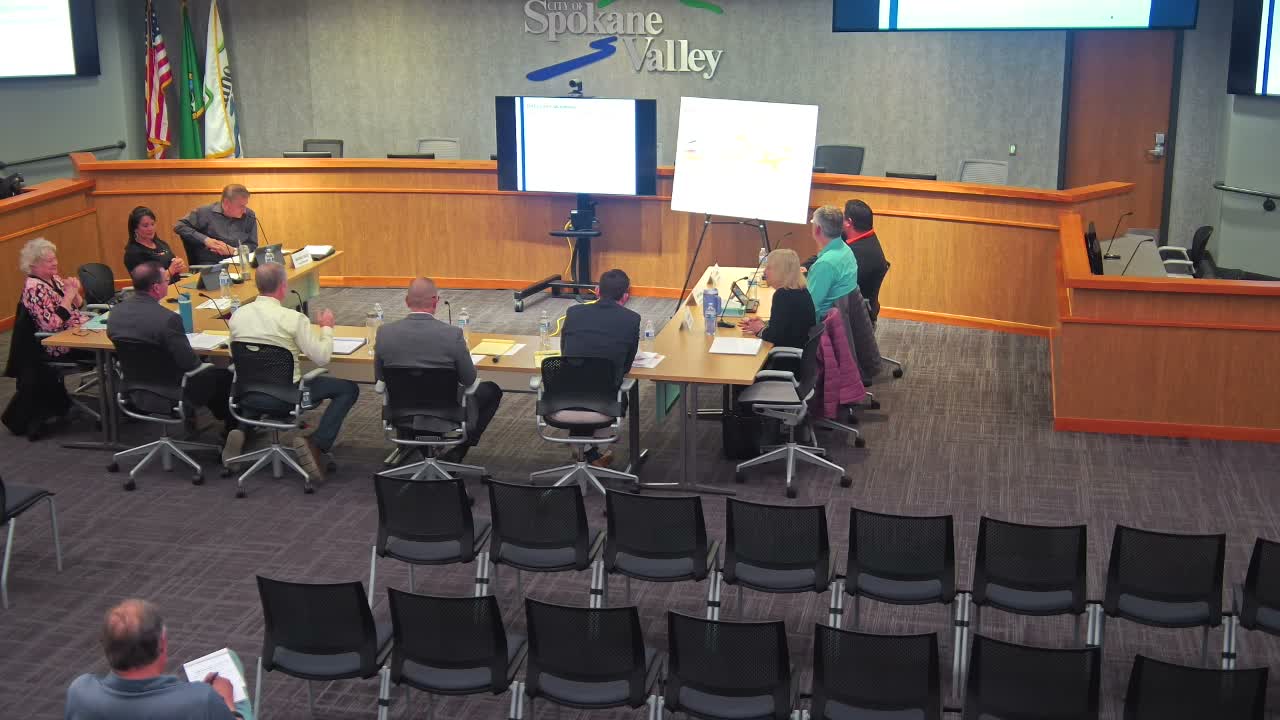
The Spokane Valley City Council on April 14 reviewed draft elements of its 2026 comprehensive plan update and signaled consensus to move forward with land‑use Scenario A, staff said.
Mike Basinger, the city’s Community and Economic Development Director, told the council the draft retains the city’s long-standing focus on concentrating growth along the Sprague Corridor and preserving flexible quarter mixed‑use zoning. Basinger said the approach aims to “meet some of our affordability targets without disrupting some of our residential neighborhoods” by directing development toward corridors served by transit and existing sewer infrastructure.
Consultants briefed the council on two land‑use scenarios prepared to meet the state’s housing allocation. Elliot, a consultant leading the housing analysis, told members the scenarios and associated density calculations were developed to show compliance with state requirements and to support a subsequent environmental impact statement and development regulations work.
Council members pressed for clarity about what each scenario would mean for homeownership and neighborhood character. Councilmember Yeager stressed that homeownership should remain a priority, saying the city should “help people get on the housing ladder,” while Councilmember Wick urged that denser growth be focused near services and not spread through existing single‑family neighborhoods.
After additional discussion about localized concerns — including Auto Row dealerships and how corridor versus neighborhood density could evolve — the mayor asked for a show of hands on Scenario A. The mayor announced that four of six members raised their hands in favor; staff said they would proceed with Scenario A and return development regulations and feasibility analyses for review.
Staff and the consultant team also committed to follow up on implementation details and to invite developer Jim Frank to a future workshop to discuss alternative housing typologies and how to support ownership options such as cottages, townhomes and condominiums rather than only large rental complexes.
The meeting closed after routine business. A formal motion to adjourn was made and approved by voice vote.
What happens next: staff will continue drafting the land‑use map and development regulations tied to Scenario A, conduct the environmental review, and return refined policy language and feasibility analysis for the council’s review in coming months.
Mike Basinger, the city’s Community and Economic Development Director, told the council the draft retains the city’s long-standing focus on concentrating growth along the Sprague Corridor and preserving flexible quarter mixed‑use zoning. Basinger said the approach aims to “meet some of our affordability targets without disrupting some of our residential neighborhoods” by directing development toward corridors served by transit and existing sewer infrastructure.
Consultants briefed the council on two land‑use scenarios prepared to meet the state’s housing allocation. Elliot, a consultant leading the housing analysis, told members the scenarios and associated density calculations were developed to show compliance with state requirements and to support a subsequent environmental impact statement and development regulations work.
Council members pressed for clarity about what each scenario would mean for homeownership and neighborhood character. Councilmember Yeager stressed that homeownership should remain a priority, saying the city should “help people get on the housing ladder,” while Councilmember Wick urged that denser growth be focused near services and not spread through existing single‑family neighborhoods.
After additional discussion about localized concerns — including Auto Row dealerships and how corridor versus neighborhood density could evolve — the mayor asked for a show of hands on Scenario A. The mayor announced that four of six members raised their hands in favor; staff said they would proceed with Scenario A and return development regulations and feasibility analyses for review.
Staff and the consultant team also committed to follow up on implementation details and to invite developer Jim Frank to a future workshop to discuss alternative housing typologies and how to support ownership options such as cottages, townhomes and condominiums rather than only large rental complexes.
The meeting closed after routine business. A formal motion to adjourn was made and approved by voice vote.
What happens next: staff will continue drafting the land‑use map and development regulations tied to Scenario A, conduct the environmental review, and return refined policy language and feasibility analysis for the council’s review in coming months.
View the Full Meeting & All Its Details
This article offers just a summary. Unlock complete video, transcripts, and insights as a Founder Member.
✓
Watch full, unedited meeting videos
✓
Search every word spoken in unlimited transcripts
✓
AI summaries & real-time alerts (all government levels)
✓
Permanent access to expanding government content
30-day money-back guarantee
