Kevin Evans presents New Castle County Police Accountability Board 2025 report; council raises questions about turnover and use-of-force review
April 14, 2026 | New Castle County, Delaware
This article was created by AI summarizing key points discussed. AI makes mistakes, so for full details and context, please refer to the video of the full meeting. Please report any errors so we can fix them. Report an error »
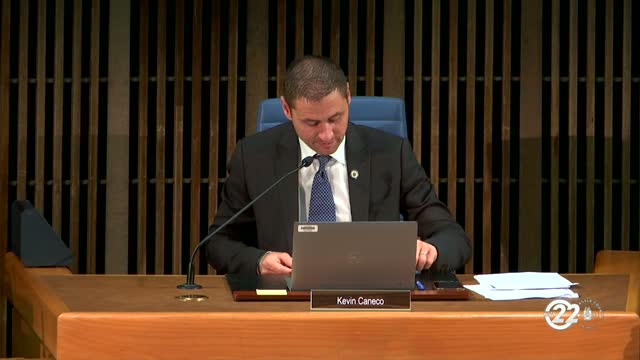
Kevin Evans, chair of the newly seated New Castle County Police Accountability Board, presented the board's 2025 annual report to the New Castle County Public Safety Committee on April 14, 2026, and outlined recommendations, accomplishments and challenges.
Evans told the committee the report was submitted in March and covers the calendar year ending Dec. 31, 2025. "The report was written by the previous members," he said, adding that he served as co-chair of the inaugural board and was the author of the document.
The report highlighted three ordinance-related changes: setting the annual report submission date to April 1 to align with other county boards; giving the county administrator authority to select the board chairman; and removing organizational parameters for member selection. Evans also noted two standing committees (research and community outreach) and said both submitted year reports.
Among accomplishments, Evans called out the implementation of a citizen feedback form and tracking process and an in-person workshop with Dr. Jim Nolan on structure, oversight and reform in Delaware policing. He said the appendices list 2025 board events and that the report includes a link to county crime statistics as required by the ordinance establishing the board.
Council members concentrated their questions on two areas: recent board turnover and the board's recommendation about use-of-force policy. Councilman Street challenged the authorship and timing of the report after a near-complete change in board membership, saying the new members had not been consulted. "This is just blatant mischief," he said, and accused the process of not aligning with the spirit of the accountability work.
Evans responded that the ordinance calls for two-year member terms, the original board's two-year period had ended, and most members did not reapply. "Only two of us reapplied, which were myself and Dr. Jenna Delaterio," he said, and he reiterated that the new board had no input on the report because it was written before their appointment.
Councilman Carter praised the board's focus on de-escalation and use-of-force context and asked whether recommendations would include expanded community-policing and behavioral-health responses. Evans said the board plans a comprehensive review of de-escalation and trauma-informed training and will study models from other municipalities; he noted that expanding behavioral-health units requires funding and that the New Castle County Police Department is "actively looking at expanding" that capacity.
On the use-of-force recommendation, Evans said the board's 2024 recommendation on shootings involving moving vehicles was rejected by the police department for legally absolute language. To avoid repeated rejections, the board established a task force composed of board members and public-safety staff to have technical, informal conversations before issuing recommendations so proposed language meets legal standards and can be implemented. Evans said one of the board's required town halls could be devoted to that topic and invited council participation.
Councilman Smiley asked whether the report's listed chairwoman, Kim Eppheimer (name appears with variant spellings in the record), remained on the new board; Evans said she is not on the newly seated board and that she has returned to duties at Friendship House. Several council members also asked whether exit interviews had been conducted with departing members; the record shows Evans and county staff describing the membership change as a normal transition tied to two-year terms rather than firings, while Councilman Street continued to press for further review.
No formal votes were taken on the report itself. The committee approved procedural items (minutes) at the start of the meeting and adjourned at the end. Evans said he will work to schedule a town hall in the coming months to discuss the moving-vehicle shootings policy and to invite council and police to provide explanation and receive public input.
The committee did not take further formal action on the report; next steps noted on the record include the task force discussions and a planned town-hall conversation to refine policy language and consider training and behavioral-health resources.
Evans told the committee the report was submitted in March and covers the calendar year ending Dec. 31, 2025. "The report was written by the previous members," he said, adding that he served as co-chair of the inaugural board and was the author of the document.
The report highlighted three ordinance-related changes: setting the annual report submission date to April 1 to align with other county boards; giving the county administrator authority to select the board chairman; and removing organizational parameters for member selection. Evans also noted two standing committees (research and community outreach) and said both submitted year reports.
Among accomplishments, Evans called out the implementation of a citizen feedback form and tracking process and an in-person workshop with Dr. Jim Nolan on structure, oversight and reform in Delaware policing. He said the appendices list 2025 board events and that the report includes a link to county crime statistics as required by the ordinance establishing the board.
Council members concentrated their questions on two areas: recent board turnover and the board's recommendation about use-of-force policy. Councilman Street challenged the authorship and timing of the report after a near-complete change in board membership, saying the new members had not been consulted. "This is just blatant mischief," he said, and accused the process of not aligning with the spirit of the accountability work.
Evans responded that the ordinance calls for two-year member terms, the original board's two-year period had ended, and most members did not reapply. "Only two of us reapplied, which were myself and Dr. Jenna Delaterio," he said, and he reiterated that the new board had no input on the report because it was written before their appointment.
Councilman Carter praised the board's focus on de-escalation and use-of-force context and asked whether recommendations would include expanded community-policing and behavioral-health responses. Evans said the board plans a comprehensive review of de-escalation and trauma-informed training and will study models from other municipalities; he noted that expanding behavioral-health units requires funding and that the New Castle County Police Department is "actively looking at expanding" that capacity.
On the use-of-force recommendation, Evans said the board's 2024 recommendation on shootings involving moving vehicles was rejected by the police department for legally absolute language. To avoid repeated rejections, the board established a task force composed of board members and public-safety staff to have technical, informal conversations before issuing recommendations so proposed language meets legal standards and can be implemented. Evans said one of the board's required town halls could be devoted to that topic and invited council participation.
Councilman Smiley asked whether the report's listed chairwoman, Kim Eppheimer (name appears with variant spellings in the record), remained on the new board; Evans said she is not on the newly seated board and that she has returned to duties at Friendship House. Several council members also asked whether exit interviews had been conducted with departing members; the record shows Evans and county staff describing the membership change as a normal transition tied to two-year terms rather than firings, while Councilman Street continued to press for further review.
No formal votes were taken on the report itself. The committee approved procedural items (minutes) at the start of the meeting and adjourned at the end. Evans said he will work to schedule a town hall in the coming months to discuss the moving-vehicle shootings policy and to invite council and police to provide explanation and receive public input.
The committee did not take further formal action on the report; next steps noted on the record include the task force discussions and a planned town-hall conversation to refine policy language and consider training and behavioral-health resources.
View the Full Meeting & All Its Details
This article offers just a summary. Unlock complete video, transcripts, and insights as a Founder Member.
✓
Watch full, unedited meeting videos
✓
Search every word spoken in unlimited transcripts
✓
AI summaries & real-time alerts (all government levels)
✓
Permanent access to expanding government content
30-day money-back guarantee
