Denton ISD projects $21.9 million surplus; trustees to consider 4% teacher pay recommendation in May
April 14, 2026 | DENTON ISD, School Districts, Texas
This article was created by AI summarizing key points discussed. AI makes mistakes, so for full details and context, please refer to the video of the full meeting. Please report any errors so we can fix them. Report an error »
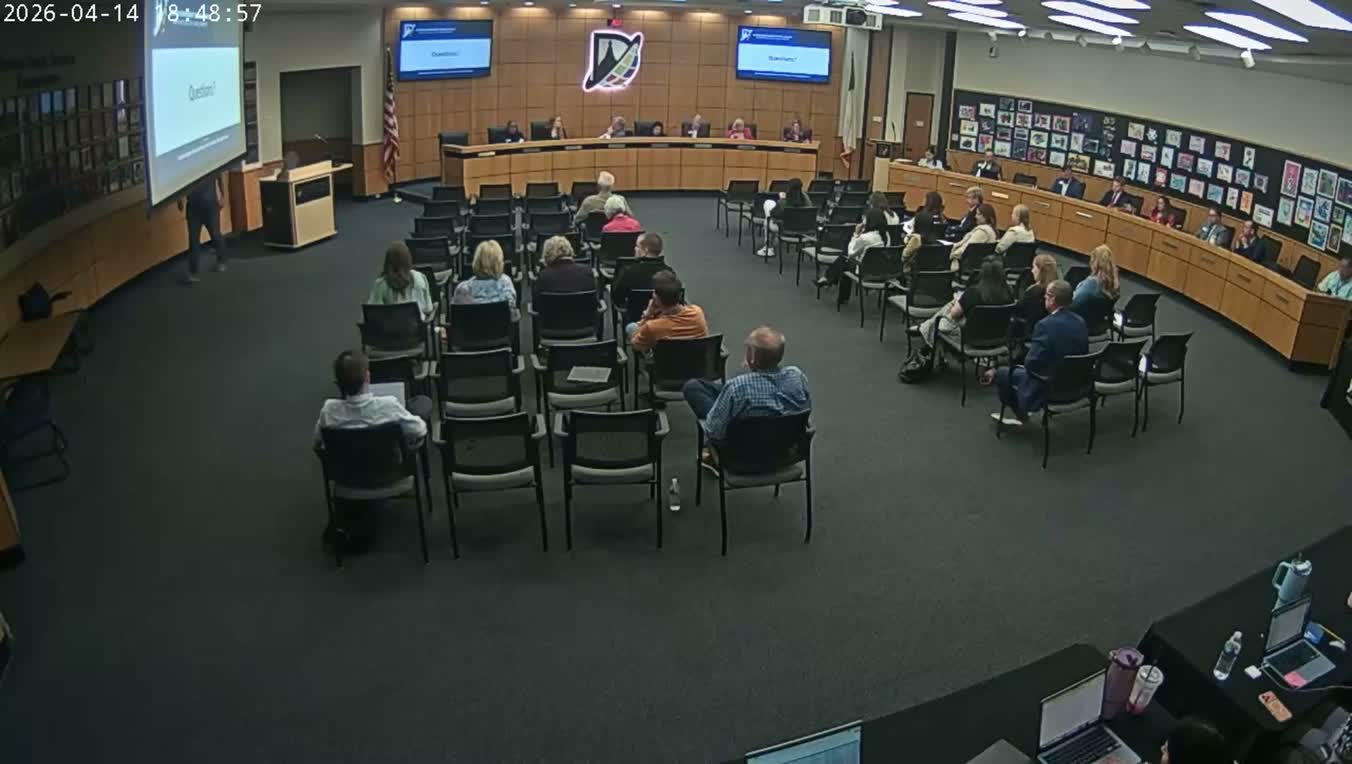
Denton ISD staff told the Board of Trustees on April 14 that the district expects a current‑year surplus of about $21.9 million, driven by higher-than-expected revenue this year. Jennifer Stewart, presenting the budget update, said anticipated revenue now totals about $387.6 million — roughly $62 million more than the budget adopted last year — and described $7.4 million of that as one‑time revenue the district does not expect to recur.
"When you look at the projected revenue budget, compare that to expenditure budget, we are looking at a $21,900,000 surplus in this year," Stewart said. She told trustees the revenue increase reflects a combination of state funding changes and recently incorporated tax-related dollars.
Following the revenue briefing, compensation staff recommended a 4% market adjustment to the teacher pay schedule that, combined with earlier local increases, would move starting teacher pay to about 101% of the market median for the board’s peer group. Jason Rainey, who presented the compensation plan, said the recommendation would close part of the district’s gap with comparable districts but noted the 4% would absorb a large share of the district’s projected variance if approved.
"With this recommendation, we're excited about this because we are closing the gap," Rainey said. Board leadership said the district expects to rely on state funding mechanisms — including House Bill 2 changes and the teacher incentive allotment — to sustain future raises. "The additional teacher pay is going to come from the state through teacher incentive allotment," said President Barbara Burns during the presentation. Trustees were told that the district may need to amend the adopted budget later when state guidance on special education funding is finalized.
Public commenters pressed trustees on staffing and special education. JD Aaron, a former teacher and Denton ISD parent, said the district has lost positions in special education and expressed concern that the district must ‘‘move the needle’’ quickly on compensation and staffing to maintain voter support for future tax/bond measures.
Board members discussed bond-rating and fund‑balance implications, noting that restoring fund balance was a priority before expanding compensation commitments. Trustees did not take action on the compensation recommendation at the April 14 meeting; staff said the board will be asked to consider approval at its May meeting.
"When you look at the projected revenue budget, compare that to expenditure budget, we are looking at a $21,900,000 surplus in this year," Stewart said. She told trustees the revenue increase reflects a combination of state funding changes and recently incorporated tax-related dollars.
Following the revenue briefing, compensation staff recommended a 4% market adjustment to the teacher pay schedule that, combined with earlier local increases, would move starting teacher pay to about 101% of the market median for the board’s peer group. Jason Rainey, who presented the compensation plan, said the recommendation would close part of the district’s gap with comparable districts but noted the 4% would absorb a large share of the district’s projected variance if approved.
"With this recommendation, we're excited about this because we are closing the gap," Rainey said. Board leadership said the district expects to rely on state funding mechanisms — including House Bill 2 changes and the teacher incentive allotment — to sustain future raises. "The additional teacher pay is going to come from the state through teacher incentive allotment," said President Barbara Burns during the presentation. Trustees were told that the district may need to amend the adopted budget later when state guidance on special education funding is finalized.
Public commenters pressed trustees on staffing and special education. JD Aaron, a former teacher and Denton ISD parent, said the district has lost positions in special education and expressed concern that the district must ‘‘move the needle’’ quickly on compensation and staffing to maintain voter support for future tax/bond measures.
Board members discussed bond-rating and fund‑balance implications, noting that restoring fund balance was a priority before expanding compensation commitments. Trustees did not take action on the compensation recommendation at the April 14 meeting; staff said the board will be asked to consider approval at its May meeting.
Don't Miss a Word: See the Full Meeting!
Go beyond summaries. Unlock every video, transcript, and key insight with a Founder Membership.
✓
Get instant access to full meeting videos
✓
Search and clip any phrase from complete transcripts
✓
Receive AI-powered summaries & custom alerts
✓
Enjoy lifetime, unrestricted access to government data
30-day money-back guarantee
