Syracuse City budget hearing details neighborhood development spending, housing strategy timing
April 16, 2026 | Syracuse City, Onondaga County, New York
This article was created by AI summarizing key points discussed. AI makes mistakes, so for full details and context, please refer to the video of the full meeting. Please report any errors so we can fix them. Report an error »
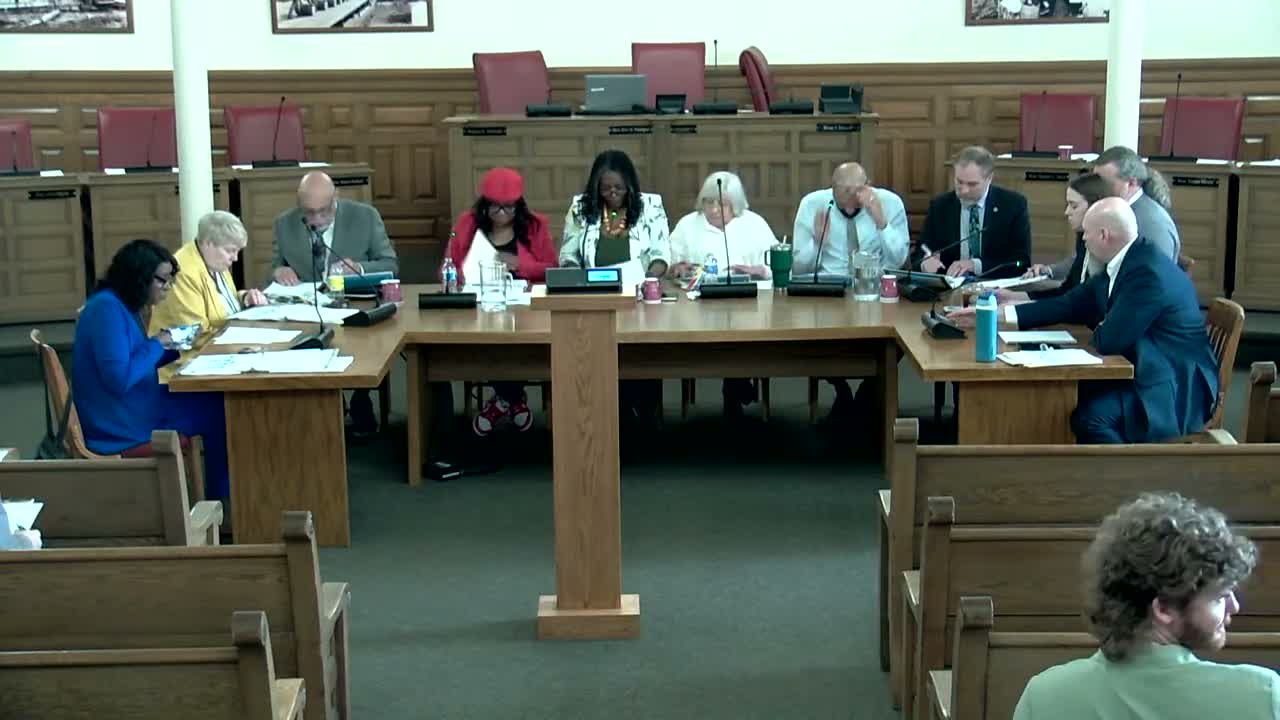
Michael Collins, commissioner for the Department for Neighborhood Business Development, told Syracuse City councilors at a budget hearing that the department’s two budgets under review — neighborhood business development and planning and sustainability — total roughly $1.3 million and $390,000 respectively and rely on multiple grant and lending programs to multiply city investment.
Collins said the department staffs roughly 33 people across the divisions covered in the hearing and taps about 16 funding sources and more than 30 grant programs. “We are able to take less than $2,000,000 and do more than 30 times that amount of work within the community,” Collins said, describing the leverage created by city grants, loans and partner investments.
Collins outlined SEDCO’s lending work as a local backstop when traditional banks will not finance projects, describing about $1.8 million in lending activity overseen by commercial-underwriting staff. He said that Sedco’s underwriting aims to expand business lending where community benefit is clear and traditional lenders are unwilling to take on the risk.
On housing, Michelle Cipanski, deputy commissioner of neighborhood development, reviewed the council‑adopted Housing Strategies plan and a three‑wave rollout that places Salt Springs and Tippill in Wave 1 (launch 2025), Eastwood and Elmwood in Wave 2 (anticipated 2027) and Courtwood Lawn in Wave 3 (anticipated 2029). Cipanski said the strategy assumes roughly $2–2.5 million per year to sustain a two‑year cadence through the neighborhood list and estimated a $25 million fundraising target to complete the first two neighborhoods’ work over a decade.
Cipanski described the city’s role in a Choice Neighborhoods Implementation (CNI) award that totals $50 million, with the city recorded as co‑awardee and $7.5 million of the funds attributed to the city for critical community improvements such as housing, neighborhood amenities and business supports. She said the team is leading substantial community engagement about how that money will be spent.
Councilors pressed staff on fund restrictions and timing. Cipanski said state funding tied to the 24/25 allocation cannot be used for staff compensation and that only up to 10% of certain 24/25 funds may be used for administration. She also said the state money referenced earlier remains available but that the department expects to spend about $2.5 million annually in active neighborhoods while seeking additional fundraising to reach larger investment goals.
On operational capacity, staff listed current vacancies — including a deputy commissioner for business development, a SEDCO loan officer and environmental-review coordinator — and explained a personnel shift that moved a public information officer into the department from the mayor’s office as a one‑for‑one trade rather than a net new city expense.
Cipanski said the Neighborhood Development division manages principal HUD entitlement grants (CDBG, Emergency Solutions, HOME) and that the division’s portfolio includes about $21 million in active or recently awarded neighborhood development grants. She explained the emergency repair program targets major health-and-safety code violations (most effective for 1–4 unit rentals), estimated the department’s current repair‑focused grant resources at roughly $600,000 and said fully curing larger housing‑stock problems would cost orders of magnitude more than current funding allows.
Staff also reported Home Headquarters receives just over $2 million annually in CDBG funding, with approximately $1.8 million earmarked for direct homeowner assistance programs. For homelessness prevention and outreach, Cipanski said the Emergency Solutions Grant is $430,000 and identified Sue McMahon as the grant lead for outreach activities; opioid settlement funds also support portions of outreach and related programs.
The hearing closed with staff available to follow up on detailed questions and councilors moving on to the next agenda item (codes enforcement).
Collins said the department staffs roughly 33 people across the divisions covered in the hearing and taps about 16 funding sources and more than 30 grant programs. “We are able to take less than $2,000,000 and do more than 30 times that amount of work within the community,” Collins said, describing the leverage created by city grants, loans and partner investments.
Collins outlined SEDCO’s lending work as a local backstop when traditional banks will not finance projects, describing about $1.8 million in lending activity overseen by commercial-underwriting staff. He said that Sedco’s underwriting aims to expand business lending where community benefit is clear and traditional lenders are unwilling to take on the risk.
On housing, Michelle Cipanski, deputy commissioner of neighborhood development, reviewed the council‑adopted Housing Strategies plan and a three‑wave rollout that places Salt Springs and Tippill in Wave 1 (launch 2025), Eastwood and Elmwood in Wave 2 (anticipated 2027) and Courtwood Lawn in Wave 3 (anticipated 2029). Cipanski said the strategy assumes roughly $2–2.5 million per year to sustain a two‑year cadence through the neighborhood list and estimated a $25 million fundraising target to complete the first two neighborhoods’ work over a decade.
Cipanski described the city’s role in a Choice Neighborhoods Implementation (CNI) award that totals $50 million, with the city recorded as co‑awardee and $7.5 million of the funds attributed to the city for critical community improvements such as housing, neighborhood amenities and business supports. She said the team is leading substantial community engagement about how that money will be spent.
Councilors pressed staff on fund restrictions and timing. Cipanski said state funding tied to the 24/25 allocation cannot be used for staff compensation and that only up to 10% of certain 24/25 funds may be used for administration. She also said the state money referenced earlier remains available but that the department expects to spend about $2.5 million annually in active neighborhoods while seeking additional fundraising to reach larger investment goals.
On operational capacity, staff listed current vacancies — including a deputy commissioner for business development, a SEDCO loan officer and environmental-review coordinator — and explained a personnel shift that moved a public information officer into the department from the mayor’s office as a one‑for‑one trade rather than a net new city expense.
Cipanski said the Neighborhood Development division manages principal HUD entitlement grants (CDBG, Emergency Solutions, HOME) and that the division’s portfolio includes about $21 million in active or recently awarded neighborhood development grants. She explained the emergency repair program targets major health-and-safety code violations (most effective for 1–4 unit rentals), estimated the department’s current repair‑focused grant resources at roughly $600,000 and said fully curing larger housing‑stock problems would cost orders of magnitude more than current funding allows.
Staff also reported Home Headquarters receives just over $2 million annually in CDBG funding, with approximately $1.8 million earmarked for direct homeowner assistance programs. For homelessness prevention and outreach, Cipanski said the Emergency Solutions Grant is $430,000 and identified Sue McMahon as the grant lead for outreach activities; opioid settlement funds also support portions of outreach and related programs.
The hearing closed with staff available to follow up on detailed questions and councilors moving on to the next agenda item (codes enforcement).
Don't Miss a Word: See the Full Meeting!
Go beyond summaries. Unlock every video, transcript, and key insight with a Founder Membership.
✓
Get instant access to full meeting videos
✓
Search and clip any phrase from complete transcripts
✓
Receive AI-powered summaries & custom alerts
✓
Enjoy lifetime, unrestricted access to government data
30-day money-back guarantee
