House education panel advances bill setting 48-credit minimum for school-counselor licensure
April 15, 2026 | 2026 Legislature CO, Colorado
This article was created by AI summarizing key points discussed. AI makes mistakes, so for full details and context, please refer to the video of the full meeting. Please report any errors so we can fix them. Report an error »
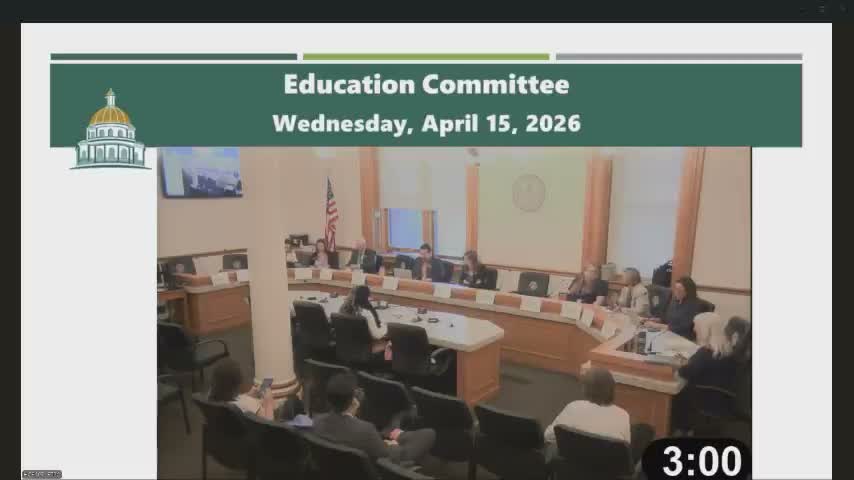
The House Education Committee voted 12–1 to advance Senate Bill 153, a measure that would require a 48-credit-hour minimum of coursework beyond a master’s degree for Colorado school-counselor licensure.
Rep. Bacon, a sponsor, told the panel the bill was brought "forward by actual practitioners" to restore a consistent professional threshold after the State Board of Education eliminated a previous credit-hour requirement. Bacon said the bill reflects a compromise supported by the Colorado School Counselor Association and that the measure previously passed the Senate unanimously.
Colleen Stavilepsy, school counseling program chair at Adams State University, testified in support and said her review of university programs nationwide found "anything less than 48 is insufficient." Stavilepsy told the committee applicants with fewer than 48 hours often lack preparation in crisis response, classroom lesson planning and postsecondary advising.
Katie Brown, an elementary school counselor in Pueblo West and deputy executive director of the Colorado School Counselor Association, described daily crisis-response duties and urged the committee to keep training standards. "Without it, I would not know what I don't know," Brown said, arguing that a clear minimum helps protect students and supports rural districts that struggle to recruit trained counselors.
One public commenter, Jeanne Rush, testified in opposition, saying the state should not "attend to the emotional needs" of children and that such policies overstep parental rights. Rush’s remarks framed the issue as a broader objection to state and departmental roles in school mental-health practice.
Committee members questioned sponsors about why the State Board of Education removed the credit-hour threshold and whether other educator credentials have comparable minimums. Sponsors and witnesses pointed to other credentialing requirements — such as examinations and degree requirements — and emphasized that the proposed 48-credit floor is intended to balance quality and workforce concerns.
After closing the testimony and amendment phases with no changes, Rep. Bacon moved and Rep. Martinez seconded that the committee send SB 153 to the Committee of the Whole with a favorable recommendation. A roll-call vote recorded 12 yes votes and one no vote from Rep. Weinberg.
The committee’s favorable recommendation sends the bill to the Committee of the Whole for further consideration; no floor date was announced at the committee meeting.
Rep. Bacon, a sponsor, told the panel the bill was brought "forward by actual practitioners" to restore a consistent professional threshold after the State Board of Education eliminated a previous credit-hour requirement. Bacon said the bill reflects a compromise supported by the Colorado School Counselor Association and that the measure previously passed the Senate unanimously.
Colleen Stavilepsy, school counseling program chair at Adams State University, testified in support and said her review of university programs nationwide found "anything less than 48 is insufficient." Stavilepsy told the committee applicants with fewer than 48 hours often lack preparation in crisis response, classroom lesson planning and postsecondary advising.
Katie Brown, an elementary school counselor in Pueblo West and deputy executive director of the Colorado School Counselor Association, described daily crisis-response duties and urged the committee to keep training standards. "Without it, I would not know what I don't know," Brown said, arguing that a clear minimum helps protect students and supports rural districts that struggle to recruit trained counselors.
One public commenter, Jeanne Rush, testified in opposition, saying the state should not "attend to the emotional needs" of children and that such policies overstep parental rights. Rush’s remarks framed the issue as a broader objection to state and departmental roles in school mental-health practice.
Committee members questioned sponsors about why the State Board of Education removed the credit-hour threshold and whether other educator credentials have comparable minimums. Sponsors and witnesses pointed to other credentialing requirements — such as examinations and degree requirements — and emphasized that the proposed 48-credit floor is intended to balance quality and workforce concerns.
After closing the testimony and amendment phases with no changes, Rep. Bacon moved and Rep. Martinez seconded that the committee send SB 153 to the Committee of the Whole with a favorable recommendation. A roll-call vote recorded 12 yes votes and one no vote from Rep. Weinberg.
The committee’s favorable recommendation sends the bill to the Committee of the Whole for further consideration; no floor date was announced at the committee meeting.
Don't Miss a Word: See the Full Meeting!
Go beyond summaries. Unlock every video, transcript, and key insight with a Founder Membership.
✓
Get instant access to full meeting videos
✓
Search and clip any phrase from complete transcripts
✓
Receive AI-powered summaries & custom alerts
✓
Enjoy lifetime, unrestricted access to government data
30-day money-back guarantee
