Authors and families urge restoring lifetime health coverage for duty‑disabled public safety workers; cities warn of fiscal hit
April 14, 2026 | 2026 Legislature MN, Minnesota
This article was created by AI summarizing key points discussed. AI makes mistakes, so for full details and context, please refer to the video of the full meeting. Please report any errors so we can fix them. Report an error »
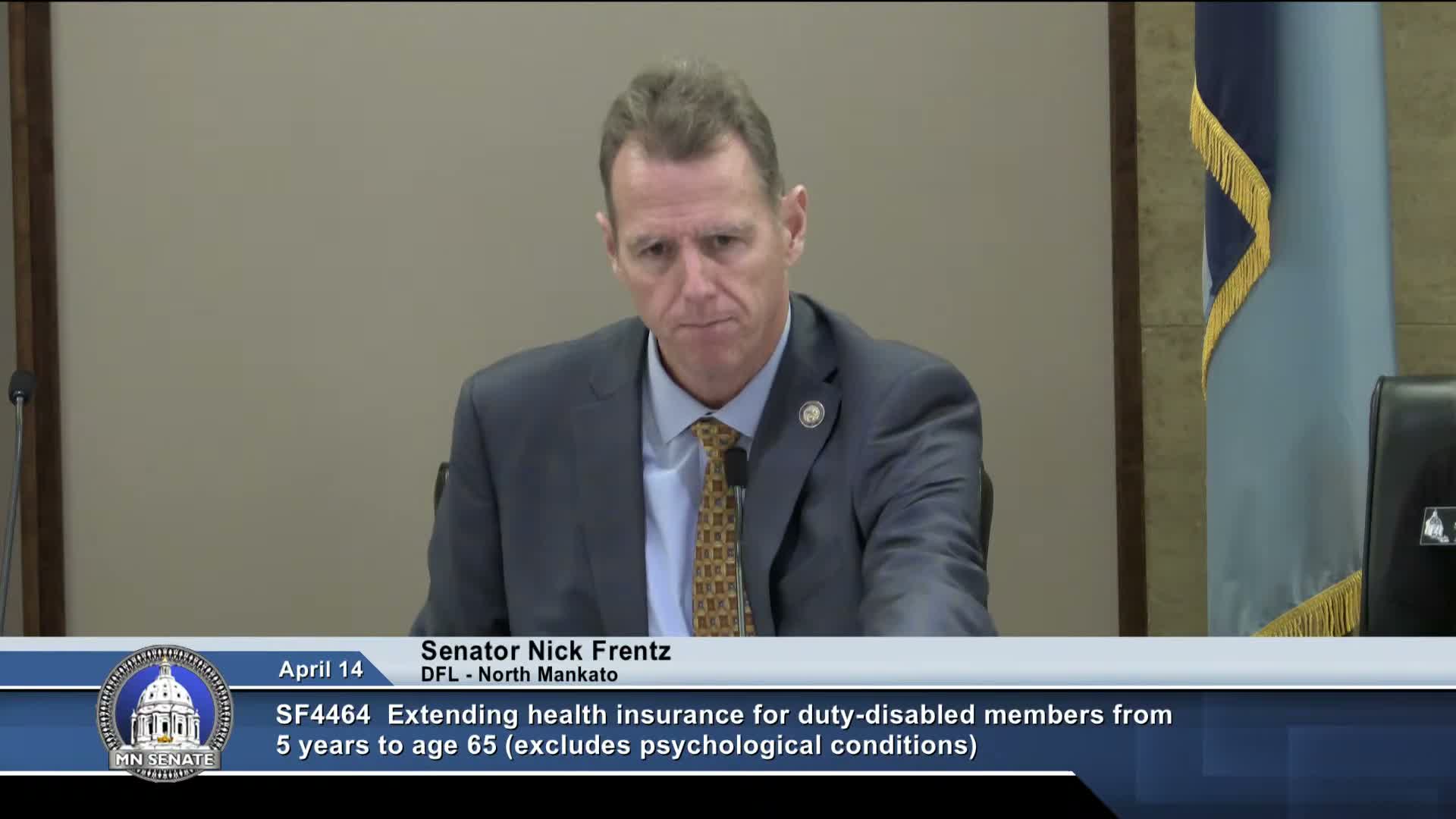
Senator Steve Howe presented Senate File 4464 to the Legislative Commission on Pensions and Retirement, saying the bill would close a gap that can leave public‑safety workers without employer‑provided health insurance if a line‑of‑duty physical injury ends their careers. "When someone is injured in service to their country or their community, our obligation is to take care of them," Howe said.
Supporters gave personal testimony about lifelong injuries and uncertain recoveries. Mike Ladue of Law Enforcement Labor Services told the commission he represents more than 8,800 public‑safety professionals and described the bill as a narrow fix restoring coverage for documented physical line‑of‑duty injuries. "If we expect these professionals to protect us, we have a responsibility to protect them when those risks become reality," Ladue said.
Family members and injured officers described the stakes. Amber Waldner testified on behalf of her husband, Deputy Logan Waldner of the Nobles County Sheriff’s Department, who suffered a traumatic brain injury in April 2025. "This bill would extend our health insurance coverage beyond the five years, providing stability until Logan reaches age 65," she said. Officer Ryan Chic, who was shot three times in 2023, described ongoing pain and possible long‑term complications and said that five years of coverage "isn't even close" for serious injuries.
Opponents urged caution and a funding plan. Anne Finn of the League of Minnesota Cities said a coalition of public employers submitted a joint letter opposing the bill as drafted. Finn noted that, under current law changes enacted in 2025, continued coverage for many new duty‑disability applicants is capped at five years and estimated that covering an employee to age 65 could cost roughly $500,000 per person over time. Citing the staff memo, she said property‑tax implications could reach about $25 million per year if costs shift to local employers.
Members queried the authors about legal distinctions between physical and mental duty disability, and Senator Howe said nonpartisan staff and employer attorneys had reviewed the separation and concluded it could be done constitutionally. Several members requested copies of the legal opinions and additional fiscal detail before acting.
Outcome: After testimony and questions, the authors asked the commission to lay the bill over for further consultation with authors and with LCPR staff; the commission laid SF4464 over for later consideration.
Supporters gave personal testimony about lifelong injuries and uncertain recoveries. Mike Ladue of Law Enforcement Labor Services told the commission he represents more than 8,800 public‑safety professionals and described the bill as a narrow fix restoring coverage for documented physical line‑of‑duty injuries. "If we expect these professionals to protect us, we have a responsibility to protect them when those risks become reality," Ladue said.
Family members and injured officers described the stakes. Amber Waldner testified on behalf of her husband, Deputy Logan Waldner of the Nobles County Sheriff’s Department, who suffered a traumatic brain injury in April 2025. "This bill would extend our health insurance coverage beyond the five years, providing stability until Logan reaches age 65," she said. Officer Ryan Chic, who was shot three times in 2023, described ongoing pain and possible long‑term complications and said that five years of coverage "isn't even close" for serious injuries.
Opponents urged caution and a funding plan. Anne Finn of the League of Minnesota Cities said a coalition of public employers submitted a joint letter opposing the bill as drafted. Finn noted that, under current law changes enacted in 2025, continued coverage for many new duty‑disability applicants is capped at five years and estimated that covering an employee to age 65 could cost roughly $500,000 per person over time. Citing the staff memo, she said property‑tax implications could reach about $25 million per year if costs shift to local employers.
Members queried the authors about legal distinctions between physical and mental duty disability, and Senator Howe said nonpartisan staff and employer attorneys had reviewed the separation and concluded it could be done constitutionally. Several members requested copies of the legal opinions and additional fiscal detail before acting.
Outcome: After testimony and questions, the authors asked the commission to lay the bill over for further consultation with authors and with LCPR staff; the commission laid SF4464 over for later consideration.
View the Full Meeting & All Its Details
This article offers just a summary. Unlock complete video, transcripts, and insights as a Founder Member.
✓
Watch full, unedited meeting videos
✓
Search every word spoken in unlimited transcripts
✓
AI summaries & real-time alerts (all government levels)
✓
Permanent access to expanding government content
30-day money-back guarantee
