Seclusion bill divides committee after working‑group recommendations; advocates and educators sharply disagree
April 14, 2026 | 2026 Legislature MN, Minnesota
This article was created by AI summarizing key points discussed. AI makes mistakes, so for full details and context, please refer to the video of the full meeting. Please report any errors so we can fix them. Report an error »
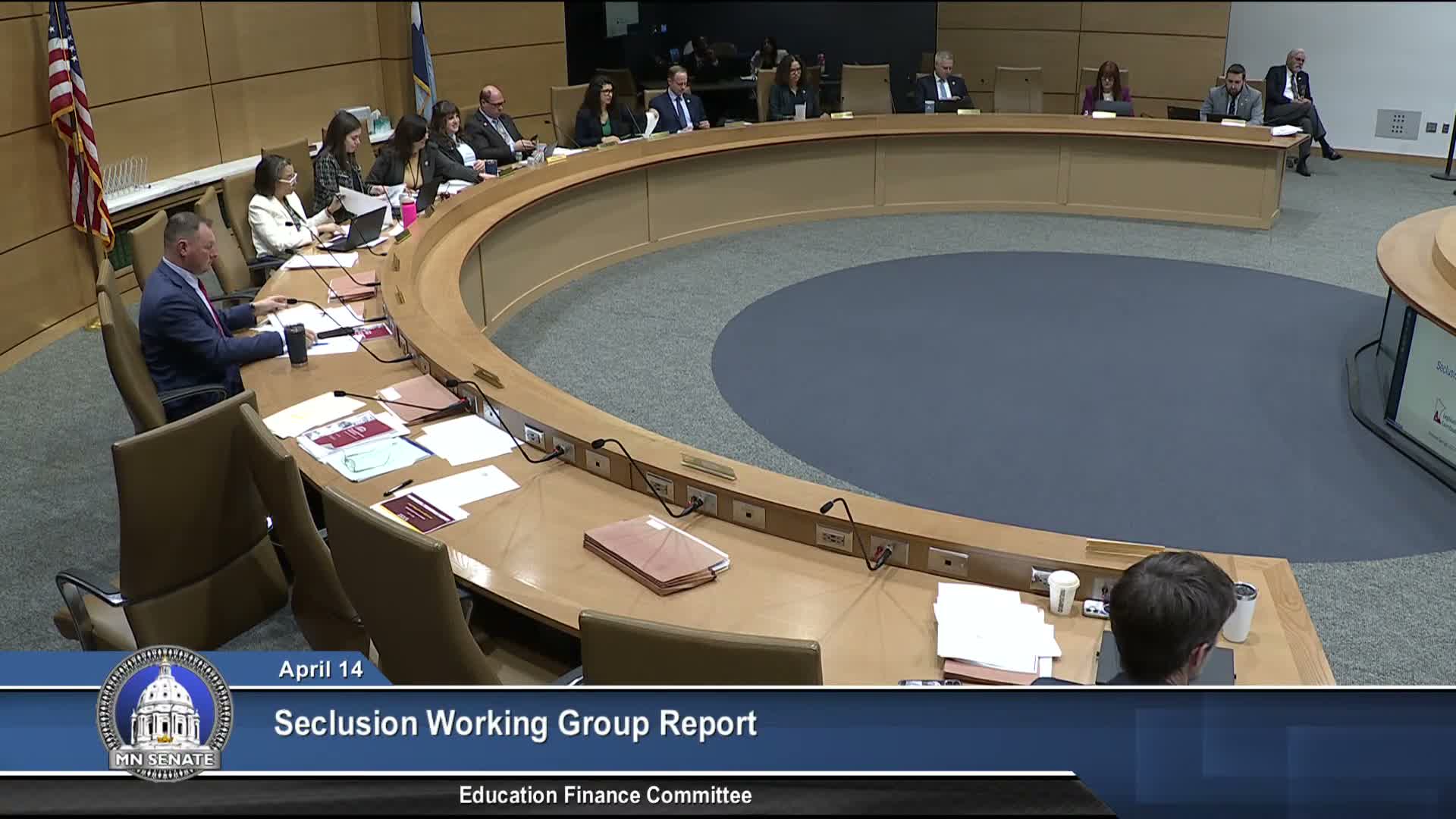
Senate File 46‑77, introduced by Senator Seaburger and based on recommendations from the Seclusion Working Group, drew sustained, often emotional testimony and cross‑examination at the Senate Education Finance Committee. The working group met 11 times (Aug. 2025–Jan. 2026) and produced recommendations on training, IEP safeguards, data collection, accountability thresholds, alternative interventions (including Ukeru), and funding to implement substitutes.
Andrew George, research analyst for the Legislative Coordinating Commission, summarized the work group’s process and recommendations, noting adopted items on mandatory training, enhanced IEP requirements, data collection and monitoring, alternatives research, and funding. He said the group reported membership across legislative and stakeholder appointments and that final recommendations were distributed in the group's report.
Senator Seaburger described SF 46‑77 as a practical, cautious approach that preserves seclusion as a limited emergency tool while building safeguards and a runway to eliminate it. She argued that after a 2023 restriction, schools saw increases in physical holds and staff injuries and that the bill requires written parental consent, mental‑health professionals on IEP teams, demonstration of seclusion rooms to caregivers, additional data collection and accountability, and a sunset (target 2036) tied to vetted alternatives. “Nobody wants to use seclusion. Nobody wants it,” Seaburger said. “But what we recognized is there is no good alternative at this moment to fill that gap.”
Many educators and administrators supported the bill’s recommendations as a pragmatic, resourced transition. Nicole Woodward (representing MACE) said the recommendations “sharply limit when and where seclusion can be used” and create accountability that would identify districts misusing restrictive procedures. Kate Hulse, who served on the working group, urged a 10‑year runway to implement alternatives with fidelity and repeated that implementation requires funding and time.
The Minnesota Department of Education told the committee it does not support expanding allowable uses of seclusion and favors eliminating the practice, stressing the significant resources and change management needed for any expansion. Darren Corte, assistant commissioner at MDE, said the agency “does not support a proposal that would expand the allowable uses of seclusion in Minnesota schools.”
Disability advocates, parent groups and civil‑rights organizations strongly opposed reversing the 2023 restrictions. Jessica Heiser (Minnesota Disability Law Center) and others argued national trends and federal civil‑rights enforcement increasingly treat seclusion as unlawful or harmful; parents and survivors recounted traumatic experiences, some alleging prolonged seclusion without parental knowledge. Opponents said seclusion disproportionately harms students of color and students with disabilities and urged maintenance of the current ban for kindergarten through third grade.
Committee members pressed staff on the working‑group votes and whether a late requested vote change affected final tallies; members also questioned data sources, thresholds, and the proposed timeline. After extended debate and multiple personal testimonies from both sides, the committee laid SF 46‑77 over for further consideration rather than advancing it out of committee this day.
Andrew George, research analyst for the Legislative Coordinating Commission, summarized the work group’s process and recommendations, noting adopted items on mandatory training, enhanced IEP requirements, data collection and monitoring, alternatives research, and funding. He said the group reported membership across legislative and stakeholder appointments and that final recommendations were distributed in the group's report.
Senator Seaburger described SF 46‑77 as a practical, cautious approach that preserves seclusion as a limited emergency tool while building safeguards and a runway to eliminate it. She argued that after a 2023 restriction, schools saw increases in physical holds and staff injuries and that the bill requires written parental consent, mental‑health professionals on IEP teams, demonstration of seclusion rooms to caregivers, additional data collection and accountability, and a sunset (target 2036) tied to vetted alternatives. “Nobody wants to use seclusion. Nobody wants it,” Seaburger said. “But what we recognized is there is no good alternative at this moment to fill that gap.”
Many educators and administrators supported the bill’s recommendations as a pragmatic, resourced transition. Nicole Woodward (representing MACE) said the recommendations “sharply limit when and where seclusion can be used” and create accountability that would identify districts misusing restrictive procedures. Kate Hulse, who served on the working group, urged a 10‑year runway to implement alternatives with fidelity and repeated that implementation requires funding and time.
The Minnesota Department of Education told the committee it does not support expanding allowable uses of seclusion and favors eliminating the practice, stressing the significant resources and change management needed for any expansion. Darren Corte, assistant commissioner at MDE, said the agency “does not support a proposal that would expand the allowable uses of seclusion in Minnesota schools.”
Disability advocates, parent groups and civil‑rights organizations strongly opposed reversing the 2023 restrictions. Jessica Heiser (Minnesota Disability Law Center) and others argued national trends and federal civil‑rights enforcement increasingly treat seclusion as unlawful or harmful; parents and survivors recounted traumatic experiences, some alleging prolonged seclusion without parental knowledge. Opponents said seclusion disproportionately harms students of color and students with disabilities and urged maintenance of the current ban for kindergarten through third grade.
Committee members pressed staff on the working‑group votes and whether a late requested vote change affected final tallies; members also questioned data sources, thresholds, and the proposed timeline. After extended debate and multiple personal testimonies from both sides, the committee laid SF 46‑77 over for further consideration rather than advancing it out of committee this day.
View the Full Meeting & All Its Details
This article offers just a summary. Unlock complete video, transcripts, and insights as a Founder Member.
✓
Watch full, unedited meeting videos
✓
Search every word spoken in unlimited transcripts
✓
AI summaries & real-time alerts (all government levels)
✓
Permanent access to expanding government content
30-day money-back guarantee
