Committee advances bill to require cost-of-living analysis for state regulations
April 14, 2026 | California State Assembly, House, Legislative, California
This article was created by AI summarizing key points discussed. AI makes mistakes, so for full details and context, please refer to the video of the full meeting. Please report any errors so we can fix them. Report an error »
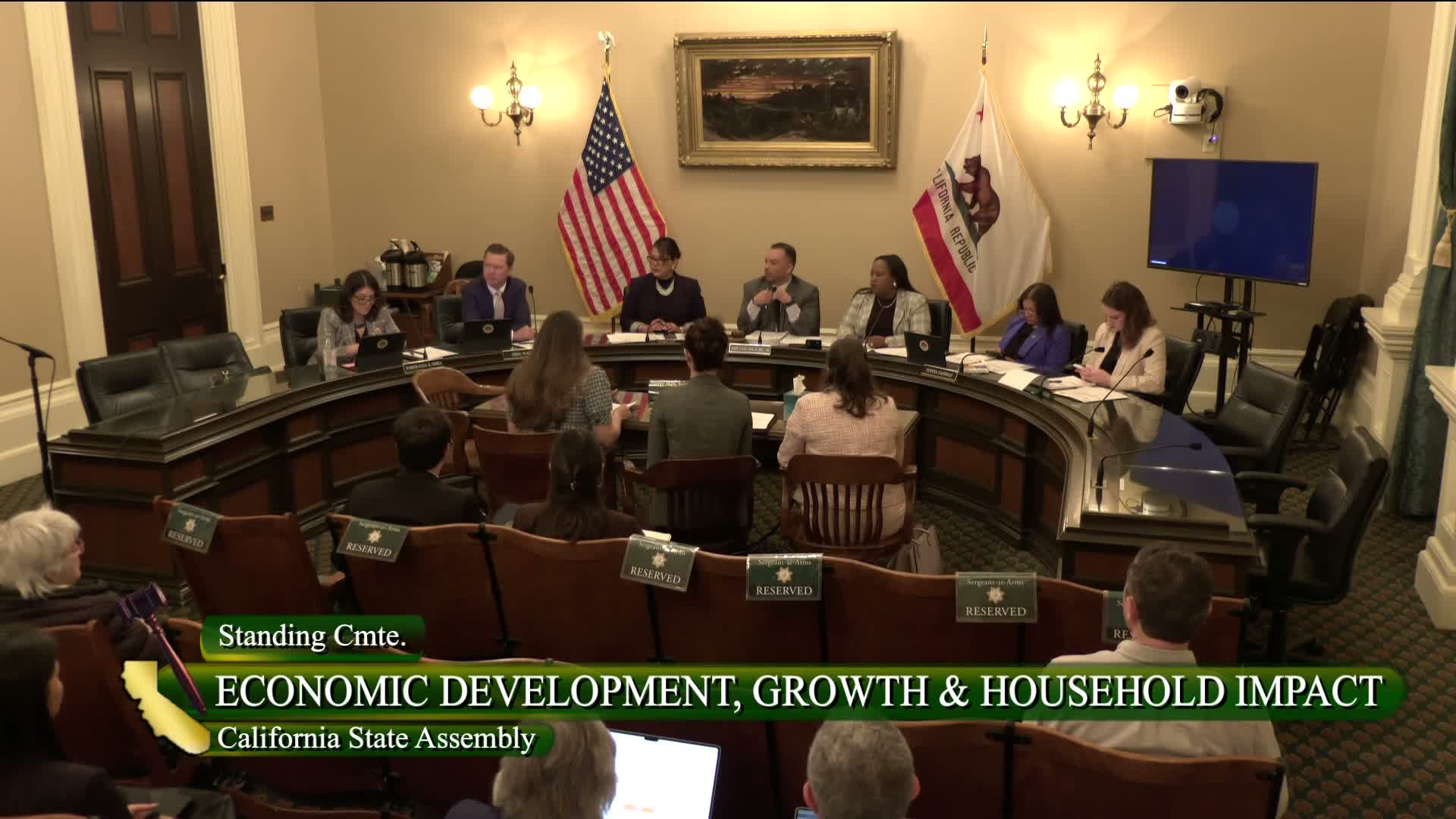
The Assembly subcommittee on economic development advanced Assembly Bill 2366 on a committee vote, sending the measure to the judiciary committee with a recommendation to pass.
The bill's author introduced AB2366 as a requirement that state agencies explicitly assess the potential for proposed administrative regulations to impose adverse economic impacts on businesses and individuals, "to ensure that the proposed regulations' financial impacts on everyday Californians will be directly and adequately disclosed and analyzed," the author said during the hearing. Supporters argued the change would add transparency to rulemaking and help avoid unintended affordability impacts.
Brenda Bass of KP Public Affairs, testifying for the New California Coalition, said the bill responds to California's affordability crisis and "builds upon the existing standardized regulatory impact analysis and explicitly adds cost of living impacts to the list of impacts that state agencies must evaluate and consider when undertaking rulemaking." She urged members to vote aye.
Sarah Bridges of the California Manufacturers and Technology Association said manufacturers bear the cumulative burden of regulations and that AB2366 would require agencies to use a consistent statewide methodology, require independent LAO review and create a regulatory economic burden tracker to show costs across sectors over time. "This adds an important layer of accountability and ensures that the real-world impacts on industries ... are not underestimated or overlooked," Bridges said.
Members asked for assurances that the bill's requirements would be implementable and that agencies would pursue less-costly alternatives when significant impacts are found. Assemblymember Petrie-Norris said she wanted legislative review if the commission or study produced recommendations affecting policy; the author agreed to amendments and to work with committee staff.
On a roll call after quorum was achieved, the committee recorded a favorable recommendation and referred AB2366 to the judiciary committee. The clerk later announced the item as reported out (committee record indicated a reported 7-0 tally where noted in the transcript).
The committee left the measure open for additional votes before formally transmitting the recommendation. The committee scheduled no immediate implementation steps beyond referral; any step to adopt regulatory changes or implementation would require subsequent action by agencies and, where applicable, legislative enactment.
The bill's author introduced AB2366 as a requirement that state agencies explicitly assess the potential for proposed administrative regulations to impose adverse economic impacts on businesses and individuals, "to ensure that the proposed regulations' financial impacts on everyday Californians will be directly and adequately disclosed and analyzed," the author said during the hearing. Supporters argued the change would add transparency to rulemaking and help avoid unintended affordability impacts.
Brenda Bass of KP Public Affairs, testifying for the New California Coalition, said the bill responds to California's affordability crisis and "builds upon the existing standardized regulatory impact analysis and explicitly adds cost of living impacts to the list of impacts that state agencies must evaluate and consider when undertaking rulemaking." She urged members to vote aye.
Sarah Bridges of the California Manufacturers and Technology Association said manufacturers bear the cumulative burden of regulations and that AB2366 would require agencies to use a consistent statewide methodology, require independent LAO review and create a regulatory economic burden tracker to show costs across sectors over time. "This adds an important layer of accountability and ensures that the real-world impacts on industries ... are not underestimated or overlooked," Bridges said.
Members asked for assurances that the bill's requirements would be implementable and that agencies would pursue less-costly alternatives when significant impacts are found. Assemblymember Petrie-Norris said she wanted legislative review if the commission or study produced recommendations affecting policy; the author agreed to amendments and to work with committee staff.
On a roll call after quorum was achieved, the committee recorded a favorable recommendation and referred AB2366 to the judiciary committee. The clerk later announced the item as reported out (committee record indicated a reported 7-0 tally where noted in the transcript).
The committee left the measure open for additional votes before formally transmitting the recommendation. The committee scheduled no immediate implementation steps beyond referral; any step to adopt regulatory changes or implementation would require subsequent action by agencies and, where applicable, legislative enactment.
Don't Miss a Word: See the Full Meeting!
Go beyond summaries. Unlock every video, transcript, and key insight with a Founder Membership.
✓
Get instant access to full meeting videos
✓
Search and clip any phrase from complete transcripts
✓
Receive AI-powered summaries & custom alerts
✓
Enjoy lifetime, unrestricted access to government data
30-day money-back guarantee
