HF1082 DE6 bundles training increases, new offenses and grant priorities into public-safety finance vehicle
April 14, 2026 | 2026 Legislature MN, Minnesota
This article was created by AI summarizing key points discussed. AI makes mistakes, so for full details and context, please refer to the video of the full meeting. Please report any errors so we can fix them. Report an error »
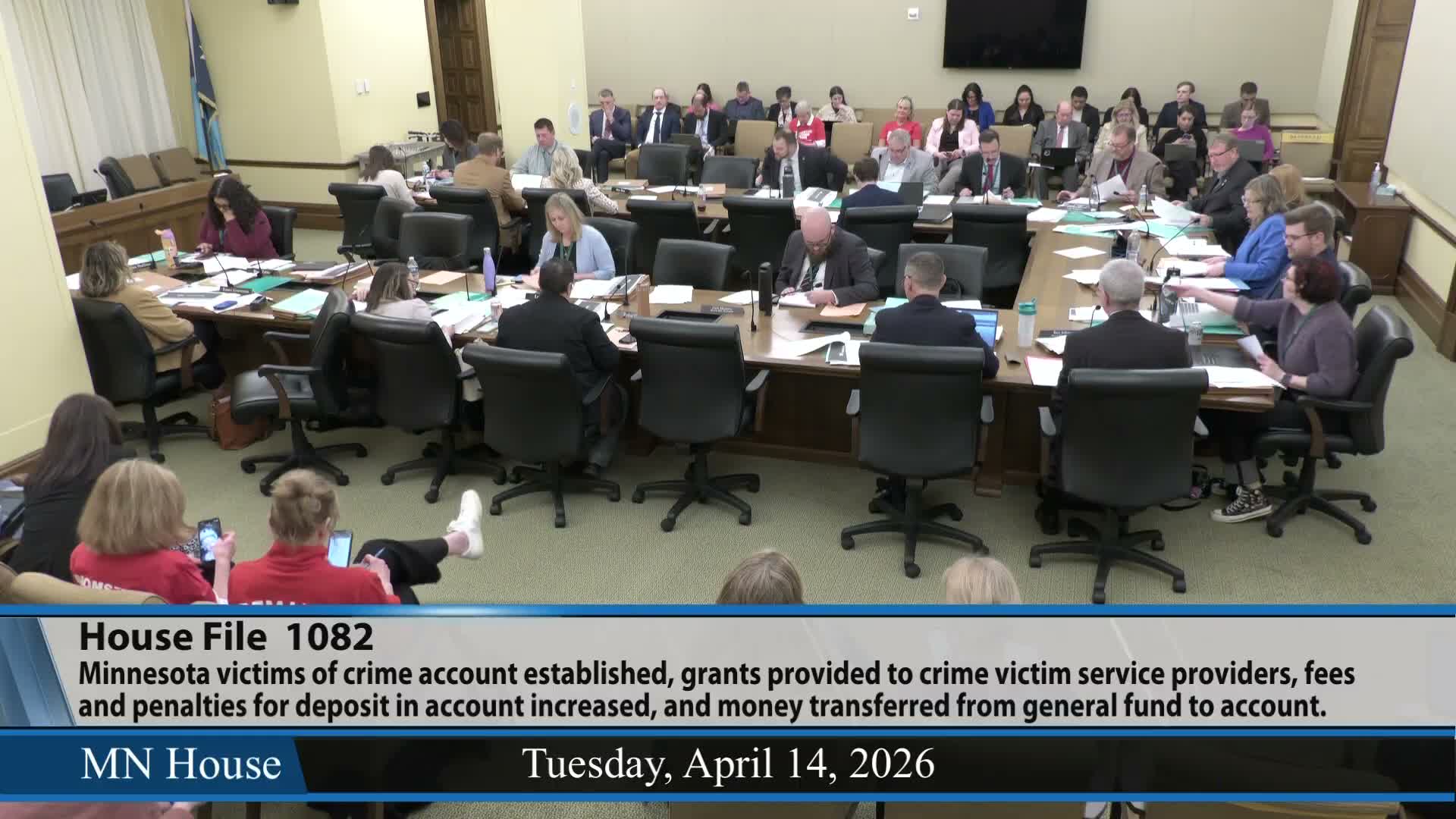
Committee staff reviewed the DE6 amendment to House File 1082, explaining the amendment incorporates multiple public-safety provisions from separate bills and several budgetary effects.
A staff member described line items that include a House File 2742 nonfatal-shooting clearance grant ($1,000,000 in FY2027), Office of Justice Programs items tied to a domestic-violence task force (House File 3946: $214,000 in FY27 and $100,000 in FY28), and a $100,000 appropriation for a first-responder uniform identification task force (House File 3095). Staff calculated a Department of Public Safety subtotal for those entries.
Staff also summarized four bills with expected Department of Corrections bed impacts that create new felony provisions: impersonation of a peace officer (House File 3404), a medical-facility-security fourth-degree assault (House File 3405), theft from a vulnerable adult (House File 3465), and grooming penalties (House File 3489). Staff presented dollared estimates for bed impacts in the tails biennium and a DOC total for the current biennium and tails.
The amendment increases the Philando Castile training reimbursement to an even $6,000,000 per year in the version included in DE6; staff said the rounded increase yields a multiyear cost to the post board and provided an estimated annual cost in the 26-27 window. Other DE6 language described decommissioning requirements for public-safety vehicles before sale (from a bill by Representative Hewitt) and a task force on a standard identification system with no changes from the committee version.
Staff noted changes to Representative Frazier’s House File 2742: the grant that had been proposed as ongoing funding would instead receive a one-time appropriation in session law, and prioritization language was altered so that half of the appropriation must go to agencies outside the metropolitan area; a prior cause requiring demonstration of excessive unsolved cases and inadequate staffing was removed.
Several members asked clarifying statutory-construction questions, including a vice chair’s question about the grooming definition and potential age-differential cases. Nonpartisan counsel responded that the grooming sub-offense applies when the defendant is in a position of authority (for example a school employee) and that other age-differential rules in criminal statutes address peer relationships.
No formal committee vote on DE6 or on the attached provisions is recorded in the transcript; staff emphasized that the committee was walking the language and that official action was not taken that day.
A staff member described line items that include a House File 2742 nonfatal-shooting clearance grant ($1,000,000 in FY2027), Office of Justice Programs items tied to a domestic-violence task force (House File 3946: $214,000 in FY27 and $100,000 in FY28), and a $100,000 appropriation for a first-responder uniform identification task force (House File 3095). Staff calculated a Department of Public Safety subtotal for those entries.
Staff also summarized four bills with expected Department of Corrections bed impacts that create new felony provisions: impersonation of a peace officer (House File 3404), a medical-facility-security fourth-degree assault (House File 3405), theft from a vulnerable adult (House File 3465), and grooming penalties (House File 3489). Staff presented dollared estimates for bed impacts in the tails biennium and a DOC total for the current biennium and tails.
The amendment increases the Philando Castile training reimbursement to an even $6,000,000 per year in the version included in DE6; staff said the rounded increase yields a multiyear cost to the post board and provided an estimated annual cost in the 26-27 window. Other DE6 language described decommissioning requirements for public-safety vehicles before sale (from a bill by Representative Hewitt) and a task force on a standard identification system with no changes from the committee version.
Staff noted changes to Representative Frazier’s House File 2742: the grant that had been proposed as ongoing funding would instead receive a one-time appropriation in session law, and prioritization language was altered so that half of the appropriation must go to agencies outside the metropolitan area; a prior cause requiring demonstration of excessive unsolved cases and inadequate staffing was removed.
Several members asked clarifying statutory-construction questions, including a vice chair’s question about the grooming definition and potential age-differential cases. Nonpartisan counsel responded that the grooming sub-offense applies when the defendant is in a position of authority (for example a school employee) and that other age-differential rules in criminal statutes address peer relationships.
No formal committee vote on DE6 or on the attached provisions is recorded in the transcript; staff emphasized that the committee was walking the language and that official action was not taken that day.
View the Full Meeting & All Its Details
This article offers just a summary. Unlock complete video, transcripts, and insights as a Founder Member.
✓
Watch full, unedited meeting videos
✓
Search every word spoken in unlimited transcripts
✓
AI summaries & real-time alerts (all government levels)
✓
Permanent access to expanding government content
30-day money-back guarantee
