Committee declines statewide noise-rule rollback; amended bill fails 7–6 and is postponed
April 14, 2026 | 2026 Legislature CO, Colorado
This article was created by AI summarizing key points discussed. AI makes mistakes, so for full details and context, please refer to the video of the full meeting. Please report any errors so we can fix them. Report an error »
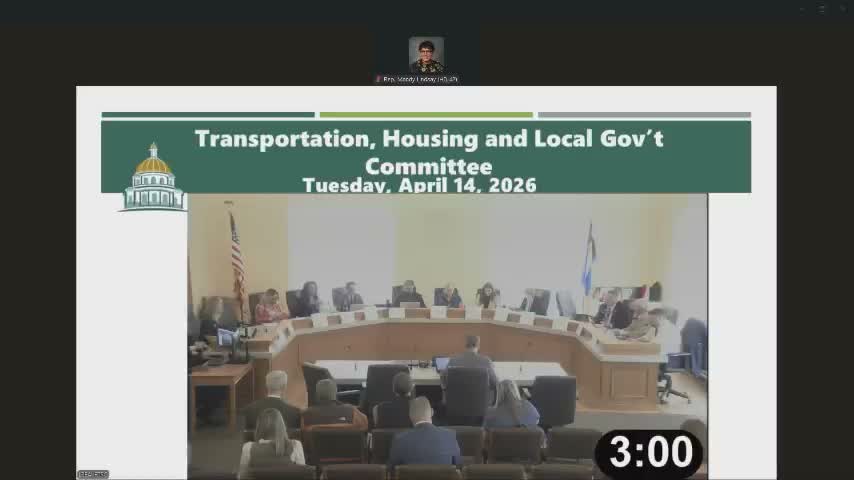
The House Housing and Local Government Committee debated an amended proposal to change Colorado's Noise Abatement Act on an action-only agenda and voted the measure down.
Representative Brooks, sponsor of the measure, described two amendments the sponsors offered in committee. She said amendment L12 "reinforces the private right of action under the Noise Abatement Act" and "makes expressly clear violations of local permit are not exempted from enforcement through litigation," and that the amendment also ensures counties can seek relief under the Noise Abatement Act or other remedies. Brooks later moved L13, which she said would lower the decibel threshold in the bill to 60 dB and create a process enabling a county to seek negotiation, an MOU, or an intergovernmental agreement with a municipality when noise exceeds that level.
Co-prime sponsor Representative Lindsey, who participated remotely, said she had reviewed the statute and that residential thresholds are "50 at nighttime and 55 during the day," framing L13 as a modest change consistent with statutory ranges. Representative Jackson thanked sponsors for listening to testimony but said the question was whether local control is working; he cautioned that the bill "shifts full responsibility to the local level." Representative Richardson underscored the acoustic implications, saying the difference between 50 and 60 decibels "is twice the perceived loudness," noting the scale is logarithmic.
Sponsors said the amendments were intended as good-faith concessions to address community testimony — including concerns from El Paso County residents who told sponsors they lacked a voice in municipal permitting decisions — while opponents warned the changes would remove state-level guardrails that protect residents. After debate, the committee recorded six votes in favor and seven opposed; the motion to send the bill as amended to the Committee of the Whole failed on a 7–6 vote. Vice Chair Stewart then moved to postpone Senate Bill 98 indefinitely on a reverse roll call, and that motion carried, removing the bill from near-term consideration.
The committee record shows the drafter confirmed current law exempts property use by the state, political subdivisions of the state, and nonprofit entities from statutory noise-level limits; sponsors disclaimed that the bill compelled permits or changed exemptions but said it requires conversation and negotiation when thresholds are exceeded.
What happens next: The committee postponed the bill indefinitely, effectively halting its progress in the current posture. Sponsors said they remain open to continuing conversations to find a compromise.
Representative Brooks, sponsor of the measure, described two amendments the sponsors offered in committee. She said amendment L12 "reinforces the private right of action under the Noise Abatement Act" and "makes expressly clear violations of local permit are not exempted from enforcement through litigation," and that the amendment also ensures counties can seek relief under the Noise Abatement Act or other remedies. Brooks later moved L13, which she said would lower the decibel threshold in the bill to 60 dB and create a process enabling a county to seek negotiation, an MOU, or an intergovernmental agreement with a municipality when noise exceeds that level.
Co-prime sponsor Representative Lindsey, who participated remotely, said she had reviewed the statute and that residential thresholds are "50 at nighttime and 55 during the day," framing L13 as a modest change consistent with statutory ranges. Representative Jackson thanked sponsors for listening to testimony but said the question was whether local control is working; he cautioned that the bill "shifts full responsibility to the local level." Representative Richardson underscored the acoustic implications, saying the difference between 50 and 60 decibels "is twice the perceived loudness," noting the scale is logarithmic.
Sponsors said the amendments were intended as good-faith concessions to address community testimony — including concerns from El Paso County residents who told sponsors they lacked a voice in municipal permitting decisions — while opponents warned the changes would remove state-level guardrails that protect residents. After debate, the committee recorded six votes in favor and seven opposed; the motion to send the bill as amended to the Committee of the Whole failed on a 7–6 vote. Vice Chair Stewart then moved to postpone Senate Bill 98 indefinitely on a reverse roll call, and that motion carried, removing the bill from near-term consideration.
The committee record shows the drafter confirmed current law exempts property use by the state, political subdivisions of the state, and nonprofit entities from statutory noise-level limits; sponsors disclaimed that the bill compelled permits or changed exemptions but said it requires conversation and negotiation when thresholds are exceeded.
What happens next: The committee postponed the bill indefinitely, effectively halting its progress in the current posture. Sponsors said they remain open to continuing conversations to find a compromise.
View the Full Meeting & All Its Details
This article offers just a summary. Unlock complete video, transcripts, and insights as a Founder Member.
✓
Watch full, unedited meeting videos
✓
Search every word spoken in unlimited transcripts
✓
AI summaries & real-time alerts (all government levels)
✓
Permanent access to expanding government content
30-day money-back guarantee
