JBC caucus says Medicaid growth forced painful cuts; committee plans summer review
April 14, 2026 | 2026 Legislature CO, Colorado
This article was created by AI summarizing key points discussed. AI makes mistakes, so for full details and context, please refer to the video of the full meeting. Please report any errors so we can fix them. Report an error »
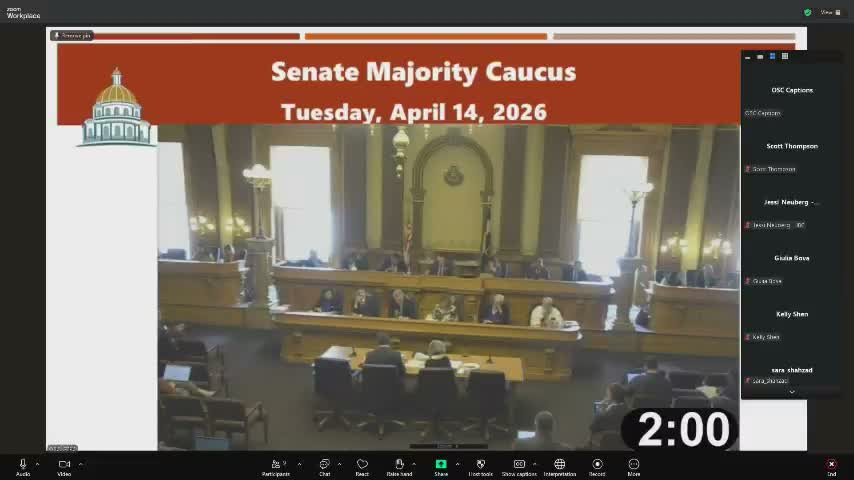
Senator Bridges and other caucus members framed Medicaid as one of the state's largest budget pressures, noting it represents approximately a third of the budget and grows faster than inflation. "A third of our budget is Medicaid," Bridges said, adding that health-care cost growth requires action to avoid the program crowding out other state services.
Senator Weissman explained the committee accepted some cuts but said Medicaid spending still rises: "If you just focus on the general fund, up by 3.7% from last year," Weissman said. The caucus listed specific program-level changes: reductions to behavioral-health spending, cuts affecting office of community living and IDD services, caps and age limits on the community connector program, reductions to provider rates, and targeted rate increases (for example, IV nutrition) to preserve scarce providers.
Members repeatedly described the year as a "harm reduction" budgeting exercise rather than benefit expansion. "We are not in a benefit expansion mode. We are in a harm reduction mode," a caucus member said, summarizing the tradeoffs. The committee signaled it will hold a summer series with the JBC and health committee chairs to examine Medicaid cost drivers, improve data accuracy and pursue options for utilization management and other cost-containment strategies.
The caucus also discussed audit and oversight tools (bills 1412/1413 were mentioned in the meeting as related to audit mechanisms for certain providers) and set aside funding to assist with a planned review and final recommendations.
Senator Weissman explained the committee accepted some cuts but said Medicaid spending still rises: "If you just focus on the general fund, up by 3.7% from last year," Weissman said. The caucus listed specific program-level changes: reductions to behavioral-health spending, cuts affecting office of community living and IDD services, caps and age limits on the community connector program, reductions to provider rates, and targeted rate increases (for example, IV nutrition) to preserve scarce providers.
Members repeatedly described the year as a "harm reduction" budgeting exercise rather than benefit expansion. "We are not in a benefit expansion mode. We are in a harm reduction mode," a caucus member said, summarizing the tradeoffs. The committee signaled it will hold a summer series with the JBC and health committee chairs to examine Medicaid cost drivers, improve data accuracy and pursue options for utilization management and other cost-containment strategies.
The caucus also discussed audit and oversight tools (bills 1412/1413 were mentioned in the meeting as related to audit mechanisms for certain providers) and set aside funding to assist with a planned review and final recommendations.
View the Full Meeting & All Its Details
This article offers just a summary. Unlock complete video, transcripts, and insights as a Founder Member.
✓
Watch full, unedited meeting videos
✓
Search every word spoken in unlimited transcripts
✓
AI summaries & real-time alerts (all government levels)
✓
Permanent access to expanding government content
30-day money-back guarantee
