San Diego Council adopts rules to comply with SB 707; organized virtual and in-person public comment formalized
April 14, 2026 | San Diego City, San Diego County, California
This article was created by AI summarizing key points discussed. AI makes mistakes, so for full details and context, please refer to the video of the full meeting. Please report any errors so we can fix them. Report an error »
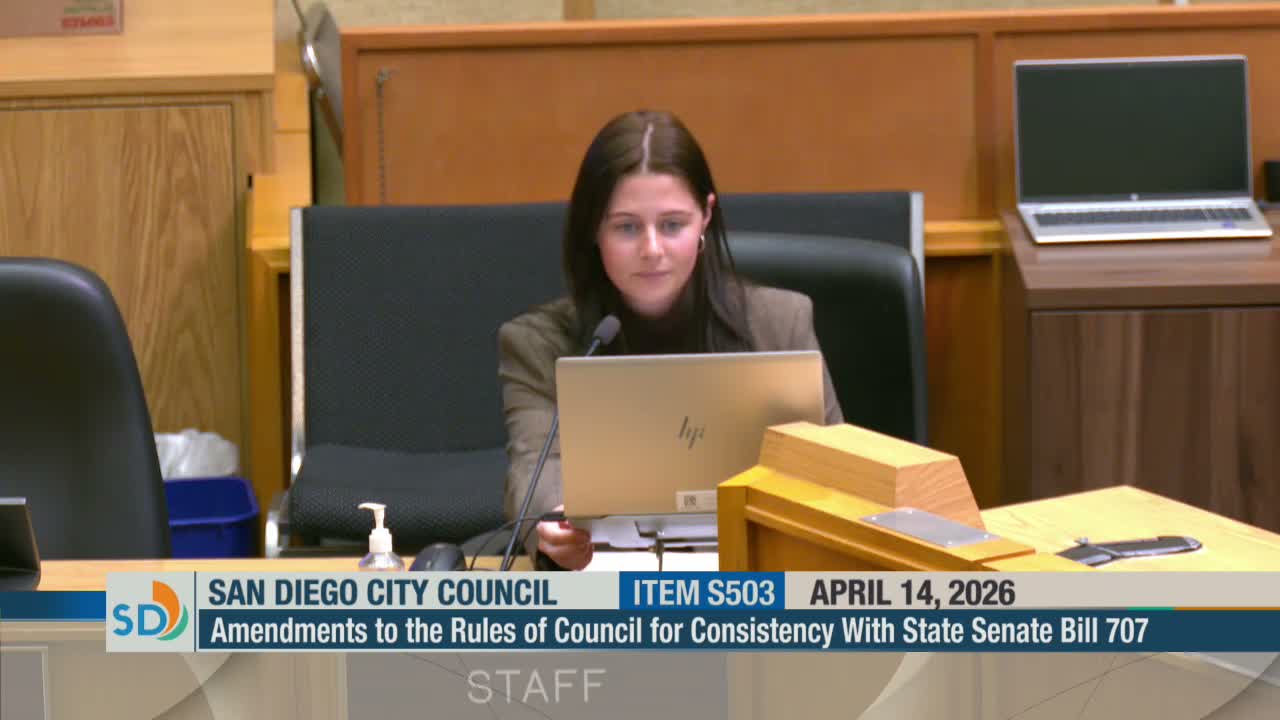
The San Diego City Council voted unanimously on April 14 to amend its Rules of Council to implement state law changes under SB 707. The adopted changes aim to ensure parity between in-person and virtual public participation, create a process for organized group presentations, and set a clear policy for Internet or telephonic disruptions that affect the public's ability to participate.
Senior policy advisor Abby Reuter summarized the key elements: group "organized presentations" will be allowed (up to 15 minutes), with a 24-hour filing requirement for regular meetings (and an 18-hour requirement for special meetings posted fewer than 48 hours in advance). Electronic presentation materials intended for display will be due two hours before the meeting to allow staff to scan and prepare. The amendments also clarify that if remote audio/video service is disrupted, the council will recess for up to one hour while staff attempts to restore service; if service cannot be restored the council may adjourn or make specific findings to continue.
The proposal also aligns closed-session practice with what the Brown Act requires by allowing recorded closed sessions rather than requiring a verbatim transcription by a court reporter, a change staff said would save material cost while complying with law.
Community planning groups (CPGs) and the Community Planners Committee (CPC) urged the council to go further by formalizing a "seat at the table" for recognized planning bodies so they can present deliberated recommendations with the same structure afforded to project applicants. Victoria Labruzzo of the CPC asked the council to adopt procedures that would grant planning groups equivalent presentation time and the opportunity for follow-up questions; councilmembers said they were open to further discussion on how to operationalize that request as staff and clerk offices implement the SB 707 changes.
What happens next: The rule changes take effect July 1, 2026. City clerk and council staff will refine implementation details and monitor public feedback as the new process is rolled out.
Senior policy advisor Abby Reuter summarized the key elements: group "organized presentations" will be allowed (up to 15 minutes), with a 24-hour filing requirement for regular meetings (and an 18-hour requirement for special meetings posted fewer than 48 hours in advance). Electronic presentation materials intended for display will be due two hours before the meeting to allow staff to scan and prepare. The amendments also clarify that if remote audio/video service is disrupted, the council will recess for up to one hour while staff attempts to restore service; if service cannot be restored the council may adjourn or make specific findings to continue.
The proposal also aligns closed-session practice with what the Brown Act requires by allowing recorded closed sessions rather than requiring a verbatim transcription by a court reporter, a change staff said would save material cost while complying with law.
Community planning groups (CPGs) and the Community Planners Committee (CPC) urged the council to go further by formalizing a "seat at the table" for recognized planning bodies so they can present deliberated recommendations with the same structure afforded to project applicants. Victoria Labruzzo of the CPC asked the council to adopt procedures that would grant planning groups equivalent presentation time and the opportunity for follow-up questions; councilmembers said they were open to further discussion on how to operationalize that request as staff and clerk offices implement the SB 707 changes.
What happens next: The rule changes take effect July 1, 2026. City clerk and council staff will refine implementation details and monitor public feedback as the new process is rolled out.
View the Full Meeting & All Its Details
This article offers just a summary. Unlock complete video, transcripts, and insights as a Founder Member.
✓
Watch full, unedited meeting videos
✓
Search every word spoken in unlimited transcripts
✓
AI summaries & real-time alerts (all government levels)
✓
Permanent access to expanding government content
30-day money-back guarantee
