Committee advances bill to expand court-ordered outpatient treatment as an alternative to incarceration
April 14, 2026 | 2026 Legislature OK, Oklahoma
This article was created by AI summarizing key points discussed. AI makes mistakes, so for full details and context, please refer to the video of the full meeting. Please report any errors so we can fix them. Report an error »
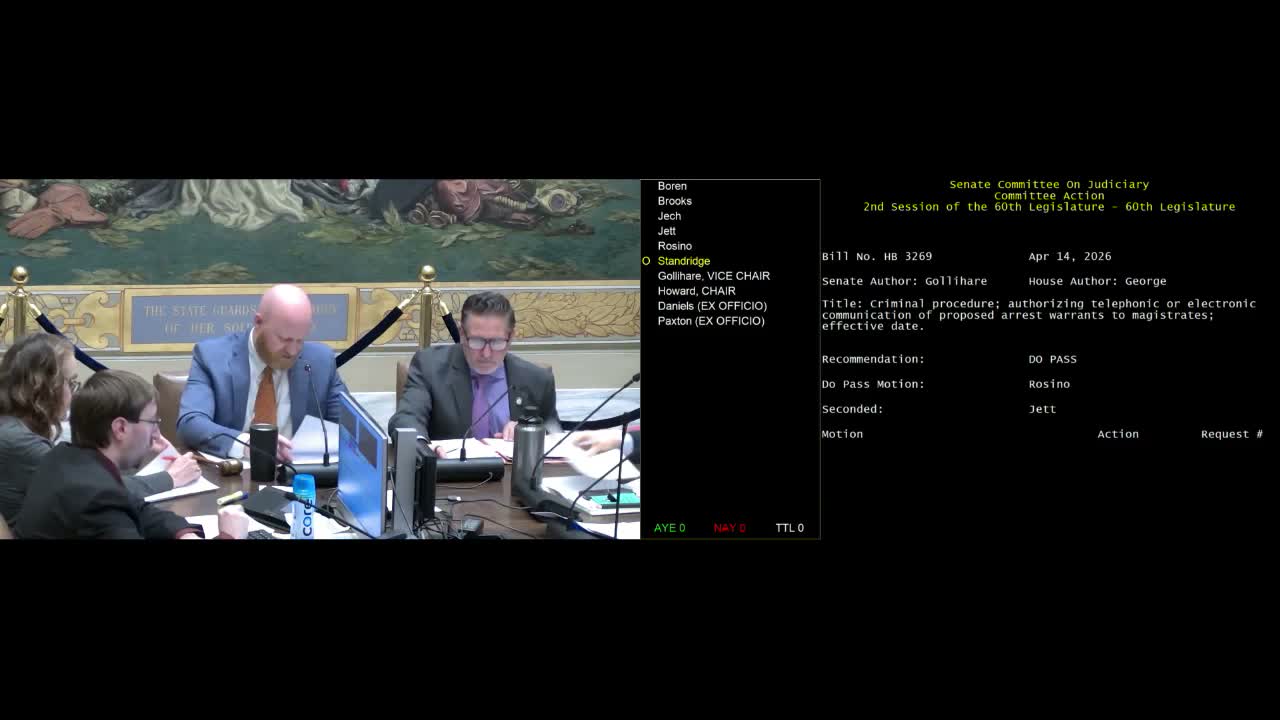
Vice Chair Galahari told the Senate Judiciary Committee that House Bill 3,587 "improves the processes, procedures, and protection for the implementation of court ordered outpatient treatment," and that the measure is intended to create a "stronger alternative to incarceration." Galahari said the bill would help judges require outpatient treatment in appropriate criminal cases and better coordinate with certified community mental health providers.
Senator Brooks pressed the sponsor in a series of follow-up questions about whether the bill applies only in criminal proceedings and what would happen if a person failed to follow a court-ordered treatment plan. Brooks asked whether failing to participate could result in contempt or jail; the sponsor replied, "That's not anticipated in this bill that they'd be put into jail or held in contempt," and described the provision as a diversion tool that would be used consistently and reliably to try to get people help.
The sponsor also said the bill anticipates coordination between district attorneys and certified community mental health or substance-abuse providers to work on competency restoration and treatment plans. Committee members discussed whether the bill covers only defendants who have a criminal case component; the sponsor confirmed it is targeted at people going through the criminal process and at times may involve competency restoration measures.
After questions and brief discussion, the committee voted to advance the bill. The chair announced the recorded tally as seven ayes and zero nays. The committee did not adopt amendments on the floor record. The measure will now proceed toward the chamber calendar for potential floor consideration.
Senator Brooks pressed the sponsor in a series of follow-up questions about whether the bill applies only in criminal proceedings and what would happen if a person failed to follow a court-ordered treatment plan. Brooks asked whether failing to participate could result in contempt or jail; the sponsor replied, "That's not anticipated in this bill that they'd be put into jail or held in contempt," and described the provision as a diversion tool that would be used consistently and reliably to try to get people help.
The sponsor also said the bill anticipates coordination between district attorneys and certified community mental health or substance-abuse providers to work on competency restoration and treatment plans. Committee members discussed whether the bill covers only defendants who have a criminal case component; the sponsor confirmed it is targeted at people going through the criminal process and at times may involve competency restoration measures.
After questions and brief discussion, the committee voted to advance the bill. The chair announced the recorded tally as seven ayes and zero nays. The committee did not adopt amendments on the floor record. The measure will now proceed toward the chamber calendar for potential floor consideration.
View the Full Meeting & All Its Details
This article offers just a summary. Unlock complete video, transcripts, and insights as a Founder Member.
✓
Watch full, unedited meeting videos
✓
Search every word spoken in unlimited transcripts
✓
AI summaries & real-time alerts (all government levels)
✓
Permanent access to expanding government content
30-day money-back guarantee
