Committee advances GPS-tracking requirement for some repeat domestic-violence defendants
April 14, 2026 | 2026 Legislature OK, Oklahoma
This article was created by AI summarizing key points discussed. AI makes mistakes, so for full details and context, please refer to the video of the full meeting. Please report any errors so we can fix them. Report an error »
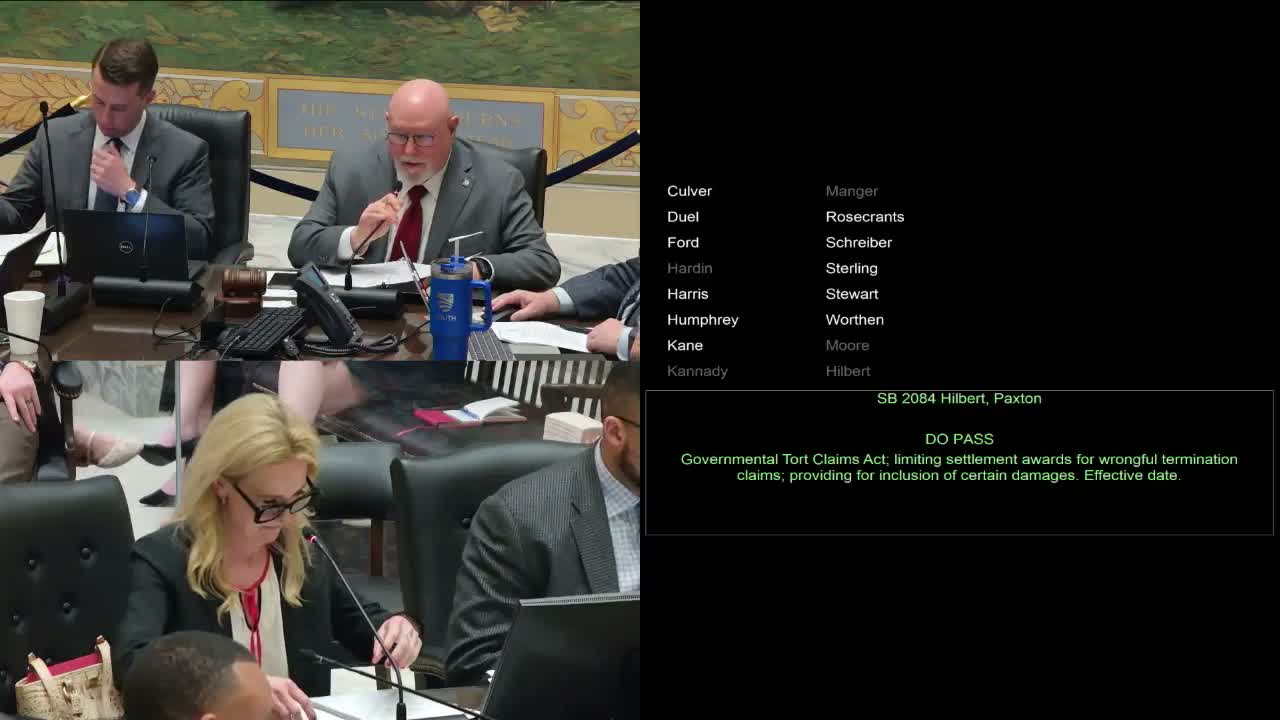
The committee advanced Senate Bill 13-25, moving the measure out of committee after extended debate over whether mandatory electronic monitoring for some repeat domestic-violence defendants on bond would protect victims or create practical and legal problems.
The sponsor said the measure is intended to protect victims at a high-risk moment — when alleged perpetrators are released on bond — and cited Oklahoma’s high domestic-homicide rate as part of the rationale. "Oklahoma today is the number 1 place for a woman to be killed by her intimate partner," the sponsor said, arguing that monitoring could keep victims safer until adjudication.
Lawmakers pressed the sponsor on implementation details. One committee member asked who would perform monitoring and whether the Department of Corrections would be tasked with that work; the sponsor said monitoring would be handled through district attorneys’ offices and not by DOC. Another lawmaker raised the cost question, noting that a monitoring device cost "probably almost $400" a decade ago and that costs could be a barrier if the statute requires defendants to pay unless they are declared indigent. The sponsor replied that perpetrators would generally be required to pay for devices unless they proved indigence and that indigent defense funds could be requested to cover costs in individual cases.
Members also asked about the bill’s application to persons who have not been convicted. A committee member pressed whether the requirement might conflict with the presumption of innocence; the sponsor said the bill would apply after a second charge and compared it to court-ordered ignition interlock requirements used in DUI cases as a condition of bond.
After questions and discussion about costs, monitoring responsibility and the bill’s scope, the committee voted to report the measure as do pass. The committee report indicated a committee tally consistent with a majority in favor.
The sponsor said the measure is intended to protect victims at a high-risk moment — when alleged perpetrators are released on bond — and cited Oklahoma’s high domestic-homicide rate as part of the rationale. "Oklahoma today is the number 1 place for a woman to be killed by her intimate partner," the sponsor said, arguing that monitoring could keep victims safer until adjudication.
Lawmakers pressed the sponsor on implementation details. One committee member asked who would perform monitoring and whether the Department of Corrections would be tasked with that work; the sponsor said monitoring would be handled through district attorneys’ offices and not by DOC. Another lawmaker raised the cost question, noting that a monitoring device cost "probably almost $400" a decade ago and that costs could be a barrier if the statute requires defendants to pay unless they are declared indigent. The sponsor replied that perpetrators would generally be required to pay for devices unless they proved indigence and that indigent defense funds could be requested to cover costs in individual cases.
Members also asked about the bill’s application to persons who have not been convicted. A committee member pressed whether the requirement might conflict with the presumption of innocence; the sponsor said the bill would apply after a second charge and compared it to court-ordered ignition interlock requirements used in DUI cases as a condition of bond.
After questions and discussion about costs, monitoring responsibility and the bill’s scope, the committee voted to report the measure as do pass. The committee report indicated a committee tally consistent with a majority in favor.
View the Full Meeting & All Its Details
This article offers just a summary. Unlock complete video, transcripts, and insights as a Founder Member.
✓
Watch full, unedited meeting videos
✓
Search every word spoken in unlimited transcripts
✓
AI summaries & real-time alerts (all government levels)
✓
Permanent access to expanding government content
30-day money-back guarantee
