County panel warns HR 1 and other state/federal shifts will force deep local budget tradeoffs
March 16, 2026 | Alameda County, California
This article was created by AI summarizing key points discussed. AI makes mistakes, so for full details and context, please refer to the video of the full meeting. Please report any errors so we can fix them. Report an error »
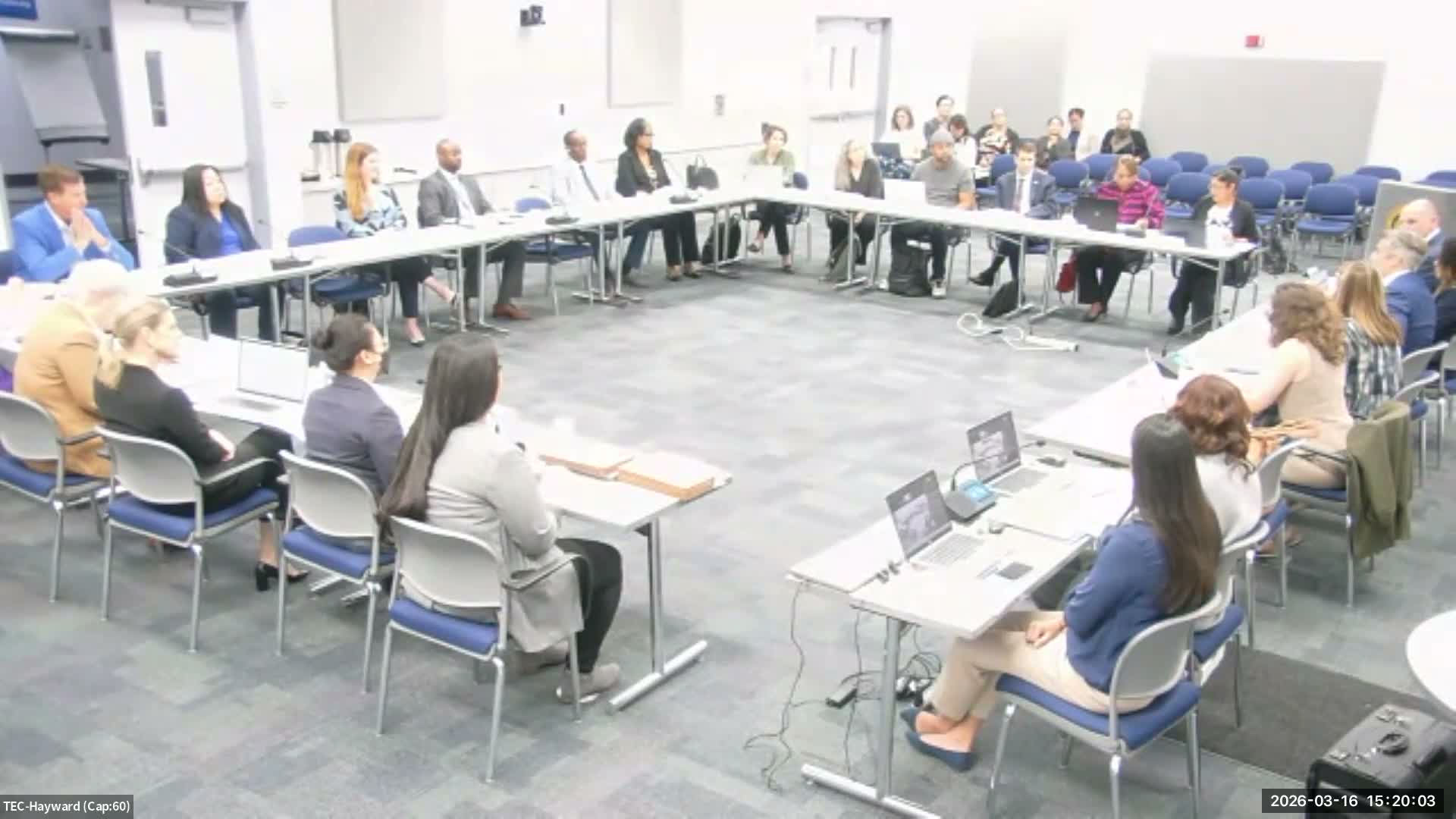
A panel of statewide health, hospital and welfare association chiefs told the Alameda County Board of Supervisors' budget work group on March 16 that recent federal and state policy changes — particularly the federal HR 1 Medicaid cuts and shifting state program decisions — will push substantial costs and workloads onto counties unless the state or federal government provides new funding.
During a panel moderated by Anika Choudhry, interim director of Alameda County Health, Carlos Marquez, executive director of the California Welfare Directors Association, said automation can cover part of the workload but counties will remain responsible for complex redeterminations. "About 2,800,000 current enrollees who are part of the ACA expansion population will ultimately be left to the county eligibility workforce," Marquez said, and he added that roughly 950,000 CalFresh recipients will require county support for exemptions or income verification.
The panel included Laura Lane of the California Association of Public Hospitals and Michelle Cabrera of the County Behavioral Health Directors Association. Lane said HR 1 reduced federal Medicaid matching funds and state directed payments, creating a structural shortfall she estimated at about $1.5 billion annually for public hospital systems and potential statewide losses of up to $5 billion once HR 1 is fully implemented. "Patients who lose coverage will still show up sicker," Lane said, predicting higher uncompensated‑care costs for county hospitals.
Cabrera described tensions in the behavioral‑health budget under Proposition 1’s infrastructure grants, noting that one‑time construction money requires counties to fund ongoing services. She said Alameda County likely will have to cut roughly $53 million in existing mental‑health services to free funds for the Prop 1 housing set‑aside. "You're getting the building, but the batteries aren't included," Cabrera said, warning that counties face ongoing service obligations that the grants do not fund.
Michelle Gibbons of the County Health Executives Association emphasized that public‑health capacity expanded during the COVID response is being eroded as pandemic‑era funding expires. She said counties are losing staff and technology supports and face renewed manual workloads for disease investigation and case follow‑up.
Graham Canals, CEO of the California State Association of Counties, framed the issue as a broad cost‑shift: "There has been an unparalleled attempt by state and federal government to shift both costs and responsibilities to counties," he said, urging coordinated state and legislative action and one‑time aid while counties plan longer‑term solutions.
Why it matters: Panelists said the combination of HR 1, state policy choices (including changes to eligibility and benefits), and the expiration of pandemic funding could force counties to cut prevention and community services, reduce hospital and public‑health capacity, and increase local uncompensated care and public‑safety costs. Panelists urged county leaders to press the state for targeted, timely assistance for eligibility workers, hospitals and behavioral‑health services.
Panelists and staff described several near‑term numeric impacts presented to the board: a potential reduction of public‑hospital revenues in the hundreds of millions statewide, a ballpark estimate of $224 million in new county behavioral‑health costs for FY 2026–27, and state estimates that automation might address about 40% of impacted Medi‑Cal enrollees but leave the remainder to county caseworkers.
The board thanked the panel and signaled it will use the testimony in upcoming budget work sessions and legislative outreach. The county’s budget schedule (an early work session April 14 and proposed budget to the board by May 28) was reiterated so staff can incorporate these statewide pressures into local projections.
During a panel moderated by Anika Choudhry, interim director of Alameda County Health, Carlos Marquez, executive director of the California Welfare Directors Association, said automation can cover part of the workload but counties will remain responsible for complex redeterminations. "About 2,800,000 current enrollees who are part of the ACA expansion population will ultimately be left to the county eligibility workforce," Marquez said, and he added that roughly 950,000 CalFresh recipients will require county support for exemptions or income verification.
The panel included Laura Lane of the California Association of Public Hospitals and Michelle Cabrera of the County Behavioral Health Directors Association. Lane said HR 1 reduced federal Medicaid matching funds and state directed payments, creating a structural shortfall she estimated at about $1.5 billion annually for public hospital systems and potential statewide losses of up to $5 billion once HR 1 is fully implemented. "Patients who lose coverage will still show up sicker," Lane said, predicting higher uncompensated‑care costs for county hospitals.
Cabrera described tensions in the behavioral‑health budget under Proposition 1’s infrastructure grants, noting that one‑time construction money requires counties to fund ongoing services. She said Alameda County likely will have to cut roughly $53 million in existing mental‑health services to free funds for the Prop 1 housing set‑aside. "You're getting the building, but the batteries aren't included," Cabrera said, warning that counties face ongoing service obligations that the grants do not fund.
Michelle Gibbons of the County Health Executives Association emphasized that public‑health capacity expanded during the COVID response is being eroded as pandemic‑era funding expires. She said counties are losing staff and technology supports and face renewed manual workloads for disease investigation and case follow‑up.
Graham Canals, CEO of the California State Association of Counties, framed the issue as a broad cost‑shift: "There has been an unparalleled attempt by state and federal government to shift both costs and responsibilities to counties," he said, urging coordinated state and legislative action and one‑time aid while counties plan longer‑term solutions.
Why it matters: Panelists said the combination of HR 1, state policy choices (including changes to eligibility and benefits), and the expiration of pandemic funding could force counties to cut prevention and community services, reduce hospital and public‑health capacity, and increase local uncompensated care and public‑safety costs. Panelists urged county leaders to press the state for targeted, timely assistance for eligibility workers, hospitals and behavioral‑health services.
Panelists and staff described several near‑term numeric impacts presented to the board: a potential reduction of public‑hospital revenues in the hundreds of millions statewide, a ballpark estimate of $224 million in new county behavioral‑health costs for FY 2026–27, and state estimates that automation might address about 40% of impacted Medi‑Cal enrollees but leave the remainder to county caseworkers.
The board thanked the panel and signaled it will use the testimony in upcoming budget work sessions and legislative outreach. The county’s budget schedule (an early work session April 14 and proposed budget to the board by May 28) was reiterated so staff can incorporate these statewide pressures into local projections.
Don't Miss a Word: See the Full Meeting!
Go beyond summaries. Unlock every video, transcript, and key insight with a Founder Membership.
✓
Get instant access to full meeting videos
✓
Search and clip any phrase from complete transcripts
✓
Receive AI-powered summaries & custom alerts
✓
Enjoy lifetime, unrestricted access to government data
30-day money-back guarantee
