Preliminary panel at Denton City Board of Ethics finds sample complaint alleging paid consulting and vote actionable
April 13, 2026 | Denton City, Denton County, Texas
This article was created by AI summarizing key points discussed. AI makes mistakes, so for full details and context, please refer to the video of the full meeting. Please report any errors so we can fix them. Report an error »
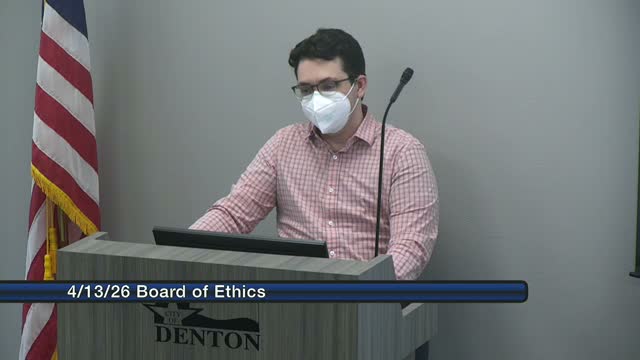
During training at its April 13 special call, the Denton City Board of Ethics ran a mock preliminary assessment and found a sample complaint alleging possible improper influence actionable and appropriate to advance to a hearing.
The complaint — read aloud by the chair as part of the exercise — identifies Kate Smith as the complainant and alleges John R. Matthews, a member of the Zoning Board of Adjustment, accepted paid consulting with Lakeside Properties LLC from October 2025 through Jan. 10, 2026 and then voted on a Lakeside variance on Jan. 26. The complaint cites Section 2-2-73 of the city ethics ordinance (outside employment) and section 2-2-73(e) (improper influence), and the packet included payment records described in the complaint showing consulting fees paid to Matthews in December 2025 and January 2026 for $10,000.
Henry Thomas (speaker 3), explaining the preliminary-assessment standard, told the panel: “The purpose of the preliminary assessment is really just to read the complaint as it's written, assume that it's true, and if it was true ... would the facts as presented be a violation of the ethics ordinance?” Using that standard, members discussed whether the outside-employment provision applied to a volunteer board member and whether the allegations better fit improper influence or a conflict-of-interest theory. Several members said outside employment likely did not apply but that improper influence and the conflict-of-interest checkboxes could make the complaint actionable. One member pointed to the payment records as strengthening the allegations.
The panel concluded, for screening purposes, that the sample complaint (Example 01) was actionable and should be advanced to a full hearing. Members directed that a letter be drafted to notify the complainant and respondent of the panel’s determination and that both parties be given an opportunity to submit additional evidence before a hearing date is scheduled.
The panel also reviewed process safeguards, with members reminding one another that ex parte communications about ethics complaints are prohibited and that rolling quorums or off-record discussions could violate the Open Meetings Act and local ordinance. The mock assessment and the procedural review were scheduled to continue as a training item at the June meeting so the full board could run through a mock hearing when more members are present.
No response from the respondent appears in the mock exercise; the panel’s determination at this stage is to advance the complaint to a hearing, not a finding of violation.
The complaint — read aloud by the chair as part of the exercise — identifies Kate Smith as the complainant and alleges John R. Matthews, a member of the Zoning Board of Adjustment, accepted paid consulting with Lakeside Properties LLC from October 2025 through Jan. 10, 2026 and then voted on a Lakeside variance on Jan. 26. The complaint cites Section 2-2-73 of the city ethics ordinance (outside employment) and section 2-2-73(e) (improper influence), and the packet included payment records described in the complaint showing consulting fees paid to Matthews in December 2025 and January 2026 for $10,000.
Henry Thomas (speaker 3), explaining the preliminary-assessment standard, told the panel: “The purpose of the preliminary assessment is really just to read the complaint as it's written, assume that it's true, and if it was true ... would the facts as presented be a violation of the ethics ordinance?” Using that standard, members discussed whether the outside-employment provision applied to a volunteer board member and whether the allegations better fit improper influence or a conflict-of-interest theory. Several members said outside employment likely did not apply but that improper influence and the conflict-of-interest checkboxes could make the complaint actionable. One member pointed to the payment records as strengthening the allegations.
The panel concluded, for screening purposes, that the sample complaint (Example 01) was actionable and should be advanced to a full hearing. Members directed that a letter be drafted to notify the complainant and respondent of the panel’s determination and that both parties be given an opportunity to submit additional evidence before a hearing date is scheduled.
The panel also reviewed process safeguards, with members reminding one another that ex parte communications about ethics complaints are prohibited and that rolling quorums or off-record discussions could violate the Open Meetings Act and local ordinance. The mock assessment and the procedural review were scheduled to continue as a training item at the June meeting so the full board could run through a mock hearing when more members are present.
No response from the respondent appears in the mock exercise; the panel’s determination at this stage is to advance the complaint to a hearing, not a finding of violation.
Don't Miss a Word: See the Full Meeting!
Go beyond summaries. Unlock every video, transcript, and key insight with a Founder Membership.
✓
Get instant access to full meeting videos
✓
Search and clip any phrase from complete transcripts
✓
Receive AI-powered summaries & custom alerts
✓
Enjoy lifetime, unrestricted access to government data
30-day money-back guarantee
