Committee advances Stand for Security Act after heated debate over training and costs
April 13, 2026 | California State Senate, Senate, Legislative, California
This article was created by AI summarizing key points discussed. AI makes mistakes, so for full details and context, please refer to the video of the full meeting. Please report any errors so we can fix them. Report an error »
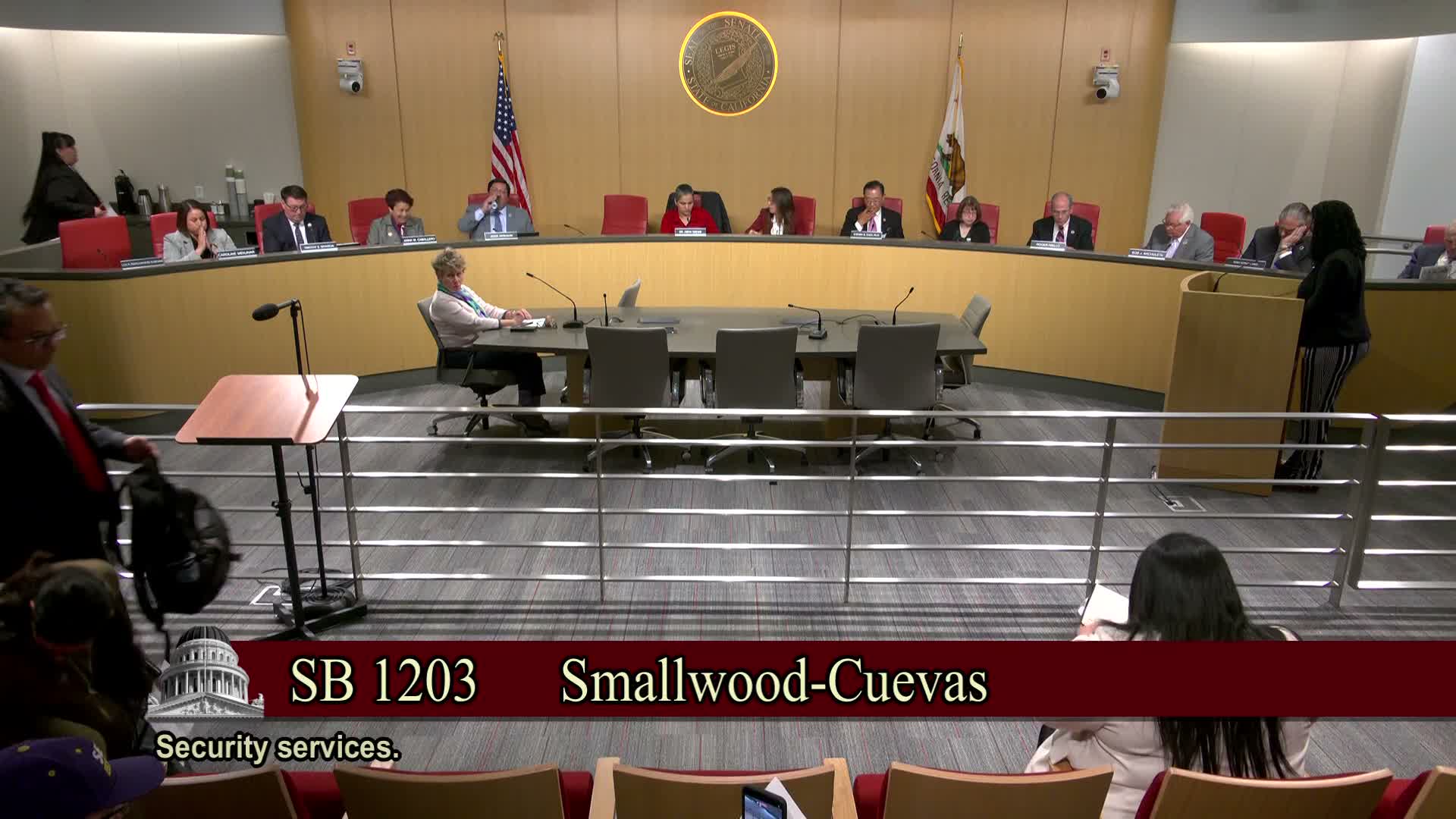
Senator Smallwood Cuevas presented SB 12 03, the ‘‘Stand for Security Act,’’ proposing new training standards, expanded in‑person trauma‑informed de‑escalation instruction, prohibitions on on‑duty/phone‑based training, and direction to the Industrial Welfare Commission to study wages and working conditions and issue an industry wage order if warranted.
Union representatives and many security officers testified in strongly personal terms. Multiple witnesses said officers routinely encounter violent incidents, suffer injury and return to work without adequate preparation, and face high turnover exceeding 50% annually. They urged mandatory, role‑based training with live practice and employer accountability on wages and scheduling.
Employer groups and trade associations — including the California Chamber, Allied Universal and other large employers — strongly opposed the bill, arguing California already leads the nation in security training and estimating very large industry costs, potential outsourcing risks and an increase in unregulated providers if training and wage mandates are imposed. They warned of costs running into the hundreds of millions or billions annually and urged more stakeholder work.
Committee members raised detailed implementation questions: whether the CBA condition for some training approvals would exclude many employers, how emergency regulations would work, whether third‑party trainers exist at scale, and whether the bill would unintentionally reverse recent training reforms. The sponsor said amendments carve out on‑post training and seek to preserve hybrid elements while requiring a higher standard for in‑person de‑escalation practice.
After extensive questioning and offers to negotiate technical fixes, the committee moved SB 12 03 to Public Safety for additional review; several members said they would press for amendments on timing, funding, exemptions for small employers and enforcement mechanics.
Union representatives and many security officers testified in strongly personal terms. Multiple witnesses said officers routinely encounter violent incidents, suffer injury and return to work without adequate preparation, and face high turnover exceeding 50% annually. They urged mandatory, role‑based training with live practice and employer accountability on wages and scheduling.
Employer groups and trade associations — including the California Chamber, Allied Universal and other large employers — strongly opposed the bill, arguing California already leads the nation in security training and estimating very large industry costs, potential outsourcing risks and an increase in unregulated providers if training and wage mandates are imposed. They warned of costs running into the hundreds of millions or billions annually and urged more stakeholder work.
Committee members raised detailed implementation questions: whether the CBA condition for some training approvals would exclude many employers, how emergency regulations would work, whether third‑party trainers exist at scale, and whether the bill would unintentionally reverse recent training reforms. The sponsor said amendments carve out on‑post training and seek to preserve hybrid elements while requiring a higher standard for in‑person de‑escalation practice.
After extensive questioning and offers to negotiate technical fixes, the committee moved SB 12 03 to Public Safety for additional review; several members said they would press for amendments on timing, funding, exemptions for small employers and enforcement mechanics.
Don't Miss a Word: See the Full Meeting!
Go beyond summaries. Unlock every video, transcript, and key insight with a Founder Membership.
✓
Get instant access to full meeting videos
✓
Search and clip any phrase from complete transcripts
✓
Receive AI-powered summaries & custom alerts
✓
Enjoy lifetime, unrestricted access to government data
30-day money-back guarantee
