Denver commenters urge council to reject Axon surveillance contract, cite privacy and ICE concerns
March 16, 2026 | Denver (Consolidated County and City), Colorado
This article was created by AI summarizing key points discussed. AI makes mistakes, so for full details and context, please refer to the video of the full meeting. Please report any errors so we can fix them. Report an error »
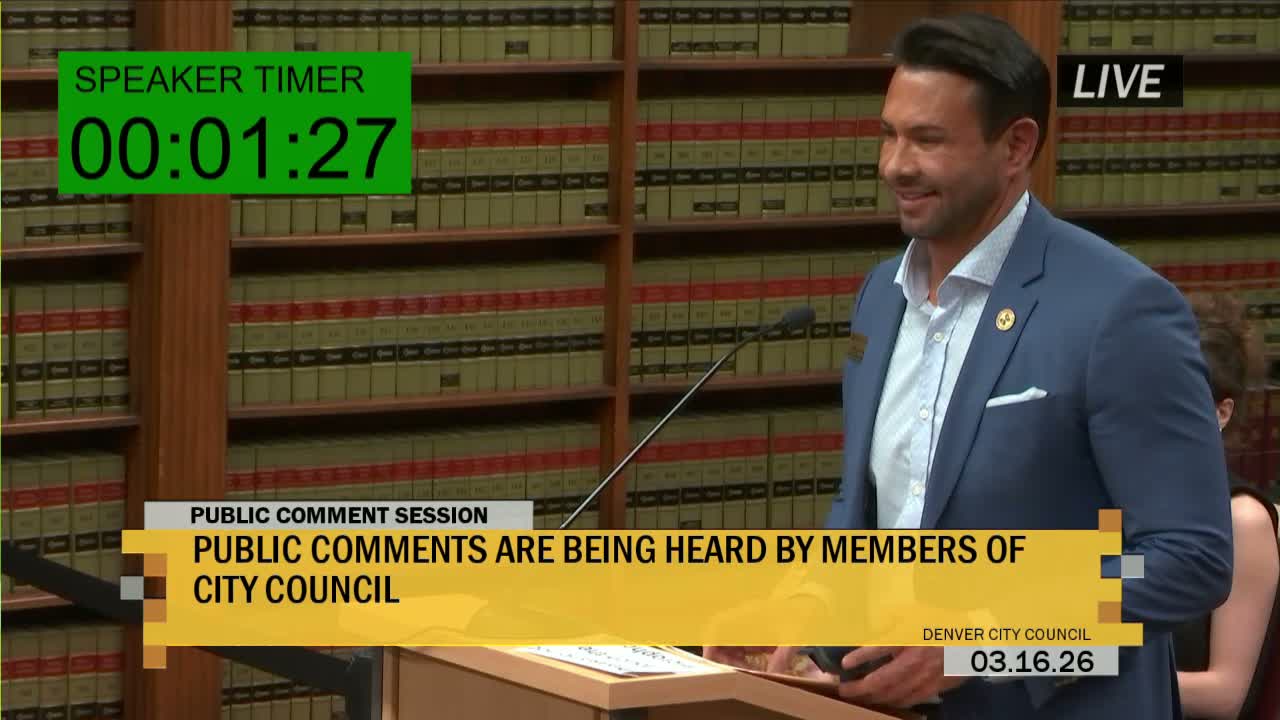
Dozens of Denver residents and educators used the city’s public-comment period to urge the Denver City and County Council not to approve a proposed surveillance contract with Axon, warning that the technology would threaten privacy and could expose residents to federal enforcement.
Robert Gould, president of the Denver Classroom Teachers Association, told the council the community should invest in housing, schools and social services rather than “invasive technology that monitors and polices our neighborhoods.” He said surveillance systems have been used disproportionately against working-class communities and communities of color.
“Every dollar spent on surveillance is a dollar that could instead support housing, public transportation, health care, schools,” Gould said.
Several speakers tied surveillance concerns to immigration enforcement. Gabriel Guerrero, a tenth-grade teacher at Abraham Lincoln High School, said his school’s enrollment has fallen from about 900 to 733 and blamed fear of federal enforcement and local surveillance for driving families away. “Our community should feel safe and welcoming for everyone,” he said.
A public commenter who said they had been arrested during a 2024 protest described distrust of the Denver Police Department (DPD), cited a $14,000,000 settlement paid to 12 protesters, and warned that data from cameras and license-plate readers could be subpoenaed by federal agencies. “I am skeptical of DPD’s promise to use these cameras to stop criminals,” the commenter said.
Isabella Nevin, a political organizer with Our Revolution, cited corporate-scale and contract history as reasons to oppose Axon. Nevin said Axon is “valued at $46,000,000,000” and asserted the company has earned about $93,000,000 from ICE-related contracts in the past 20 years, arguing the firm’s integrated data systems could expand surveillance beyond intended uses.
Carla Trevino, a city employee in the Auditor’s Office, told the council that once data exist they can be misused, stolen or hacked and that “our community should not become a place where everyone is treated as a potential suspect.” She urged council members to consider the equity implications and long-term risks of investing public funds in surveillance.
Speakers repeatedly asked the council to redirect resources to services they said reduce crime—housing, wages and access to mental health supports—rather than to surveillance technology. No council response or vote was recorded during the public-comment period.
The public-comment session closed without action; the moderator said anyone not heard could attend the next session or submit written comments. The council’s next public-comment session was announced for Monday, March 23.
Robert Gould, president of the Denver Classroom Teachers Association, told the council the community should invest in housing, schools and social services rather than “invasive technology that monitors and polices our neighborhoods.” He said surveillance systems have been used disproportionately against working-class communities and communities of color.
“Every dollar spent on surveillance is a dollar that could instead support housing, public transportation, health care, schools,” Gould said.
Several speakers tied surveillance concerns to immigration enforcement. Gabriel Guerrero, a tenth-grade teacher at Abraham Lincoln High School, said his school’s enrollment has fallen from about 900 to 733 and blamed fear of federal enforcement and local surveillance for driving families away. “Our community should feel safe and welcoming for everyone,” he said.
A public commenter who said they had been arrested during a 2024 protest described distrust of the Denver Police Department (DPD), cited a $14,000,000 settlement paid to 12 protesters, and warned that data from cameras and license-plate readers could be subpoenaed by federal agencies. “I am skeptical of DPD’s promise to use these cameras to stop criminals,” the commenter said.
Isabella Nevin, a political organizer with Our Revolution, cited corporate-scale and contract history as reasons to oppose Axon. Nevin said Axon is “valued at $46,000,000,000” and asserted the company has earned about $93,000,000 from ICE-related contracts in the past 20 years, arguing the firm’s integrated data systems could expand surveillance beyond intended uses.
Carla Trevino, a city employee in the Auditor’s Office, told the council that once data exist they can be misused, stolen or hacked and that “our community should not become a place where everyone is treated as a potential suspect.” She urged council members to consider the equity implications and long-term risks of investing public funds in surveillance.
Speakers repeatedly asked the council to redirect resources to services they said reduce crime—housing, wages and access to mental health supports—rather than to surveillance technology. No council response or vote was recorded during the public-comment period.
The public-comment session closed without action; the moderator said anyone not heard could attend the next session or submit written comments. The council’s next public-comment session was announced for Monday, March 23.
View the Full Meeting & All Its Details
This article offers just a summary. Unlock complete video, transcripts, and insights as a Founder Member.
✓
Watch full, unedited meeting videos
✓
Search every word spoken in unlimited transcripts
✓
AI summaries & real-time alerts (all government levels)
✓
Permanent access to expanding government content
30-day money-back guarantee
