Commission backs Class 1 multi‑use trail instead of buffered bike lane for Hope Elementary, asks for countdown walk signals
May 06, 2024 | Carlsbad, San Diego County, California
This article was created by AI summarizing key points discussed. AI makes mistakes, so for full details and context, please refer to the video of the full meeting. Please report any errors so we can fix them. Report an error »
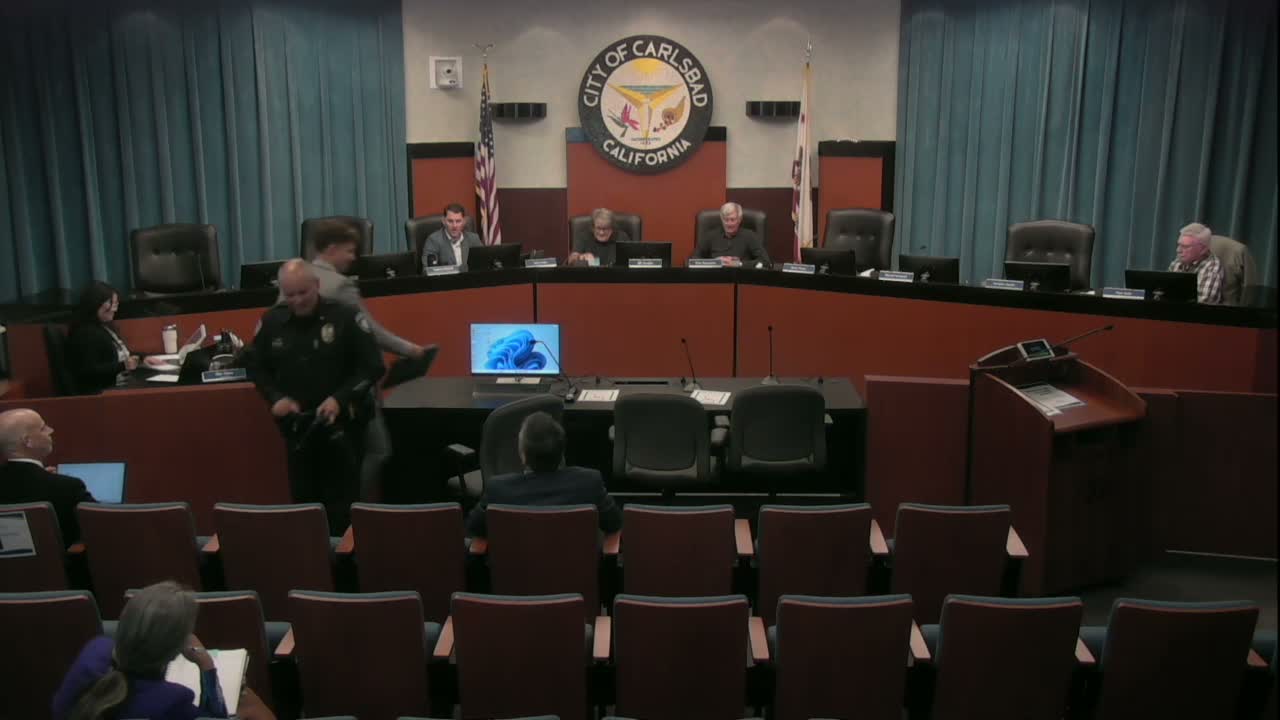
Nathan Schmidt, the city’s transportation planning and mobility manager, presented the Hope Elementary Safe Routes to School plan and said the project aims to improve walking and biking access while addressing localized congestion at pick‑up and drop‑off times. He said outreach included two listening sessions, walk audits and door‑to‑door notifications, and that parents and staff reported a gap in the existing Class 2 bike lane at the school frontage and concerns about parking and queuing.
Nick Gorman, the city’s associate engineer, described proposed infrastructure: leading pedestrian intervals and countdown pedestrian heads at Tamarack Avenue and Carlsbad Village Drive, high‑visibility crosswalks, curb extensions, school‑zone flashing beacons active only during arrival and dismissal, and a potential extension of the bike lane that would remove approximately 55 parking stalls along the school frontage. Gorman said a Class 2 buffered lane would be a restriping measure, while the recommended Class 1 multi‑use trail on the east side of Tamarack would be a constructed, separated path that preserves curbside parking but requires funding and thus is a longer‑term, unfunded recommendation.
Neighbors who spoke during public comment raised concerns that informed the commission’s discussion. Malcolm Muter, who lives across from the school, asked that staff provide a contact if flashing beacons accidentally remain lit at night. Ronnell Muter said the proposed multi‑use path would run adjacent to their backyard and raised privacy and safety concerns given steep hills and recent crashes on Tamarack.
Commissioners debated trade‑offs between parking loss and separated facilities. Commissioner Ben Sears suggested a rolling one‑year view for data and warned that removing parking often triggers strong neighborhood pushback; Commissioner Culp proposed adding countdown timers on the walk phase and making the school‑front crosswalk an exclusive pedestrian phase. Staff said the Class 1 option would require grant funding and that other non‑infrastructure measures (park‑and‑walk locations and bike education) would accompany physical improvements.
A motion to forward staff’s recommendation—that the plan be revised to provide a Class 1 multi‑use trail on the east side of Tamarack Avenue in lieu of the Class 2 buffered bike lane from Chatham Road to the school frontage, and to request staff consider countdown pedestrian display on the walk phase—was moved, seconded and approved. The transcript records the voice vote as “4 yeses, no nos, and 3 absent.” The commission will send the recommendation to City Council for decision on funding and final design.
Next steps: staff will revise the plan per the commission’s feedback and present it to City Council; the Class 1 multi‑use trail remains an unfunded element pending grant or other funding sources.
Nick Gorman, the city’s associate engineer, described proposed infrastructure: leading pedestrian intervals and countdown pedestrian heads at Tamarack Avenue and Carlsbad Village Drive, high‑visibility crosswalks, curb extensions, school‑zone flashing beacons active only during arrival and dismissal, and a potential extension of the bike lane that would remove approximately 55 parking stalls along the school frontage. Gorman said a Class 2 buffered lane would be a restriping measure, while the recommended Class 1 multi‑use trail on the east side of Tamarack would be a constructed, separated path that preserves curbside parking but requires funding and thus is a longer‑term, unfunded recommendation.
Neighbors who spoke during public comment raised concerns that informed the commission’s discussion. Malcolm Muter, who lives across from the school, asked that staff provide a contact if flashing beacons accidentally remain lit at night. Ronnell Muter said the proposed multi‑use path would run adjacent to their backyard and raised privacy and safety concerns given steep hills and recent crashes on Tamarack.
Commissioners debated trade‑offs between parking loss and separated facilities. Commissioner Ben Sears suggested a rolling one‑year view for data and warned that removing parking often triggers strong neighborhood pushback; Commissioner Culp proposed adding countdown timers on the walk phase and making the school‑front crosswalk an exclusive pedestrian phase. Staff said the Class 1 option would require grant funding and that other non‑infrastructure measures (park‑and‑walk locations and bike education) would accompany physical improvements.
A motion to forward staff’s recommendation—that the plan be revised to provide a Class 1 multi‑use trail on the east side of Tamarack Avenue in lieu of the Class 2 buffered bike lane from Chatham Road to the school frontage, and to request staff consider countdown pedestrian display on the walk phase—was moved, seconded and approved. The transcript records the voice vote as “4 yeses, no nos, and 3 absent.” The commission will send the recommendation to City Council for decision on funding and final design.
Next steps: staff will revise the plan per the commission’s feedback and present it to City Council; the Class 1 multi‑use trail remains an unfunded element pending grant or other funding sources.
View the Full Meeting & All Its Details
This article offers just a summary. Unlock complete video, transcripts, and insights as a Founder Member.
✓
Watch full, unedited meeting videos
✓
Search every word spoken in unlimited transcripts
✓
AI summaries & real-time alerts (all government levels)
✓
Permanent access to expanding government content
30-day money-back guarantee
