Assembly panel hears pleas to sustain California’s reproductive health safety net as HR 1 reduces federal funding
April 06, 2026 | California State Assembly, House, Legislative, California
This article was created by AI summarizing key points discussed. AI makes mistakes, so for full details and context, please refer to the video of the full meeting. Please report any errors so we can fix them. Report an error »
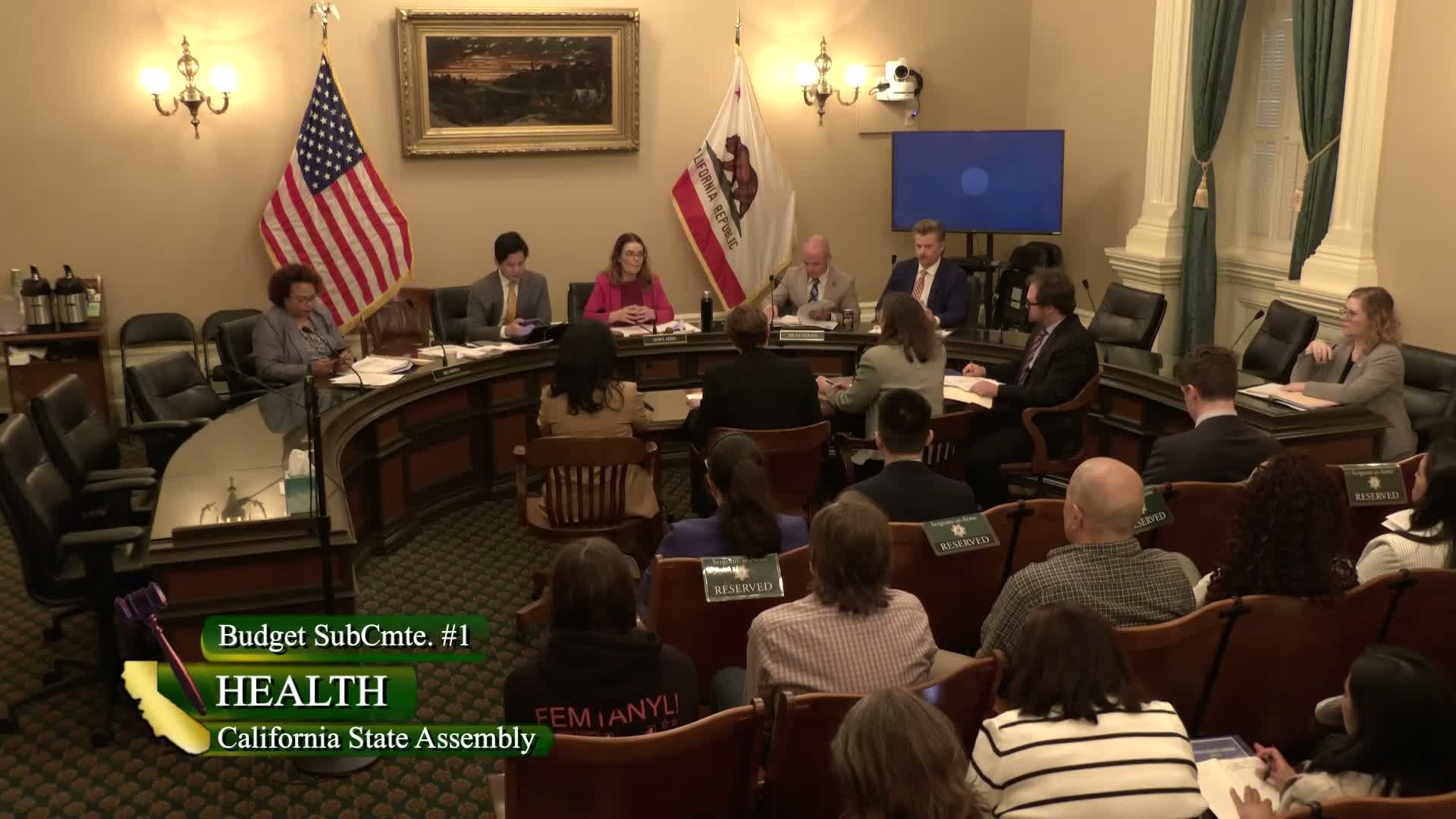
California State Assembly Budget Subcommittee on Health members heard a two‑hour panel on state reproductive health investments and the knock‑on effects of HR 1 on provider funding.
Elizabeth Landsberg, director of the Department of Health Care Access and Information, gave a line‑by‑line overview of five HCAI reproductive access programs created in the 2022–23 budget totaling about $120 million in funding. "The 2022, 23 budget included 5 programs with a total of a $120,000,000 appropriated for HCAI to implement," Landsberg said, outlining the uncompensated care grant ($40 million), an abortion practical supports fund ($20 million), capital and clinical infrastructure awards, scholarships and loan‑repayment for clinicians, and a clinician consultation hotline.
Kathy Mossberg of Essential Access Health, which administers several of the grants, told the committee the uncompensated care program has been fully awarded and is oversubscribed. "At this point, all the funds in this grant program have been awarded. So without renewal, this program will be eliminated," Mossberg said, adding the program has funded 39 grantees that served roughly 200,000 patients across all 58 counties.
Dr. Nicole Barnett, president and CEO of Planned Parenthood Northern California, described the organization’s exposure under HR 1 and urged state action. "Since 07/04/2025, Planned Parenthood has been blocked from receiving federal Medicaid funding under HR 1," she said. Barnett cited closures and warned that, without state support when federal funding is blocked or delayed, affiliates will need alternate sources to remain open.
Members pressed providers and HCAI staff on program effectiveness and demand. Assemblymember Rob Bonta asked whether Essential Access has seen year‑over‑year unmet need; Mossberg acknowledged oversubscription of roughly $2–3 million annually and said more detailed numbers could be provided to the committee. Assemblymember Patterson questioned how uncompensated funding interacts with insurance coverage, and HCAI and Essential Access clarified the grant targets individuals without coverage or whose plans do not cover abortion services.
Why it matters: witnesses said the programs function as a safety net for patients who lack coverage or who face federal restrictions on providers. Several speakers argued that short‑term budget savings would create long‑term access problems and recommended a combined package of general fund and other abortion‑access dollars to preserve services.
Next steps: providers and HCAI will provide more granular utilization and oversubscription data at the committee’s request. Members signaled interest in considering a budget request put forward by stakeholders — a $10 million annual allocation over three years (total $30 million) to sustain the uncompensated care program.
Elizabeth Landsberg, director of the Department of Health Care Access and Information, gave a line‑by‑line overview of five HCAI reproductive access programs created in the 2022–23 budget totaling about $120 million in funding. "The 2022, 23 budget included 5 programs with a total of a $120,000,000 appropriated for HCAI to implement," Landsberg said, outlining the uncompensated care grant ($40 million), an abortion practical supports fund ($20 million), capital and clinical infrastructure awards, scholarships and loan‑repayment for clinicians, and a clinician consultation hotline.
Kathy Mossberg of Essential Access Health, which administers several of the grants, told the committee the uncompensated care program has been fully awarded and is oversubscribed. "At this point, all the funds in this grant program have been awarded. So without renewal, this program will be eliminated," Mossberg said, adding the program has funded 39 grantees that served roughly 200,000 patients across all 58 counties.
Dr. Nicole Barnett, president and CEO of Planned Parenthood Northern California, described the organization’s exposure under HR 1 and urged state action. "Since 07/04/2025, Planned Parenthood has been blocked from receiving federal Medicaid funding under HR 1," she said. Barnett cited closures and warned that, without state support when federal funding is blocked or delayed, affiliates will need alternate sources to remain open.
Members pressed providers and HCAI staff on program effectiveness and demand. Assemblymember Rob Bonta asked whether Essential Access has seen year‑over‑year unmet need; Mossberg acknowledged oversubscription of roughly $2–3 million annually and said more detailed numbers could be provided to the committee. Assemblymember Patterson questioned how uncompensated funding interacts with insurance coverage, and HCAI and Essential Access clarified the grant targets individuals without coverage or whose plans do not cover abortion services.
Why it matters: witnesses said the programs function as a safety net for patients who lack coverage or who face federal restrictions on providers. Several speakers argued that short‑term budget savings would create long‑term access problems and recommended a combined package of general fund and other abortion‑access dollars to preserve services.
Next steps: providers and HCAI will provide more granular utilization and oversubscription data at the committee’s request. Members signaled interest in considering a budget request put forward by stakeholders — a $10 million annual allocation over three years (total $30 million) to sustain the uncompensated care program.
View the Full Meeting & All Its Details
This article offers just a summary. Unlock complete video, transcripts, and insights as a Founder Member.
✓
Watch full, unedited meeting videos
✓
Search every word spoken in unlimited transcripts
✓
AI summaries & real-time alerts (all government levels)
✓
Permanent access to expanding government content
30-day money-back guarantee
