City updates five-year wildfire plan, warns of early high-risk season
March 23, 2026 | Colorado Springs City, El Paso County, Colorado
This article was created by AI summarizing key points discussed. AI makes mistakes, so for full details and context, please refer to the video of the full meeting. Please report any errors so we can fix them. Report an error »
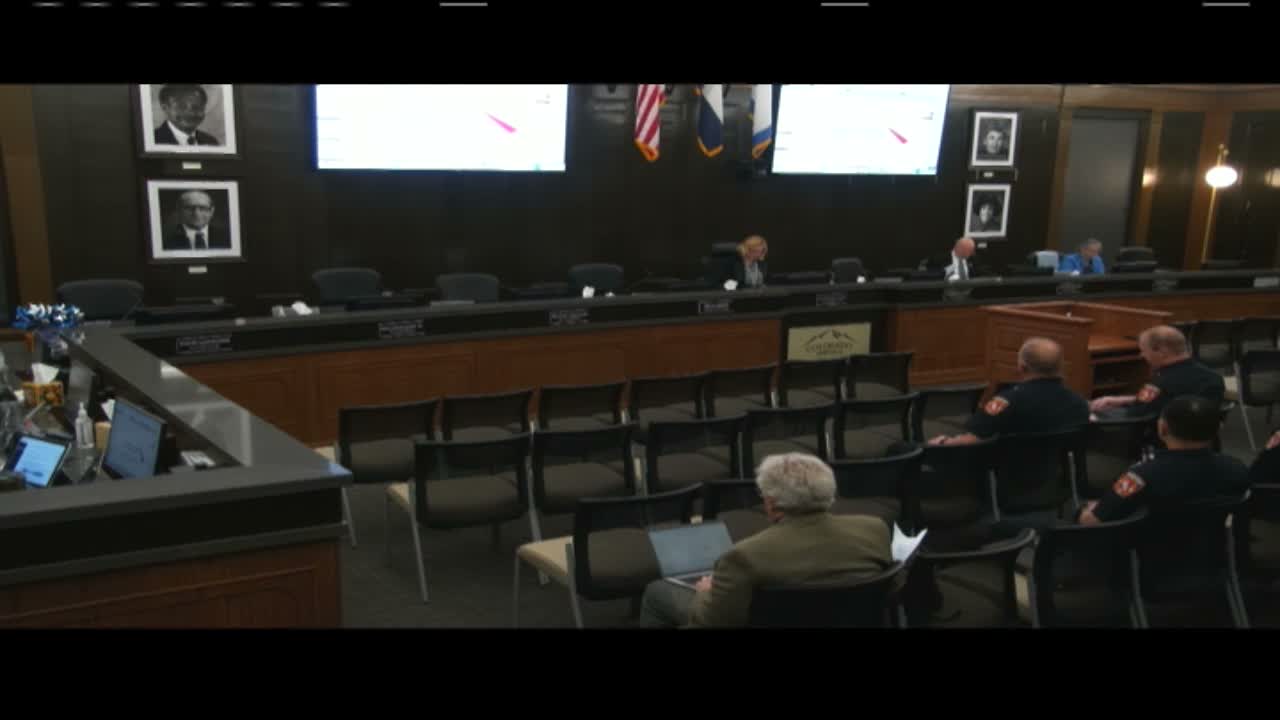
Fire Department staff on Monday presented a five‑year update to the City of Colorado Springs’ Community Wildfire Protection Plan and urged stronger public engagement as the city enters an early, high‑risk fire season.
Jess McIntyre, wildfire mitigation staff, told the council the update—required every five years and tied to federal grant eligibility—was developed with community input and partner review. “We initiated the project in October…we had 298 responses to that survey,” McIntyre said, and noted a Feb. 24 public meeting drew 53 attendees. She said roughly 2% of survey respondents reported having lost homes to wildfire.
The update’s goals include identifying treatment areas for hazardous vegetation, expanding education and town halls, establishing an eastern wildland‑urban interface (WUI) boundary, and exploring a process for prescribed fire and tribal consultation. “We are going to start talking about prescribed fire in the city, getting a process for that,” Ashley Whitworth, wildfire mitigation program administrator, said. Whitworth also said the plan recommends increasing mitigation staffing and securing a centralized facility for equipment.
Fire Marshal Chris Cooper framed the plan against present conditions, saying the region’s snowpack was about 40% and the city had already seen “25 to 30 red flag days” this year. “This year is a year to not take things for granted,” Cooper said. He listed human behavior, vegetation, power lines and weather as the primary threat drivers and urged residents to avoid any legal burning—“this is not a year to use fire in any means to clean up your yard.”
Council members asked about approval roles, enforcement and how the plan differs from state‑level wildfire resiliency code. Staff said the CWPP is a planning roadmap distinct from operational codes and that the Office of Emergency Management historically reviews but has not formally approved past plans; the CWPP also helps prioritize projects for grant funding.
Presenters emphasized volunteer engagement: McIntyre said roughly 143 neighborhoods fall within the existing WUI and there are about 250 volunteer “neighborhood champions,” most concentrated on the city’s west side. Staff urged council help in outreach to expand that footprint on the East Side, where turnout at recent town halls has been low.
The council did not take formal action at the session. Staff said the plan remains in an open comment period through April and aims to be finalized for approval and publication ahead of an August 2026 deadline.
Jess McIntyre, wildfire mitigation staff, told the council the update—required every five years and tied to federal grant eligibility—was developed with community input and partner review. “We initiated the project in October…we had 298 responses to that survey,” McIntyre said, and noted a Feb. 24 public meeting drew 53 attendees. She said roughly 2% of survey respondents reported having lost homes to wildfire.
The update’s goals include identifying treatment areas for hazardous vegetation, expanding education and town halls, establishing an eastern wildland‑urban interface (WUI) boundary, and exploring a process for prescribed fire and tribal consultation. “We are going to start talking about prescribed fire in the city, getting a process for that,” Ashley Whitworth, wildfire mitigation program administrator, said. Whitworth also said the plan recommends increasing mitigation staffing and securing a centralized facility for equipment.
Fire Marshal Chris Cooper framed the plan against present conditions, saying the region’s snowpack was about 40% and the city had already seen “25 to 30 red flag days” this year. “This year is a year to not take things for granted,” Cooper said. He listed human behavior, vegetation, power lines and weather as the primary threat drivers and urged residents to avoid any legal burning—“this is not a year to use fire in any means to clean up your yard.”
Council members asked about approval roles, enforcement and how the plan differs from state‑level wildfire resiliency code. Staff said the CWPP is a planning roadmap distinct from operational codes and that the Office of Emergency Management historically reviews but has not formally approved past plans; the CWPP also helps prioritize projects for grant funding.
Presenters emphasized volunteer engagement: McIntyre said roughly 143 neighborhoods fall within the existing WUI and there are about 250 volunteer “neighborhood champions,” most concentrated on the city’s west side. Staff urged council help in outreach to expand that footprint on the East Side, where turnout at recent town halls has been low.
The council did not take formal action at the session. Staff said the plan remains in an open comment period through April and aims to be finalized for approval and publication ahead of an August 2026 deadline.
Don't Miss a Word: See the Full Meeting!
Go beyond summaries. Unlock every video, transcript, and key insight with a Founder Membership.
✓
Get instant access to full meeting videos
✓
Search and clip any phrase from complete transcripts
✓
Receive AI-powered summaries & custom alerts
✓
Enjoy lifetime, unrestricted access to government data
30-day money-back guarantee
