Washington commission reopens review of first‑time offender waiver after data shows narrower eligibility and heavy supervision
April 10, 2026 | Board Council Commission Agencies , Executive, Washington
This article was created by AI summarizing key points discussed. AI makes mistakes, so for full details and context, please refer to the video of the full meeting. Please report any errors so we can fix them. Report an error »
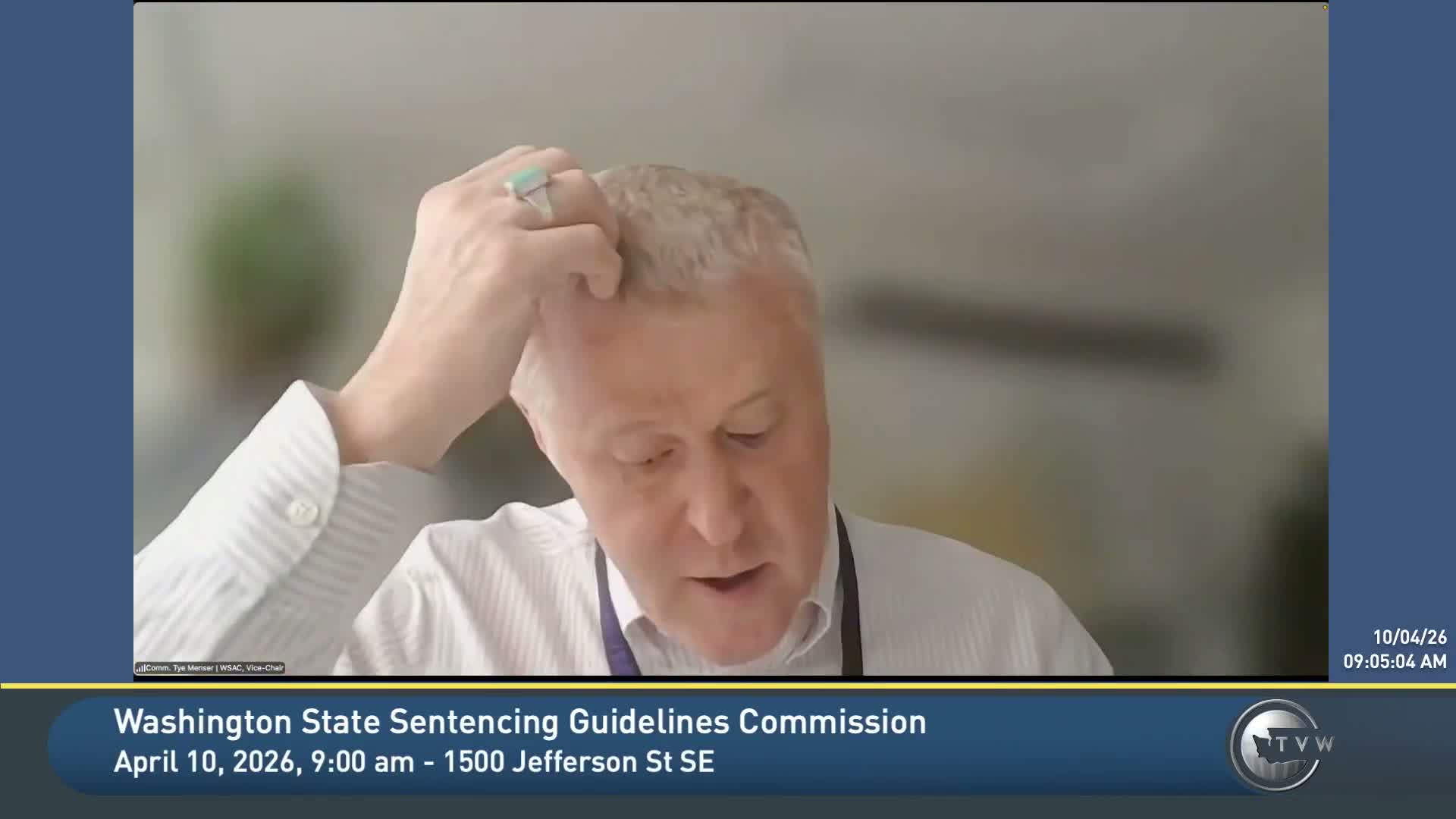
The Washington Sentencing Guideline Commission on April 10 resumed a months‑long review of the state’s First‑Time Offender Waiver (FTOW), hearing staff analysis that shows the waiver’s eligible population has declined while its use in absolute terms has remained roughly steady.
Vice Chair Ty Mentzer called the meeting to order and said the group would revisit the FTOW analysis that had been paused last year. Carrie Anne, the staff lead on the project, summarized a survey of judges, prosecutors and defense attorneys that identified practical barriers to FTOW use, including that it often offers little sentencing benefit compared with the standard range and that mandatory community‑custody requirements make the waiver less attractive to some practitioners.
Lauren (Dr. KP), who presented sentencing and Department of Corrections (DOC) supervision data, said the data show a falling eligible population and corresponding shifts in the composition of cases. “Over time, as Carrie Anne mentioned, we’ve seen a general decline in the use of FTOW,” she said, and attributed part of the change to the COVID case mix and the State v. Blake decision that removed many possession offenses from eligibility.
Lauren highlighted three quantitative findings for the commission: when FTOW is imposed it tends to carry short jail terms (she reported about 60% of FTOW sentences include roughly one month or less in jail and about 79% include two months or less), FTOW cases typically carry longer periods of community supervision (72% had a 12‑month supervision term) and DOC violation records capture some post‑sentence confinement via sanction days that narrow the gap with standard sentences in some cohorts.
Staff cautioned that the DOC violations data are a limited proxy for recidivism: changes in recording practices (2012’s Swift and Certain emphasis, a 2015 violation management system) and external events (COVID, State v. Blake) produced spikes and reporting artifacts. Lauren emphasized the analysis examined completed FTOW sentences in cohorts and excluded active 2024–25 cases to reduce bias.
Commission discussion focused on how to strengthen incentives for FTOW to be a usable option. Several members raised proposals recorded in the survey: creating a two‑tier FTOW (for less and more serious offenses), making the program more diversionary so a successful completion reduces or removes a felony record, and allowing judicial discretion to tailor community custody when the underlying offense does not ordinarily carry it.
Representative Davis urged the commission to dig into a bill introduced last session (2SSB 2217) that proposed converting FTOW in some cases into a deferred or suspended approach that could avoid a conviction if the defendant completes conditions. “I would strongly encourage us to spend time on that just to get ahead because that bill will be coming back,” she said. Judges on the commission expressed concern that a suspended/deferred structure could, if revoked, result in a returned standard sentence with loss of any community supervision benefit — undermining the incentive structure the reform intends to create.
Members did not adopt formal policy at the meeting. Instead the commission directed staff to circulate the bill report and related materials and asked members to review core elements — eligibility scope, revocation structure, community‑custody tradeoffs and immigration consequences — before the next meeting. The group also flagged a separate review of the mental‑health sentencing alternative (MHSA) after members raised anecdotal concerns about its scope and application.
The commission set a path to engage earlier with bill authors and stakeholders so recommended changes can be developed upstream of the next legislative session. The meeting adjourned after confirming the next meeting date (May 8, 2026).
Vice Chair Ty Mentzer called the meeting to order and said the group would revisit the FTOW analysis that had been paused last year. Carrie Anne, the staff lead on the project, summarized a survey of judges, prosecutors and defense attorneys that identified practical barriers to FTOW use, including that it often offers little sentencing benefit compared with the standard range and that mandatory community‑custody requirements make the waiver less attractive to some practitioners.
Lauren (Dr. KP), who presented sentencing and Department of Corrections (DOC) supervision data, said the data show a falling eligible population and corresponding shifts in the composition of cases. “Over time, as Carrie Anne mentioned, we’ve seen a general decline in the use of FTOW,” she said, and attributed part of the change to the COVID case mix and the State v. Blake decision that removed many possession offenses from eligibility.
Lauren highlighted three quantitative findings for the commission: when FTOW is imposed it tends to carry short jail terms (she reported about 60% of FTOW sentences include roughly one month or less in jail and about 79% include two months or less), FTOW cases typically carry longer periods of community supervision (72% had a 12‑month supervision term) and DOC violation records capture some post‑sentence confinement via sanction days that narrow the gap with standard sentences in some cohorts.
Staff cautioned that the DOC violations data are a limited proxy for recidivism: changes in recording practices (2012’s Swift and Certain emphasis, a 2015 violation management system) and external events (COVID, State v. Blake) produced spikes and reporting artifacts. Lauren emphasized the analysis examined completed FTOW sentences in cohorts and excluded active 2024–25 cases to reduce bias.
Commission discussion focused on how to strengthen incentives for FTOW to be a usable option. Several members raised proposals recorded in the survey: creating a two‑tier FTOW (for less and more serious offenses), making the program more diversionary so a successful completion reduces or removes a felony record, and allowing judicial discretion to tailor community custody when the underlying offense does not ordinarily carry it.
Representative Davis urged the commission to dig into a bill introduced last session (2SSB 2217) that proposed converting FTOW in some cases into a deferred or suspended approach that could avoid a conviction if the defendant completes conditions. “I would strongly encourage us to spend time on that just to get ahead because that bill will be coming back,” she said. Judges on the commission expressed concern that a suspended/deferred structure could, if revoked, result in a returned standard sentence with loss of any community supervision benefit — undermining the incentive structure the reform intends to create.
Members did not adopt formal policy at the meeting. Instead the commission directed staff to circulate the bill report and related materials and asked members to review core elements — eligibility scope, revocation structure, community‑custody tradeoffs and immigration consequences — before the next meeting. The group also flagged a separate review of the mental‑health sentencing alternative (MHSA) after members raised anecdotal concerns about its scope and application.
The commission set a path to engage earlier with bill authors and stakeholders so recommended changes can be developed upstream of the next legislative session. The meeting adjourned after confirming the next meeting date (May 8, 2026).
View the Full Meeting & All Its Details
This article offers just a summary. Unlock complete video, transcripts, and insights as a Founder Member.
✓
Watch full, unedited meeting videos
✓
Search every word spoken in unlimited transcripts
✓
AI summaries & real-time alerts (all government levels)
✓
Permanent access to expanding government content
30-day money-back guarantee
