Engineers brief council on limits of flood fixes; council authorizes emergency Deerfield flume repairs
August 17, 2025 | New Providence, Union County, New Jersey
This article was created by AI summarizing key points discussed. AI makes mistakes, so for full details and context, please refer to the video of the full meeting. Please report any errors so we can fix them. Report an error »
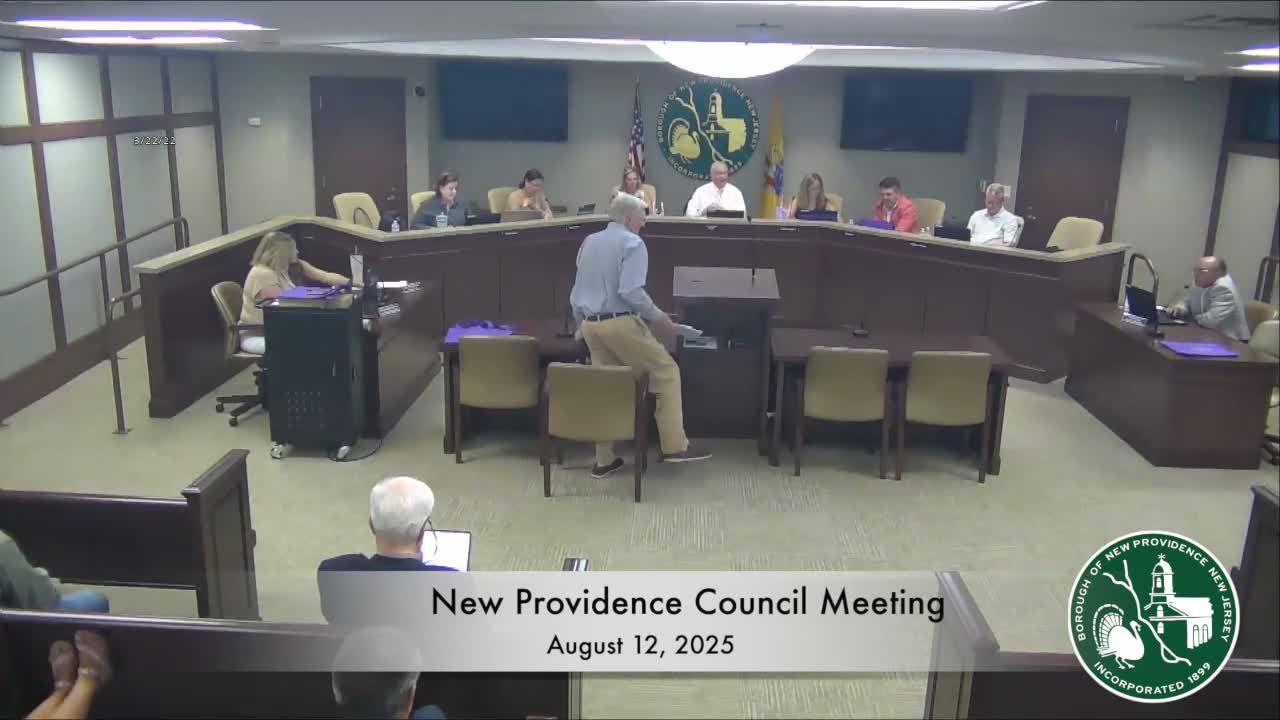
New Providence engaged its consulting engineers in a public briefing on stormwater, flood mapping and recent emergency work after the July storms.
Andy Hipplet, the borough’s consulting engineer, explained how mapped waterways (Passaic River, Salt Brook and FEMA‑mapped tributaries) and state regulations limit local authority to alter channel elevations or send additional flow downstream. He outlined past municipal projects (stream cleaning, channel improvements, Maple Street work and the Deerfield flume retention basin) and recited recent rainfall records — noting that through July the borough had seen more than 31 inches of rain so far this year and that several recent events exceeded design intensities. Hipplet emphasized that local mitigation strategies — inspections, inlet cleaning, on‑site detention rules for new development and targeted stream maintenance — reduce localized impacts but cannot change basin‑wide conditions controlled by state and federal agencies.
Residents across multiple neighborhoods described property flooding, repeated backups and driveway/yard inundation after routine summer storms. Speakers urged more frequent maintenance, clearer action‑line follow up and prioritized inspections for known hot spots such as Deerfield flume, Charmer/Gordon area and sections of Ridgeview and Woodcrest Drive. Hipplet and borough staff committed to follow‑up site visits for specific addresses submitted through the action line.
During council business the governing body adopted a resolution (2025‑216) authorizing emergency repairs and remediation to Deerfield Road and surrounding areas stemming from the July 14 storm. The resolution called for contracts for debris removal, trash‑rack replacement at the flume, sediment and rock removal and inspection services; Colliers Engineering was authorized for inspection oversight and Woodland Builders and Montana Construction were among contractors named for emergency work. Council members praised DPW and borough staff for rapid storm response and urged residents to use the action line for case documentation and escalation.
Council also reviewed possible state and federal avenues (FEMA, Blue Acres buyout program) for repetitive‑loss properties; engineers said such programs are available but typically require state or federal actions and long timelines. Hipplet recommended continued annual inlet/outfall inspections, budgeting for proactive stream maintenance, and localized engineering studies where repeated problems persist.
Andy Hipplet, the borough’s consulting engineer, explained how mapped waterways (Passaic River, Salt Brook and FEMA‑mapped tributaries) and state regulations limit local authority to alter channel elevations or send additional flow downstream. He outlined past municipal projects (stream cleaning, channel improvements, Maple Street work and the Deerfield flume retention basin) and recited recent rainfall records — noting that through July the borough had seen more than 31 inches of rain so far this year and that several recent events exceeded design intensities. Hipplet emphasized that local mitigation strategies — inspections, inlet cleaning, on‑site detention rules for new development and targeted stream maintenance — reduce localized impacts but cannot change basin‑wide conditions controlled by state and federal agencies.
Residents across multiple neighborhoods described property flooding, repeated backups and driveway/yard inundation after routine summer storms. Speakers urged more frequent maintenance, clearer action‑line follow up and prioritized inspections for known hot spots such as Deerfield flume, Charmer/Gordon area and sections of Ridgeview and Woodcrest Drive. Hipplet and borough staff committed to follow‑up site visits for specific addresses submitted through the action line.
During council business the governing body adopted a resolution (2025‑216) authorizing emergency repairs and remediation to Deerfield Road and surrounding areas stemming from the July 14 storm. The resolution called for contracts for debris removal, trash‑rack replacement at the flume, sediment and rock removal and inspection services; Colliers Engineering was authorized for inspection oversight and Woodland Builders and Montana Construction were among contractors named for emergency work. Council members praised DPW and borough staff for rapid storm response and urged residents to use the action line for case documentation and escalation.
Council also reviewed possible state and federal avenues (FEMA, Blue Acres buyout program) for repetitive‑loss properties; engineers said such programs are available but typically require state or federal actions and long timelines. Hipplet recommended continued annual inlet/outfall inspections, budgeting for proactive stream maintenance, and localized engineering studies where repeated problems persist.
Don't Miss a Word: See the Full Meeting!
Go beyond summaries. Unlock every video, transcript, and key insight with a Founder Membership.
✓
Get instant access to full meeting videos
✓
Search and clip any phrase from complete transcripts
✓
Receive AI-powered summaries & custom alerts
✓
Enjoy lifetime, unrestricted access to government data
30-day money-back guarantee
