Task force recommends stricter siting and cost allocation for data centers, members call for more evidence
April 10, 2026 | Board Council Commission Agencies , Executive, Washington
This article was created by AI summarizing key points discussed. AI makes mistakes, so for full details and context, please refer to the video of the full meeting. Please report any errors so we can fix them. Report an error »
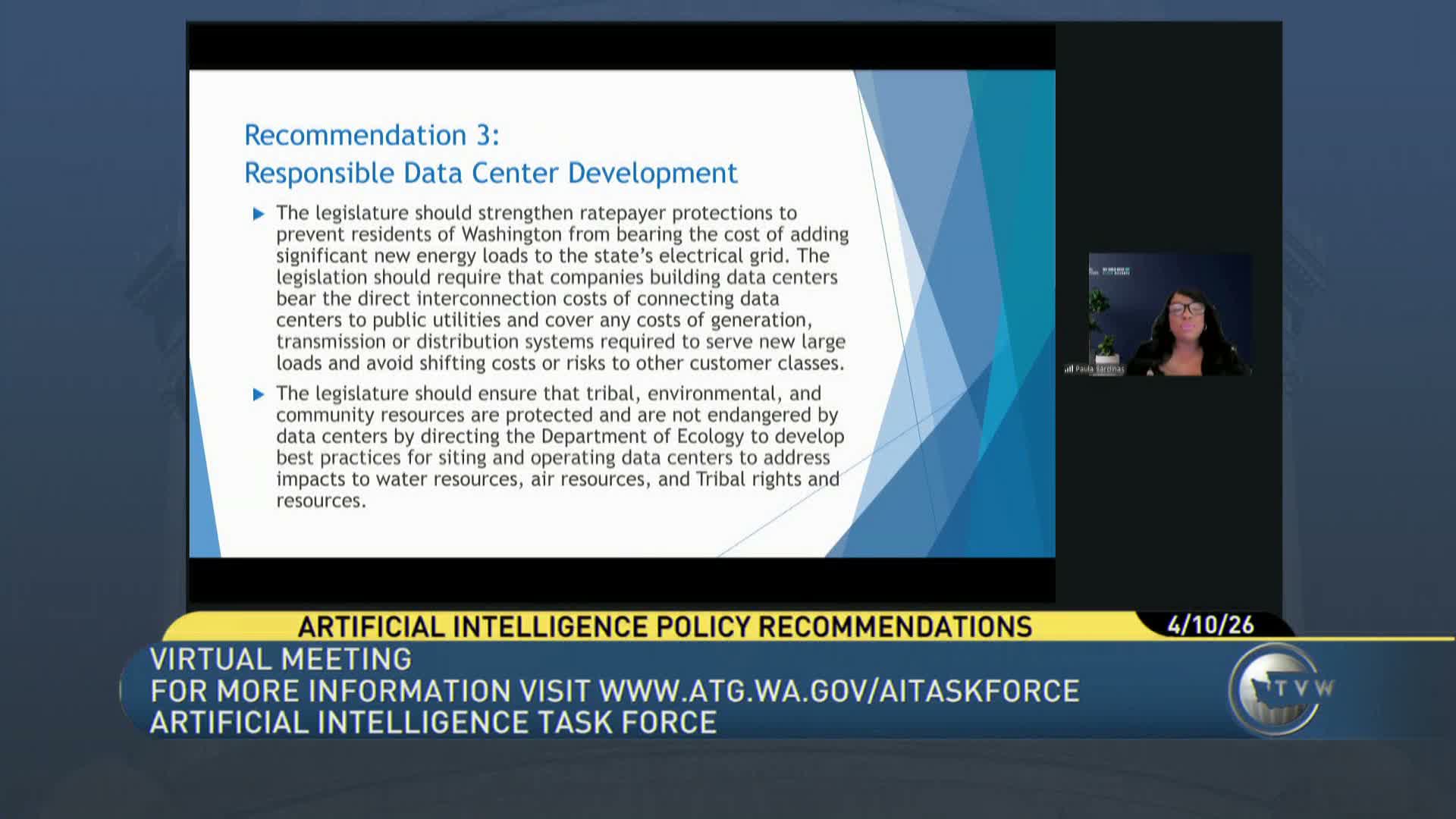
Paula Sardinas, cochair of the Innovation & Industry subcommittee, presented Recommendation 3 on the "responsible development" of data centers in Washington, saying the findings balance economic benefits against significant demands on water, energy and community resources. Sardinas cited a preliminary working‑group report (Department of Revenue work group) and an Environmental Justice study that highlighted water demands and local impacts, and argued that companies should cover indirect and direct costs for transmission and distribution upgrades.
Sardinas said the recommendation would direct the Department of Ecology to develop best practices to protect water resources, air quality and tribal treaty rights and to ensure community participation. She framed it as "a Washington‑based recommendation" seeking to keep economic benefits and accountability local.
Members raised operational questions and requested additional evidence: some speakers pressed for clearer sourcing of certain findings (one speaker flagged a citation to an AI‑generated website), others asked the task force to analyze whether current power and transmission capacity can support new data centers and whether data centers could themselves drive new generation. Several members urged the subcommittee to incorporate environmental justice analysis about where data centers are being sited and the potential disproportionate impacts on underserved communities.
The task force did not vote; subcommittees were asked to gather additional evidence, clarify sources for key findings, and consider interagency roles where Ecology would lead environmental safeguards while Commerce or other agencies address economic implications.
Sardinas said the recommendation would direct the Department of Ecology to develop best practices to protect water resources, air quality and tribal treaty rights and to ensure community participation. She framed it as "a Washington‑based recommendation" seeking to keep economic benefits and accountability local.
Members raised operational questions and requested additional evidence: some speakers pressed for clearer sourcing of certain findings (one speaker flagged a citation to an AI‑generated website), others asked the task force to analyze whether current power and transmission capacity can support new data centers and whether data centers could themselves drive new generation. Several members urged the subcommittee to incorporate environmental justice analysis about where data centers are being sited and the potential disproportionate impacts on underserved communities.
The task force did not vote; subcommittees were asked to gather additional evidence, clarify sources for key findings, and consider interagency roles where Ecology would lead environmental safeguards while Commerce or other agencies address economic implications.
Don't Miss a Word: See the Full Meeting!
Go beyond summaries. Unlock every video, transcript, and key insight with a Founder Membership.
✓
Get instant access to full meeting videos
✓
Search and clip any phrase from complete transcripts
✓
Receive AI-powered summaries & custom alerts
✓
Enjoy lifetime, unrestricted access to government data
30-day money-back guarantee
