Board hears AVID presentation highlighting higher graduation and college-enrollment rates for participants
November 01, 2024 | Sequoia Union High, School Districts, California
This article was created by AI summarizing key points discussed. AI makes mistakes, so for full details and context, please refer to the video of the full meeting. Please report any errors so we can fix them. Report an error »
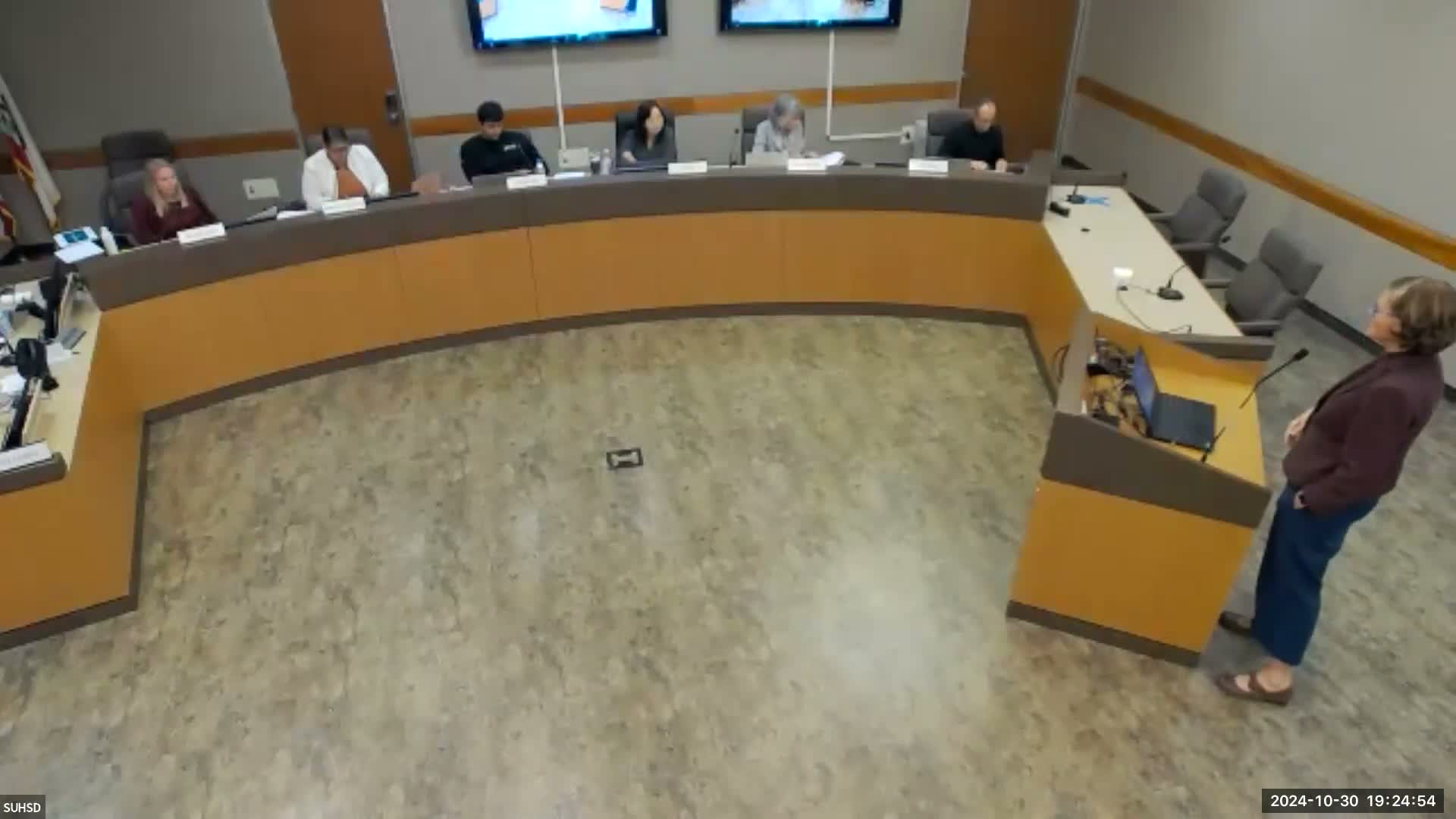
The Sequoia Union High School District board received a detailed presentation on Oct. 30 about AVID (Advancement Via Individual Determination), a program the district uses to prepare students for college and career readiness.
Rachel Andrews, who identified herself as the district AVID teacher-on-assignment, described AVID’s mission and the four implementation domains — instruction, systems, leadership and culture — and explained instructional strategies summarized by the WICR acronym (writing, inquiry, collaboration, organization, reading). Teachers and students from multiple sites explained how tutorials, focus notes and small-group work build student agency and belonging.
Two students spoke about the program’s impact. Daisy Duarte, an AVID junior at Sequoia High School, said AVID created a “safe space” and helped her build relationships and confidence. Camila Aguilar, a tenth grader at Menlo-Atherton, said AVID helped her move from C– and B-level work to A– and B-level work through tutorials and focus-note routines.
District data presented by staff showed that, since 2018, AVID students at the district’s larger high schools had higher 4-year graduation rates (the presenter said AVID’s lowest graduation rate since 2019 was 96.2 percent) and higher A–G course completion rates (roughly 79–87 percent for AVID students versus under 70 percent districtwide for the four large schools combined). The presenter also said that college enrollment within one year of graduation for AVID graduates has been 84 percent or higher since 2018; staff framed these data as consistent with AVID’s goal to close opportunity gaps for underrepresented students.
Trustees asked about selection criteria, representation across student groups, supports for students with IEPs and scheduling challenges; presenters said most applicants who apply are admitted, that AVID seeks students committed to college and that accommodations required by 504 plans or IEPs are implemented in AVID classrooms. Trustees discussed whether AVID could expand to serve more students but acknowledged funding constraints and the program’s labor-intensive nature.
Next steps: Trustees and staff discussed possible board participation in AVID training, continued site-level implementation and follow-up on data requests for subgroup outcomes.
Rachel Andrews, who identified herself as the district AVID teacher-on-assignment, described AVID’s mission and the four implementation domains — instruction, systems, leadership and culture — and explained instructional strategies summarized by the WICR acronym (writing, inquiry, collaboration, organization, reading). Teachers and students from multiple sites explained how tutorials, focus notes and small-group work build student agency and belonging.
Two students spoke about the program’s impact. Daisy Duarte, an AVID junior at Sequoia High School, said AVID created a “safe space” and helped her build relationships and confidence. Camila Aguilar, a tenth grader at Menlo-Atherton, said AVID helped her move from C– and B-level work to A– and B-level work through tutorials and focus-note routines.
District data presented by staff showed that, since 2018, AVID students at the district’s larger high schools had higher 4-year graduation rates (the presenter said AVID’s lowest graduation rate since 2019 was 96.2 percent) and higher A–G course completion rates (roughly 79–87 percent for AVID students versus under 70 percent districtwide for the four large schools combined). The presenter also said that college enrollment within one year of graduation for AVID graduates has been 84 percent or higher since 2018; staff framed these data as consistent with AVID’s goal to close opportunity gaps for underrepresented students.
Trustees asked about selection criteria, representation across student groups, supports for students with IEPs and scheduling challenges; presenters said most applicants who apply are admitted, that AVID seeks students committed to college and that accommodations required by 504 plans or IEPs are implemented in AVID classrooms. Trustees discussed whether AVID could expand to serve more students but acknowledged funding constraints and the program’s labor-intensive nature.
Next steps: Trustees and staff discussed possible board participation in AVID training, continued site-level implementation and follow-up on data requests for subgroup outcomes.
View the Full Meeting & All Its Details
This article offers just a summary. Unlock complete video, transcripts, and insights as a Founder Member.
✓
Watch full, unedited meeting videos
✓
Search every word spoken in unlimited transcripts
✓
AI summaries & real-time alerts (all government levels)
✓
Permanent access to expanding government content
30-day money-back guarantee
