Ketchikan school board approves RIF plan in first reading after staff present consolidation-based budget to cut roughly 43 FTEs
March 07, 2026 | Ketchikan Gateway Borough, Alaska
This article was created by AI summarizing key points discussed. AI makes mistakes, so for full details and context, please refer to the video of the full meeting. Please report any errors so we can fix them. Report an error »
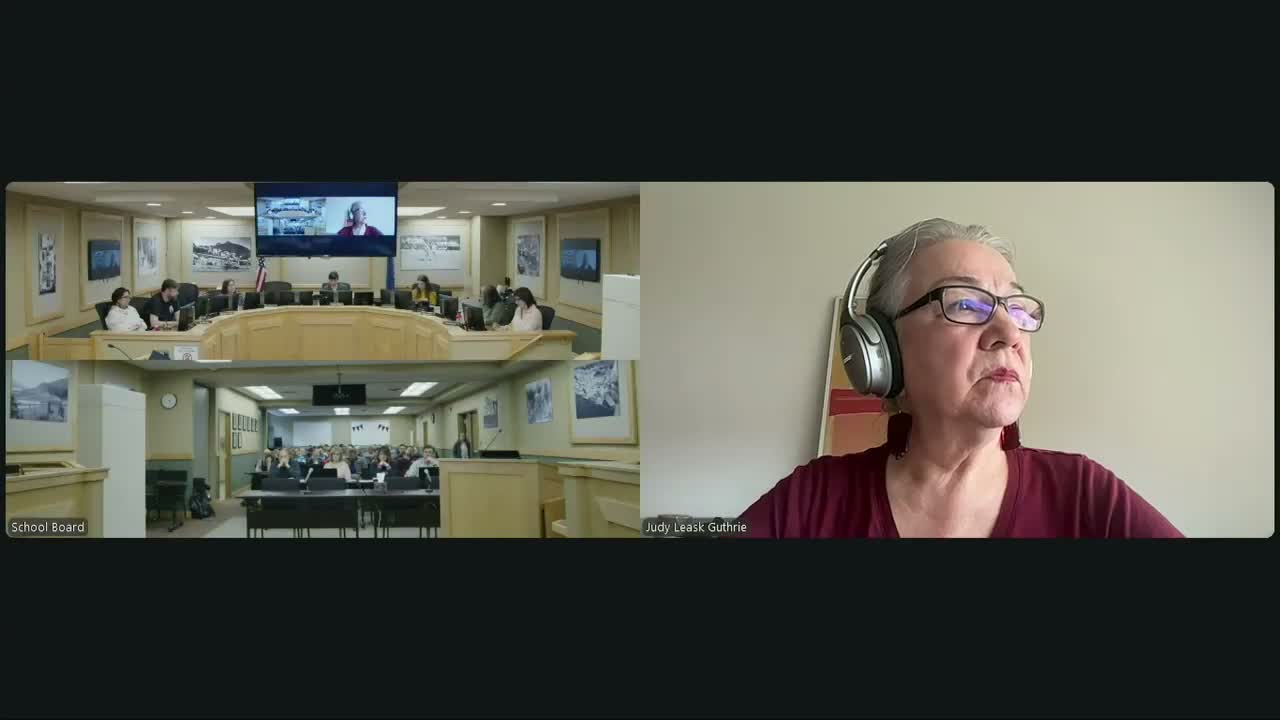
The Ketchikan Gateway Borough School District Board of Education approved the district’s reduction‑in‑force plan in first reading at a special meeting on March 7, 2026, voting 7–0 after staff presented a consolidated, facilities‑based plan to close two elementary schools and reduce certified staffing to meet a multi‑million‑dollar shortfall.
District presenters Jason House, director of student services, and special education director Sally Stockhausen told the board the proposal was developed on a compressed timeline and was intended to be scalable and compliant with regulatory requirements. The plan targets a reduction of about 43 certified full‑time equivalent positions and reconfigures schools into centralized “hubs” (elementary K–5, middle 6–8 and a 9–12 high school) while preserving key programs such as CTE and fine arts where possible.
Why it matters: the district’s operating‑fund personnel target for next year is about $34.5 million; presenters said their package produces roughly $5.5 million in the immediate savings the board requested but still leaves a projected operating shortfall near $900,000 under conservative revenue assumptions, partly driven by a projected 19% increase in insurance costs. Lisa Pierce, who presented the revenue outlook, said consolidation adjustments could add roughly $936,000 in the first year under state funding formulas but warned projections will change and staff would continue refining the numbers.
Public comment and union concerns shaped the discussion. Mary Meili, speaking for the Ketchikan Education Association, said KEA had been excluded from the RIF’s development as presented, called portions of the packet incomplete, and requested a mandated meeting with district leadership before the March 11 second reading. "KEA has so far been excluded from the development of the RIF plan prior to its first reading today," Meili said, and asked the board to direct staff to collaborate with union leadership between readings. The district’s staffing team said it had engaged in multiple email exchanges with KEA and that the plan had been reviewed by district legal counsel, but board members nonetheless pressed for the requested meeting.
Families and tribal leaders also spoke. Gloria Burns, president of the Ketchikan Indian Community, urged the board to preserve culturally relevant programming and to involve the tribe in decisions affecting Title VI funds and preschool services; public commenters and teachers raised questions about posted layoff lists and asked the district to follow negotiated RIF procedures.
Votes at a glance: the board approved three formal items tied to the session—an amendment to the meeting agenda to add an early public‑comment slot (approved as amended), a memorandum of agreement between the district and Ketchikan Gateway Borough (approved 7–0), and the RIF plan in first reading (approved 7–0). The board scheduled a public listening session and the RIF second reading for March 11, 2026, and directed staff to arrange a meeting with KEA prior to that date.
Board members repeatedly emphasized the human impact of the proposal while acknowledging fiscal constraints. "This is nothing any of us want," Stockhausen said of the staffing reductions, and several board members asked staff to return with clarifications, corrected packet figures and a documented record of outreach to KEA and other stakeholders before the next formal vote.
What happens next: staff will continue to refine the RIF and budget materials, correct identified errors in the packet, and meet with KEA and tribal representatives; the board will take a second reading on March 11, with additional budget sessions planned later in March and April.
The meeting also included a work session on the FY‑27 budget outlook and an approved memorandum of agreement with the borough; the board adjourned after setting dates for further public engagement.
District presenters Jason House, director of student services, and special education director Sally Stockhausen told the board the proposal was developed on a compressed timeline and was intended to be scalable and compliant with regulatory requirements. The plan targets a reduction of about 43 certified full‑time equivalent positions and reconfigures schools into centralized “hubs” (elementary K–5, middle 6–8 and a 9–12 high school) while preserving key programs such as CTE and fine arts where possible.
Why it matters: the district’s operating‑fund personnel target for next year is about $34.5 million; presenters said their package produces roughly $5.5 million in the immediate savings the board requested but still leaves a projected operating shortfall near $900,000 under conservative revenue assumptions, partly driven by a projected 19% increase in insurance costs. Lisa Pierce, who presented the revenue outlook, said consolidation adjustments could add roughly $936,000 in the first year under state funding formulas but warned projections will change and staff would continue refining the numbers.
Public comment and union concerns shaped the discussion. Mary Meili, speaking for the Ketchikan Education Association, said KEA had been excluded from the RIF’s development as presented, called portions of the packet incomplete, and requested a mandated meeting with district leadership before the March 11 second reading. "KEA has so far been excluded from the development of the RIF plan prior to its first reading today," Meili said, and asked the board to direct staff to collaborate with union leadership between readings. The district’s staffing team said it had engaged in multiple email exchanges with KEA and that the plan had been reviewed by district legal counsel, but board members nonetheless pressed for the requested meeting.
Families and tribal leaders also spoke. Gloria Burns, president of the Ketchikan Indian Community, urged the board to preserve culturally relevant programming and to involve the tribe in decisions affecting Title VI funds and preschool services; public commenters and teachers raised questions about posted layoff lists and asked the district to follow negotiated RIF procedures.
Votes at a glance: the board approved three formal items tied to the session—an amendment to the meeting agenda to add an early public‑comment slot (approved as amended), a memorandum of agreement between the district and Ketchikan Gateway Borough (approved 7–0), and the RIF plan in first reading (approved 7–0). The board scheduled a public listening session and the RIF second reading for March 11, 2026, and directed staff to arrange a meeting with KEA prior to that date.
Board members repeatedly emphasized the human impact of the proposal while acknowledging fiscal constraints. "This is nothing any of us want," Stockhausen said of the staffing reductions, and several board members asked staff to return with clarifications, corrected packet figures and a documented record of outreach to KEA and other stakeholders before the next formal vote.
What happens next: staff will continue to refine the RIF and budget materials, correct identified errors in the packet, and meet with KEA and tribal representatives; the board will take a second reading on March 11, with additional budget sessions planned later in March and April.
The meeting also included a work session on the FY‑27 budget outlook and an approved memorandum of agreement with the borough; the board adjourned after setting dates for further public engagement.
View the Full Meeting & All Its Details
This article offers just a summary. Unlock complete video, transcripts, and insights as a Founder Member.
✓
Watch full, unedited meeting videos
✓
Search every word spoken in unlimited transcripts
✓
AI summaries & real-time alerts (all government levels)
✓
Permanent access to expanding government content
30-day money-back guarantee
