Town of Warner meeting moves into non-public session after roll-call vote amid procedural questions
April 08, 2026 | Town of Warner , Merrimack County , New Hampshire
This article was created by AI summarizing key points discussed. AI makes mistakes, so for full details and context, please refer to the video of the full meeting. Please report any errors so we can fix them. Report an error »
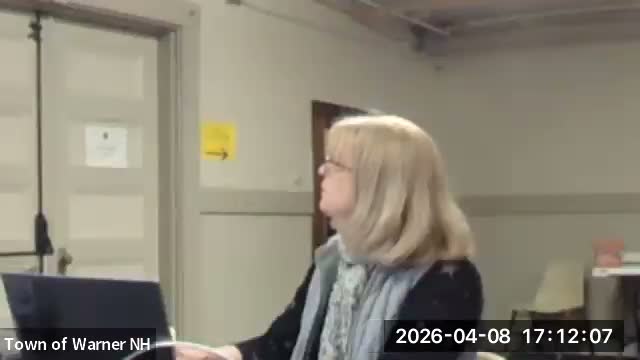
At a Town of Warner meeting, the participant leading the session (identified in the transcript by meeting cues as the Chair) announced a transition in business and the group voted to enter a non-public session after brief procedural discussion.
The Chair said, “So that concludes our business part of our meeting. And now we are going to move into another public session.” A different participant in the record (hereafter identified as Committee member) pressed for clarification: “I what's the non public session for? Are you going to come out of non public and go back into public session?” The Committee member also said they had only learned of the meeting after it was posted and emailed and noted that the posted agenda “doesn't say who it's for,” adding, “I'm not gonna review it. It's non public.”
Before the vote, participants discussed whether a formal motion was required. The Committee member asked, “So you have to make the motion to go into non public?” The record shows the group then proceeded to a roll-call vote. The transcript records the roll call responses as: “Rick? Yes.” “Michael. Yes.” “Albert. Yes.” The audio does not capture a verbal mover or seconder, and the precise motion wording is not recorded in the audible text; the group also refers to a statutory citation in the agenda as “RSA a 3 2 a.”
The transcript therefore documents (a) procedural uncertainty among participants about the purpose and notice for the non-public item, (b) a roll-call vote with three affirmative votes recorded by name, and (c) an agenda citation to a statute that is recorded in the transcript exactly as spoken but which the record does not clarify further.
The meeting then proceeded into the non-public session; no additional public details about the item or attendees were provided in the transcript. The audio does not record subsequent public actions or any formal statement of who moved or seconded the motion.
The Chair said, “So that concludes our business part of our meeting. And now we are going to move into another public session.” A different participant in the record (hereafter identified as Committee member) pressed for clarification: “I what's the non public session for? Are you going to come out of non public and go back into public session?” The Committee member also said they had only learned of the meeting after it was posted and emailed and noted that the posted agenda “doesn't say who it's for,” adding, “I'm not gonna review it. It's non public.”
Before the vote, participants discussed whether a formal motion was required. The Committee member asked, “So you have to make the motion to go into non public?” The record shows the group then proceeded to a roll-call vote. The transcript records the roll call responses as: “Rick? Yes.” “Michael. Yes.” “Albert. Yes.” The audio does not capture a verbal mover or seconder, and the precise motion wording is not recorded in the audible text; the group also refers to a statutory citation in the agenda as “RSA a 3 2 a.”
The transcript therefore documents (a) procedural uncertainty among participants about the purpose and notice for the non-public item, (b) a roll-call vote with three affirmative votes recorded by name, and (c) an agenda citation to a statute that is recorded in the transcript exactly as spoken but which the record does not clarify further.
The meeting then proceeded into the non-public session; no additional public details about the item or attendees were provided in the transcript. The audio does not record subsequent public actions or any formal statement of who moved or seconded the motion.
Don't Miss a Word: See the Full Meeting!
Go beyond summaries. Unlock every video, transcript, and key insight with a Founder Membership.
✓
Get instant access to full meeting videos
✓
Search and clip any phrase from complete transcripts
✓
Receive AI-powered summaries & custom alerts
✓
Enjoy lifetime, unrestricted access to government data
30-day money-back guarantee
