House Finance Committee advances bill to align state payment rules; members dispute fiscal cost
April 09, 2026 | 2026 Legislature Alaska, Alaska
This article was created by AI summarizing key points discussed. AI makes mistakes, so for full details and context, please refer to the video of the full meeting. Please report any errors so we can fix them. Report an error »
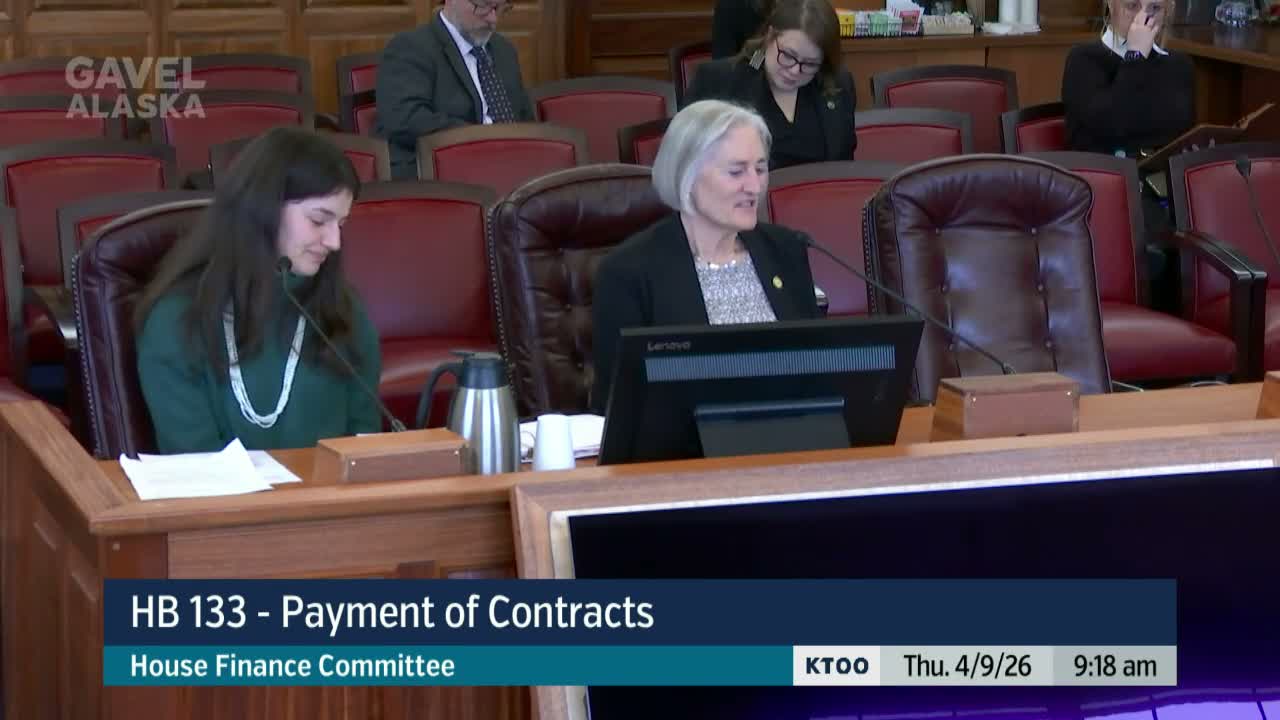
Cochair Foster presiding, the Alaska House Finance Committee voted 7–4 on Thursday to move House Bill 133 out of committee as amended after a heated discussion over fiscal notes and implementation timing.
Representative Rebecca Himshoo, the bill sponsor, summarized HB 133 as “a good governance bill,” saying it would “set a payment standard to match the standard that we already have in statute for private contractors providing public works for the state of Alaska,” and extend those payment requirements to state contracting and grants to tribes, municipalities and non‑profits. The sponsor and supporters said the bill is intended to speed payments to vendors and increase accountability.
The committee considered Amendment 1, moved by Representative Hannon, which requires state departments to report to the Finance Committee on how long they take to pay contractors; that reporting provision takes effect immediately and a report is due to the committee in January. Enforcement provisions and penalty mechanisms in the bill are delayed until July 1, 2027, under the amendment, meaning the statutory “stick” would not apply until FY 2028.
Several members expressed concern about the fiscal impact of implementing the bill. Representative Ballard objected to moving the bill out, saying the fiscal notes were “outrageously high.” Representative Tomczewski argued the bill would add seven full‑time positions at a cost of over $1,000,000 and said the legislation did not account for existing vacancies that contribute to late payments. Representative Stapp warned departments might prioritize large contracts and push smaller nonprofits further back in payment queues if penalties are imposed.
Supporters, including Representative Galvin, said the bill’s reporting requirement and eventual enforcement could prompt departments to examine processes and improve payment timeliness. Committee staff outlined procedural options for handling fiscal notes: move the bill with the departments’ fiscal notes and let Senate Finance revisit them; hold the bill to draft House Finance fiscal notes; or allow conference committee reconciliation to address the fiscal differences.
After debate and a roll call, the committee approved the motion to report HB 133, version LS0114S, out of committee as amended with individual recommendations and attached fiscal notes by a vote of 7 yea to 4 nay. Members who voted yea (as shown in the committee roll call) were Representatives Hannan, Galvin, Jimmy, Bynum, Josephson, Shrage and Foster; members who voted nay were Representatives Tomaszewski, Moore, Allard and Stapp. The committee asked members to remain to sign the committee report and adjourned at 9:38 a.m.
The next scheduled meeting is the same day at 1:30 p.m., where the committee expected a presentation from the Department of Education and Early Development on bond reimbursement and grant review, although that presentation could be delayed or canceled if the legislature was on the floor.
Representative Rebecca Himshoo, the bill sponsor, summarized HB 133 as “a good governance bill,” saying it would “set a payment standard to match the standard that we already have in statute for private contractors providing public works for the state of Alaska,” and extend those payment requirements to state contracting and grants to tribes, municipalities and non‑profits. The sponsor and supporters said the bill is intended to speed payments to vendors and increase accountability.
The committee considered Amendment 1, moved by Representative Hannon, which requires state departments to report to the Finance Committee on how long they take to pay contractors; that reporting provision takes effect immediately and a report is due to the committee in January. Enforcement provisions and penalty mechanisms in the bill are delayed until July 1, 2027, under the amendment, meaning the statutory “stick” would not apply until FY 2028.
Several members expressed concern about the fiscal impact of implementing the bill. Representative Ballard objected to moving the bill out, saying the fiscal notes were “outrageously high.” Representative Tomczewski argued the bill would add seven full‑time positions at a cost of over $1,000,000 and said the legislation did not account for existing vacancies that contribute to late payments. Representative Stapp warned departments might prioritize large contracts and push smaller nonprofits further back in payment queues if penalties are imposed.
Supporters, including Representative Galvin, said the bill’s reporting requirement and eventual enforcement could prompt departments to examine processes and improve payment timeliness. Committee staff outlined procedural options for handling fiscal notes: move the bill with the departments’ fiscal notes and let Senate Finance revisit them; hold the bill to draft House Finance fiscal notes; or allow conference committee reconciliation to address the fiscal differences.
After debate and a roll call, the committee approved the motion to report HB 133, version LS0114S, out of committee as amended with individual recommendations and attached fiscal notes by a vote of 7 yea to 4 nay. Members who voted yea (as shown in the committee roll call) were Representatives Hannan, Galvin, Jimmy, Bynum, Josephson, Shrage and Foster; members who voted nay were Representatives Tomaszewski, Moore, Allard and Stapp. The committee asked members to remain to sign the committee report and adjourned at 9:38 a.m.
The next scheduled meeting is the same day at 1:30 p.m., where the committee expected a presentation from the Department of Education and Early Development on bond reimbursement and grant review, although that presentation could be delayed or canceled if the legislature was on the floor.
View the Full Meeting & All Its Details
This article offers just a summary. Unlock complete video, transcripts, and insights as a Founder Member.
✓
Watch full, unedited meeting videos
✓
Search every word spoken in unlimited transcripts
✓
AI summaries & real-time alerts (all government levels)
✓
Permanent access to expanding government content
30-day money-back guarantee
