Alaska Marine Highway officials tell DOT panel they will seek $161M in federal ferry aid to bridge $78M shortfall
April 08, 2026 | 2026 Legislature Alaska, Alaska
This article was created by AI summarizing key points discussed. AI makes mistakes, so for full details and context, please refer to the video of the full meeting. Please report any errors so we can fix them. Report an error »
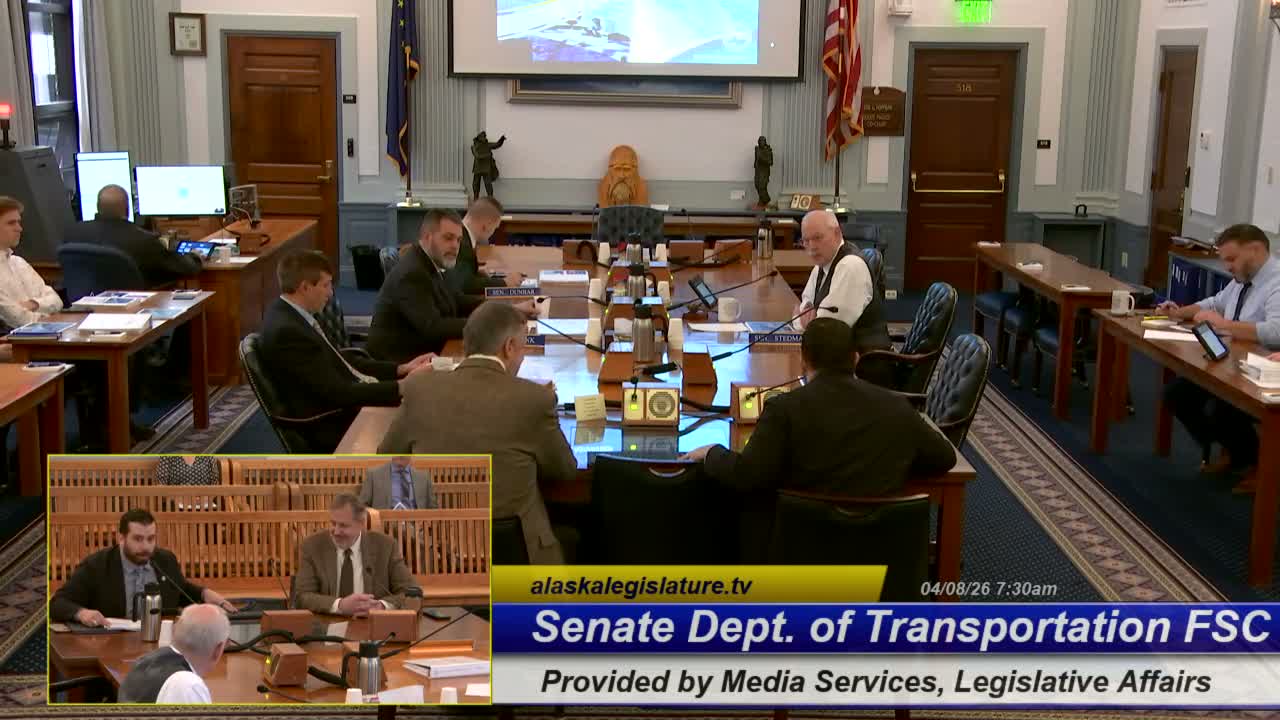
On April 8, the DOT Finance Subcommittee heard that the Alaska Marine Highway System faces a federal revenue shortfall of $78,000,000 and plans to apply for $161,000,000 in operating assistance from the Federal Transit Administration's new rural ferry grant program, officials said.
An agency official told the committee, "Our current year budget has a federal revenue shortfall of $78,000,000," and said the department intends to pursue competitive FTA grants made available through a notice of funding opportunity that converts $410,000,000 in advanced appropriations into competitive awards. "The Federal Transit Administration did issue a notice of funding opportunity on Monday," the official added, noting eligibility for operating assistance, planning and capital projects and a condition that systems continue to provide 75% of the state funding average from 2017–2019.
Why it matters: AMHS provides critical surface connectivity for coastal Alaska communities and the shortfall, if unaddressed, could force service reductions or deeper dependence on one-time transfers. Department presenters told the committee they want to realign the system's budget from calendar-year appropriations to a two-year, fiscal-year-aligned appropriation that would give six months of padding before and after the calendar year and allow greater flexibility in managing labor cost adjustments.
How officials would bridge the gap: The department described a "waterfall" approach to temporarily swap federal funds and AMHS revenue between appropriations so the system can be kept whole while awaiting grant awards. The plan is to apply for $161,000,000 of operating-assistance funds to cover portions of calendar year 2026 and 2027, leaving about $250,000,000 of the $410,000,000 program for capital projects.
Immediate savings and fare changes: The presentation listed near-term cost reductions intended to stretch current funds while the grant application is processed. Officials said disposing of the Matanuska — currently used as a crew "hotel" in Ketchikan and costing roughly $800,000 a month — and shifting the Tazlina crew-quarters costs to capital would move crew time off the operating budget. "These two will save us about $1,150,000 a month," the agency official said. The department also noted a planned farebox tariff adjustment of about 2.1% scheduled to take effect on May 1, 2026.
Financial context and federal match: Presenters reported FY2025 AMHS revenues of $37,200,000, operating uses of $16,200,000 and capital overhaul spending of $22,200,000 (a net change of negative $1,300,000). They said AMHS has preliminarily earned $23,400,000 in toll credits to substitute for matching funds on federal grants and indicated the governor's FY2027 request includes $20,800,000 in operating and $27,500,000 in overhaul funding.
Projects and fleet issues: Director Craig Toronga (Alaska Marine Highways) described several capital and modernization priorities, including extensive work on the Kennecott (hull blasting, steel replacement and new anodes after electrolysis issues), a planned Columbia modernization (previously replaced the fire-main system in 2024), and the Tustamina procurement, which has lost bidders as firms pursue other federal contracts. Toronga said the department has $9,000,000 earmarked to design mainliner replacement vessels and is working on diesel-electric shuttle ferry design and other vessel projects.
Operations and workforce: Toronga reported that AMHS hired 64 crewmembers and had 67 separations in 2025, said system uptime was approximately 98.55% (total downtime under 2%), and described recruitment programs (cadet pipelines, scholarships, pilotage incentives) aimed at improving retention and licensing pathways for Alaskans.
Next steps: Officials said FTA has committed to an expedited award schedule, with grant awards likely by late July–early September if timelines mirror the prior NOFO. Committee members asked for written follow-ups on ship sailings and load-traffic comparisons to 2019, details on a reported shipyard labor dispute, and the Army Corps' status on Cascade Point and related economic studies. The committee adjourned with staff directed to provide those written answers.
An agency official told the committee, "Our current year budget has a federal revenue shortfall of $78,000,000," and said the department intends to pursue competitive FTA grants made available through a notice of funding opportunity that converts $410,000,000 in advanced appropriations into competitive awards. "The Federal Transit Administration did issue a notice of funding opportunity on Monday," the official added, noting eligibility for operating assistance, planning and capital projects and a condition that systems continue to provide 75% of the state funding average from 2017–2019.
Why it matters: AMHS provides critical surface connectivity for coastal Alaska communities and the shortfall, if unaddressed, could force service reductions or deeper dependence on one-time transfers. Department presenters told the committee they want to realign the system's budget from calendar-year appropriations to a two-year, fiscal-year-aligned appropriation that would give six months of padding before and after the calendar year and allow greater flexibility in managing labor cost adjustments.
How officials would bridge the gap: The department described a "waterfall" approach to temporarily swap federal funds and AMHS revenue between appropriations so the system can be kept whole while awaiting grant awards. The plan is to apply for $161,000,000 of operating-assistance funds to cover portions of calendar year 2026 and 2027, leaving about $250,000,000 of the $410,000,000 program for capital projects.
Immediate savings and fare changes: The presentation listed near-term cost reductions intended to stretch current funds while the grant application is processed. Officials said disposing of the Matanuska — currently used as a crew "hotel" in Ketchikan and costing roughly $800,000 a month — and shifting the Tazlina crew-quarters costs to capital would move crew time off the operating budget. "These two will save us about $1,150,000 a month," the agency official said. The department also noted a planned farebox tariff adjustment of about 2.1% scheduled to take effect on May 1, 2026.
Financial context and federal match: Presenters reported FY2025 AMHS revenues of $37,200,000, operating uses of $16,200,000 and capital overhaul spending of $22,200,000 (a net change of negative $1,300,000). They said AMHS has preliminarily earned $23,400,000 in toll credits to substitute for matching funds on federal grants and indicated the governor's FY2027 request includes $20,800,000 in operating and $27,500,000 in overhaul funding.
Projects and fleet issues: Director Craig Toronga (Alaska Marine Highways) described several capital and modernization priorities, including extensive work on the Kennecott (hull blasting, steel replacement and new anodes after electrolysis issues), a planned Columbia modernization (previously replaced the fire-main system in 2024), and the Tustamina procurement, which has lost bidders as firms pursue other federal contracts. Toronga said the department has $9,000,000 earmarked to design mainliner replacement vessels and is working on diesel-electric shuttle ferry design and other vessel projects.
Operations and workforce: Toronga reported that AMHS hired 64 crewmembers and had 67 separations in 2025, said system uptime was approximately 98.55% (total downtime under 2%), and described recruitment programs (cadet pipelines, scholarships, pilotage incentives) aimed at improving retention and licensing pathways for Alaskans.
Next steps: Officials said FTA has committed to an expedited award schedule, with grant awards likely by late July–early September if timelines mirror the prior NOFO. Committee members asked for written follow-ups on ship sailings and load-traffic comparisons to 2019, details on a reported shipyard labor dispute, and the Army Corps' status on Cascade Point and related economic studies. The committee adjourned with staff directed to provide those written answers.
Don't Miss a Word: See the Full Meeting!
Go beyond summaries. Unlock every video, transcript, and key insight with a Founder Membership.
✓
Get instant access to full meeting videos
✓
Search and clip any phrase from complete transcripts
✓
Receive AI-powered summaries & custom alerts
✓
Enjoy lifetime, unrestricted access to government data
30-day money-back guarantee
