Committee hears first testimony on bill to restrict sale of vacuum‑sealed low‑acid homemade foods
April 08, 2026 | 2026 Legislature Alaska, Alaska
This article was created by AI summarizing key points discussed. AI makes mistakes, so for full details and context, please refer to the video of the full meeting. Please report any errors so we can fix them. Report an error »
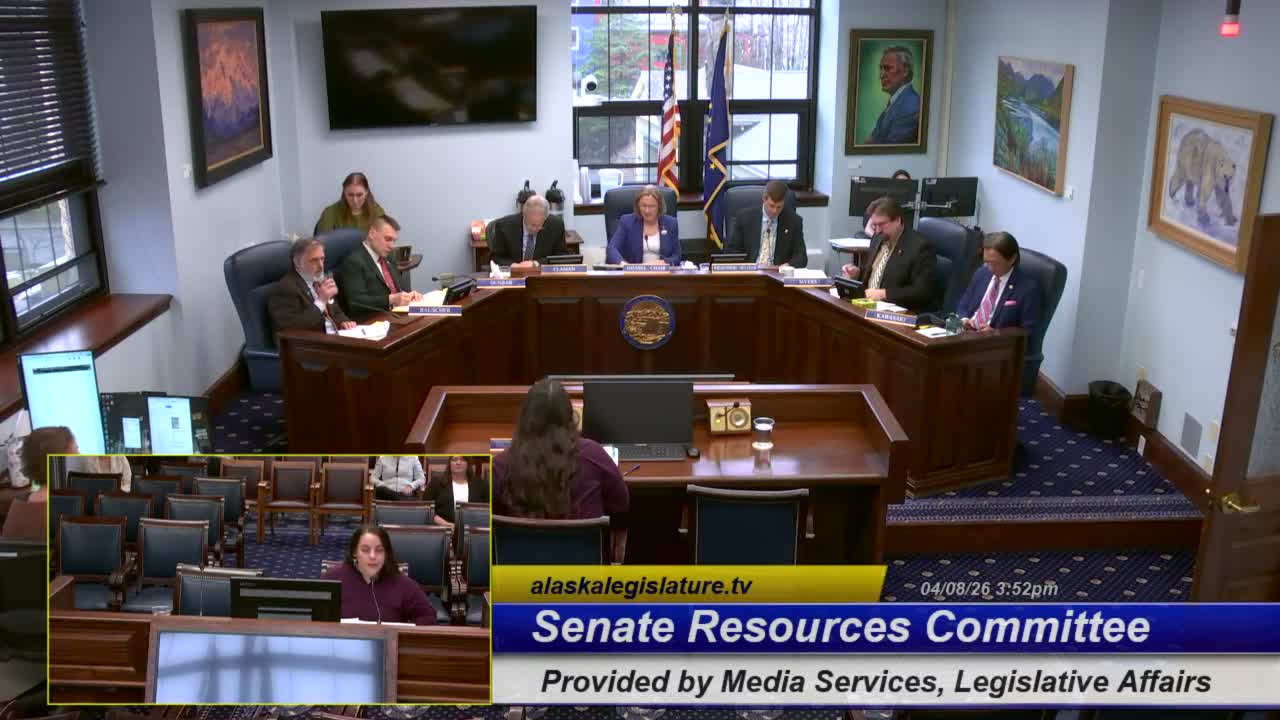
The Senate Resources Committee held the first hearing April 8 on SB 226, a bill that would disallow the sale of certain homemade foods that are prepared and sold in reduced‑oxygen packaging because of the risk of botulism.
Samantha Freeborn, staff to Sen. Giesel, presented the bill and said its purpose is to separate high‑botulism‑risk foods prepared and sold in reduced‑oxygen packaging from products that remain eligible under Alaska’s homemade‑food exemption. "This bill does not eliminate or broadly restrict the homemade food industry," Freeborn said, listing examples of exempt high‑acid foods such as jams, jellies and other preserves while highlighting that low‑acid foods — including meats and vegetables — present serious botulism risk when vacuum‑sealed or canned without appropriate process controls.
Sen. Myers asked whether the 24 botulism cases cited for 2017–2024 were linked to sold homemade foods; Freeborn said she did not have that breakdown at the hearing and offered to follow up with the committee. Johnny/Sean Perry, director of the Division of Environmental Health at the Department of Environmental Conservation, told the committee that federal regulations and hazard‑analysis (HACCP‑style) plans apply to licensed facilities producing reduced‑oxygen packaged foods and that the bill would restrict sales by home producers. Perry provided examples, saying vacuum‑sealed meat jerky and prepared vacuum‑sealed meals are typical reduced‑oxygen products that require additional controls in a licensed setting.
Sen. Kawasaki and others asked for precise definitions; state public‑health participants and DEC staff explained that "potentially hazardous" foods are those that require time‑and‑temperature control (soups, sandwiches, salads) and that reduced‑oxygen packaging includes vacuum‑sealed plastic bags and certain jar canning techniques. Staff noted a UAF Cooperative Extension handout listing acceptable and disallowed packaging and foods; the committee said Sarah Lewis of UAF Cooperative Extension will be invited to testify at a future hearing to provide additional technical detail.
Chair Giesel closed public testimony and said the bill would be set aside until the invited testimony and an amendment deadline are scheduled.
Freeborn emphasized that the bill is intended to protect consumers from a life‑threatening illness while preserving the ability to sell most homemade items by other preparation methods (fresh or frozen) or for personal consumption.
Samantha Freeborn, staff to Sen. Giesel, presented the bill and said its purpose is to separate high‑botulism‑risk foods prepared and sold in reduced‑oxygen packaging from products that remain eligible under Alaska’s homemade‑food exemption. "This bill does not eliminate or broadly restrict the homemade food industry," Freeborn said, listing examples of exempt high‑acid foods such as jams, jellies and other preserves while highlighting that low‑acid foods — including meats and vegetables — present serious botulism risk when vacuum‑sealed or canned without appropriate process controls.
Sen. Myers asked whether the 24 botulism cases cited for 2017–2024 were linked to sold homemade foods; Freeborn said she did not have that breakdown at the hearing and offered to follow up with the committee. Johnny/Sean Perry, director of the Division of Environmental Health at the Department of Environmental Conservation, told the committee that federal regulations and hazard‑analysis (HACCP‑style) plans apply to licensed facilities producing reduced‑oxygen packaged foods and that the bill would restrict sales by home producers. Perry provided examples, saying vacuum‑sealed meat jerky and prepared vacuum‑sealed meals are typical reduced‑oxygen products that require additional controls in a licensed setting.
Sen. Kawasaki and others asked for precise definitions; state public‑health participants and DEC staff explained that "potentially hazardous" foods are those that require time‑and‑temperature control (soups, sandwiches, salads) and that reduced‑oxygen packaging includes vacuum‑sealed plastic bags and certain jar canning techniques. Staff noted a UAF Cooperative Extension handout listing acceptable and disallowed packaging and foods; the committee said Sarah Lewis of UAF Cooperative Extension will be invited to testify at a future hearing to provide additional technical detail.
Chair Giesel closed public testimony and said the bill would be set aside until the invited testimony and an amendment deadline are scheduled.
Freeborn emphasized that the bill is intended to protect consumers from a life‑threatening illness while preserving the ability to sell most homemade items by other preparation methods (fresh or frozen) or for personal consumption.
Don't Miss a Word: See the Full Meeting!
Go beyond summaries. Unlock every video, transcript, and key insight with a Founder Membership.
✓
Get instant access to full meeting videos
✓
Search and clip any phrase from complete transcripts
✓
Receive AI-powered summaries & custom alerts
✓
Enjoy lifetime, unrestricted access to government data
30-day money-back guarantee
