Allendale Land Use Board adopts fourth-round housing element and fair share plan
June 28, 2025 | Allendale, Bergen County, New Jersey
This article was created by AI summarizing key points discussed. AI makes mistakes, so for full details and context, please refer to the video of the full meeting. Please report any errors so we can fix them. Report an error »
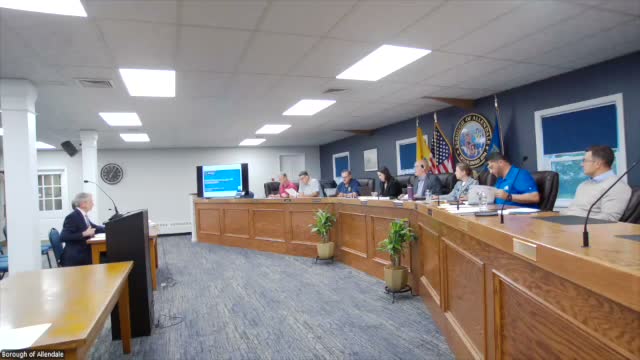
The Allendale Land Use Board on June 17 adopted a fourth-round housing element and fair share plan that commits the borough to addressing a prospective need of 200 affordable housing units over the next decade.
Affordable-housing attorney Jeff Serena told the board the borough agreed, through mediation, on a prospective allocation of 200 units and must file a housing element and fair share plan with the state within 48 hours of adopting the resolution in order to preserve statutory protections. "We agreed on a prospective need of 200," Serena said during the presentation.
Professional planner Edward Snicus, who prepared the draft housing element, walked the board through the plan's calculation of prior-round credits, realistic development potential and proposed mechanisms for reducing unmet need. Snicus summarized credits carried forward from earlier rounds and from developments such as Allendale Brook Estates and Crescent Commons and described an errata sheet correcting two items in the draft (a table and a numeric transcription error). He said the borough is pursuing a rehabilitation adjustment that would substitute a field survey'based count of 10 units in need of rehabilitation for the much larger number generated by a statistical model; "we're proposing 10," he said, describing the windshield survey and appendix documentation being submitted to the state program for review.
The plan also identifies a potential redevelopment inquiry at 168 West Crescent Avenue (Block 1005, Lot 19), a 1.75-acre parcel formerly occupied by Savini restaurant, and applies an illustrative RDP (12 units per acre with a 20% affordable set-aside) that would yield four potential affordable units for round accounting purposes. Snicus emphasized that identifying that parcel in the plan does not rezone it; it was included to reflect a plausible redevelopment scenario for planning calculations.
The document includes a spending plan showing how borough trust-fund monies might be used over a 10-year period, including proposed rehabilitation financing and an affordable-housing specialist paid from the trust fund to administer programs such as a revolving low-interest loan for rehabilitation work. Snicus told the board that certain deed-restricted units approaching the end of their original affordability term could be preserved by using trust-fund money to extend controls and thereby count as family-unit credits for the fourth round.
After the presentation and a brief public-comment opportunity (none taken), the board considered a motion to adopt the housing element and the contemporaneous resolution for memorialization so the municipality could proceed with state filing. Board attorney Larry Kelly advised that adopting the plan and immediately memorializing it by resolution would allow the municipal filing and begin the state's 60-day objection period.
The board voted to adopt the plan and to memorialize the action in the resolution; the adoption was recorded on the public record and counsel confirmed the signed documents would be filed as required.
What happens next: the borough is required to file the adopted element and resolution with the state program within the statutory timeline; that filing will open a 60-day objection period during which interested parties may submit objections, followed by mediation and, if unresolved, litigation.
Affordable-housing attorney Jeff Serena told the board the borough agreed, through mediation, on a prospective allocation of 200 units and must file a housing element and fair share plan with the state within 48 hours of adopting the resolution in order to preserve statutory protections. "We agreed on a prospective need of 200," Serena said during the presentation.
Professional planner Edward Snicus, who prepared the draft housing element, walked the board through the plan's calculation of prior-round credits, realistic development potential and proposed mechanisms for reducing unmet need. Snicus summarized credits carried forward from earlier rounds and from developments such as Allendale Brook Estates and Crescent Commons and described an errata sheet correcting two items in the draft (a table and a numeric transcription error). He said the borough is pursuing a rehabilitation adjustment that would substitute a field survey'based count of 10 units in need of rehabilitation for the much larger number generated by a statistical model; "we're proposing 10," he said, describing the windshield survey and appendix documentation being submitted to the state program for review.
The plan also identifies a potential redevelopment inquiry at 168 West Crescent Avenue (Block 1005, Lot 19), a 1.75-acre parcel formerly occupied by Savini restaurant, and applies an illustrative RDP (12 units per acre with a 20% affordable set-aside) that would yield four potential affordable units for round accounting purposes. Snicus emphasized that identifying that parcel in the plan does not rezone it; it was included to reflect a plausible redevelopment scenario for planning calculations.
The document includes a spending plan showing how borough trust-fund monies might be used over a 10-year period, including proposed rehabilitation financing and an affordable-housing specialist paid from the trust fund to administer programs such as a revolving low-interest loan for rehabilitation work. Snicus told the board that certain deed-restricted units approaching the end of their original affordability term could be preserved by using trust-fund money to extend controls and thereby count as family-unit credits for the fourth round.
After the presentation and a brief public-comment opportunity (none taken), the board considered a motion to adopt the housing element and the contemporaneous resolution for memorialization so the municipality could proceed with state filing. Board attorney Larry Kelly advised that adopting the plan and immediately memorializing it by resolution would allow the municipal filing and begin the state's 60-day objection period.
The board voted to adopt the plan and to memorialize the action in the resolution; the adoption was recorded on the public record and counsel confirmed the signed documents would be filed as required.
What happens next: the borough is required to file the adopted element and resolution with the state program within the statutory timeline; that filing will open a 60-day objection period during which interested parties may submit objections, followed by mediation and, if unresolved, litigation.
Don't Miss a Word: See the Full Meeting!
Go beyond summaries. Unlock every video, transcript, and key insight with a Founder Membership.
✓
Get instant access to full meeting videos
✓
Search and clip any phrase from complete transcripts
✓
Receive AI-powered summaries & custom alerts
✓
Enjoy lifetime, unrestricted access to government data
30-day money-back guarantee
